



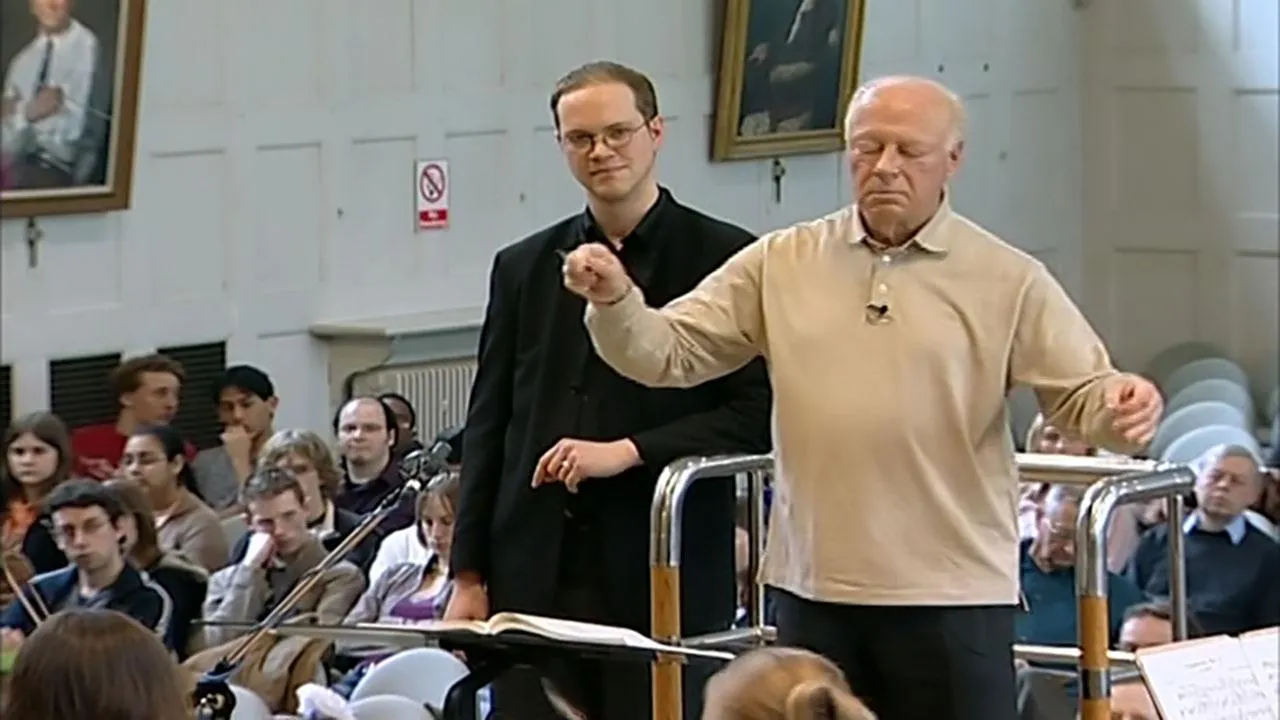
Poco Allegretto - Bernard Haitink gibt Anne-Marie Granau seine Analyse und sein Feedback
Lesson time: (21min 37sec)
Anne-Marie Granau dirigiert den introspektiven dritten Satz von Brahms' 3. Sinfonie und erhält ausführliches Feedback von Bernard Haitink.
Course preview
This lesson is part of the course Brahms - Sinfonie Nr. 3
Watch a preview of the full course below.
Lesson transcript:
Music Lesson: Third Movement Insights
The third movement is extremely touching.
It features:
- Still more chamber music
- A smaller orchestra
- A wonderful tune for celli and violins
- Later on, the oboe takes over
What's interesting about this movement is that orchestras and musicians really want to immerse themselves in it. It is extremely espressivo. However, Brahms notated mezzavoce.
Introspection in Interpretation
So, it should be very introverted in a way, not so much introverted as inward-looking. It should not resemble a quasi Italian aria. No, it needs to be... I don't like the word humble, but in that direction.
Scoring Insights
The third movement has a compelling beginning with a wonderful tune, espressivo, but marked mezzavoce. This indicates a very subtle sound.
- There are little hairpins here for the violas.
- It is a very nostalgic piece, Brahms was a lonesome man, and sometimes, as you can hear from his music, he was rather nostalgic.
There exists a sort of longing for something, perhaps unknown. This balancing act between lyricism and longing must translate into sound, which is very difficult.
Performance Technique
But the playing should not sound like daily bread and butter. The celli must really find a way to express this espressivo but mezzovoce.
- Try to answer, Celia.
- "Yeah. I would not start the crescendo too soon."
Timing is crucial in this piece:
- Tip: Bow to the next bar after two beats.
- One, two. And now, no crescendo.
Yes, here lies the nostalgia. He has no espressivo. Yes, there is vibrato, but there is no crescendo there.
Rehearsal Notes
Let's try it once more:
- One, two, sample piano.
- Okay, I hope this aligns with your way of thinking too.
Another challenge for the conductor is to convey that mood with the limited options of two hands and maybe a face.
- May I try it once?
- "Sorry, I feel always a bit inhibited because one sings. Of course, it's an ego trip. Conducting is an ego trip. But in this case, I really mean it. I mean well."
Finding the Right Tempo
Of course, you don't have to adopt my slow tempo; take your own. But try to find the right mood.
- Important Note: In the score, you might notice a small form at the last letter "I".
- You are getting dangerously slow, and gaps are beginning to appear.
Keep the line moving a little bit more.
- Notice: If it feels a bit blocked.
Revisiting Letter I
Let's revisit letter I.
- "I'd like to do this one once more, please. Be careful in the last four bars."
- Retenuto is already composed by Brahms himself, don't add something extra to it.
At letter I, the gaps feel too big for my taste.
- Reminder: Keep it moving.
- Let's do it once more.
Conducting Challenges
It is essential for a conductor to maintain the right concentration and not get upset when things go wrong during performances. In such moments:
- You can't talk or criticize.
- Don't make bad faces; just go on and try to give them confidence.
This is very important. You have to convey to them that you are there not to criticize, but to give them confidence.
About the instructor
Mit einer internationalen Dirigentenkarriere, die sich über mehr als fünf Jahrzehnte erstreckt, zählt der in Amsterdam geborene Bernard Haitink zu den gefeiertsten Dirigenten unserer Zeit. Zu Beginn der Saison 2006/07 zum Chefdirigenten des Chicago Symphony Orchestra ernannt, hat er viele der bedeutendsten Orchester der Welt geleitet, darunter über 25 Jahre an der Spitze des Royal Concertgebouw als dessen Musikdirektor. Darüber hinaus hatte Herr Haitink zuvor die Posten des Musikdirektors der Staatskapelle Dresden, der Royal Opera, Covent Garden, der Glyndebourne Festival Opera und des London Philharmonic inne. Er ist Conductor Laureate des Royal Concertgebouw Orchestra, Conductor Emeritus des Boston Symphony Orchestra und Ehrenmitglied der Berliner Philharmoniker. Als Gastdirigent trat er häufig bei den Berliner Philharmonikern, den Wiener Philharmonikern, dem Bayerischen Rundfunk, dem London Symphony und anderen führenden Orchestern auf. Herr Haitink hat umfangreich für die Labels Phillips, Decca und EMI aufgenommen, darunter Gesamtzyklen der Sinfonien von Mahler, Bruckner und Schumann mit dem Concertgebouw sowie ein umfassendes Repertoire mit den Berliner und Wiener Philharmonikern und dem Boston Symphony Orchestra. Seine jüngsten Aufnahmen sind die Gesamteinspielungen der Sinfonien von Brahms und Beethoven mit dem London Symphony Orchestra beim Label LSO Live. Seine Diskografie umfasst zudem zahlreiche Opernaufnahmen mit der Royal Opera und Glyndebourne sowie mit dem Symphonieorchester des Bayerischen Rundfunks und der Staatskapelle Dresden. Herrn Haitinks Aufnahme von Janáčeks Jenufa mit dem Orchester, den Solisten und dem Chor des Royal Opera House, Covent Garden, wurde 2004 mit einem Grammy Award für die beste Opernaufnahme ausgezeichnet. Herr Haitink hat zahlreiche internationale Auszeichnungen in Anerkennung seiner Verdienste um die Musik erhalten, darunter sowohl einen Ehrenritterschlag als auch den Order of the Companions of Honour im Vereinigten Königreich sowie den Hausorden von Oranien-Nassau in den Niederlanden. 2007 wurde er von Musical America zum „Musiker des Jahres“ ernannt. In seinem MusicGurus-Kurs über Brahms' Sinfonie Nr. 3 schöpft Haitink aus einem Leben am Dirigentenpult, um dich tief in die Partitur zu führen — wie er ihre Phrasierung, Balance, ihr Tempo und ihre Struktur formt — und gewährt seltene Einblicke, wie einer der großen Dirigenten eine Brahms-Sinfonie liest und zum Leben erweckt, ob du nun Dirigent, Orchestermusiker oder leidenschaftlicher Zuhörer bist. read more