



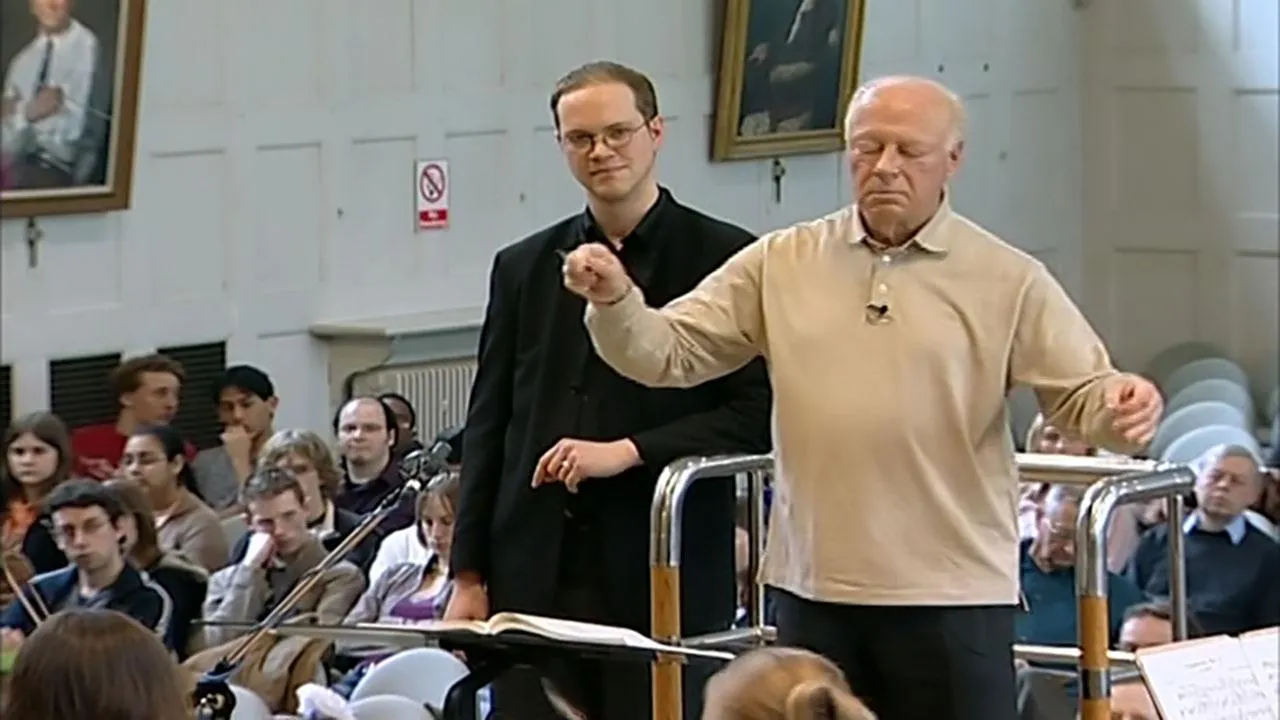
Allegro - Bernard Haitink gibt Leo McFall seine Analyse und sein Feedback
Lesson time: (10min 10sec)
Leo McFall dirigiert das Allegro-Finale von Brahms' Dritter Sinfonie, während Bernard Haitink ihm Feedback zu dessen dunklem Beginn, zur Kontrolle durch die großen Crescendi und zur Balance der tiefen Streicher gibt.
Course preview
This lesson is part of the course Brahms - Sinfonie Nr. 3
Watch a preview of the full course below.
Lesson transcript:
Music Lesson: Finale Analysis
The Finale is again a huge symphonic structure. It starts extremely softly ? very foggy, and I would say very dark, with an enormous outburst in the orchestra. Then, the whole symphonic argument goes on and on.
It's fascinating! A wonderful development where he takes bits of the first themes he uses, much like Beethoven often did in his symphonies.
Dialogue and Drama
- Dialogue: It's like people arguing, not allowing each other to speak out, but interfering continuously.
- Dramatic Conclusion: This piece culminates in a very dramatic conclusion. The real conclusion is a farewell.
What he seldom does is quote the beginning of the symphony, but in a very hidden way.
"If you're not listening carefully, it will bypass you even."
I would suggest doing it just once more. I think that is in your realm.
Suggestions for Improvement
- Initial Strength: Maybe you could get a more distinct sound from the orchestra at the beginning.
- Control During Crescendo: When it gets wild, keep the control.
"Papa, always keep an eye on the horns."
With all due respect, she didn't hear it.
Specific Adjustments
-
Beginning Adjustments:
- If we can have slightly more double bass and slightly less from everybody else, that is the main color.
-
Leo's Direction:
- I'm sure you can find a way to let them play even more.
- Just a bit less ? it's so simple, yet so difficult.
"Do it once more."
Awareness of Volume
- Danger of Volume Increase: There's a danger here. Orchestras tend to get louder and louder, and there is a lot of fog and mist in this section.
- Try to give that to them. "God knows" how you can manage it.
Key Areas to Watch
- From Letter A:
- Let them not get louder in the last few bars before the crescendo. They are already much louder, so you have to watch them a little bit.
Thank you!
Considerations at Letter B
-
I found it very dangerous that you were concentrating entirely on the basses in that section.
- Pay attention, as it can easily get out of hand.
-
Forward Movement:
- Advancement from Letter A, and focus on the horns with "pa, pa, pa, pa, pa."
- If you can make it even shorter and just a little bit louder, that would help.
"I just can't quite hear T. Pa, pa."
Very good!
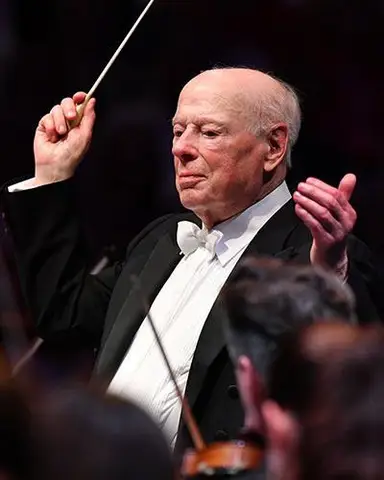
About the instructor
Mit einer internationalen Dirigentenkarriere, die sich über mehr als fünf Jahrzehnte erstreckt, zählt der in Amsterdam geborene Bernard Haitink zu den gefeiertsten Dirigenten unserer Zeit. Zu Beginn der Saison 2006/07 zum Chefdirigenten des Chicago Symphony Orchestra ernannt, hat er viele der bedeutendsten Orchester der Welt geleitet, darunter über 25 Jahre an der Spitze des Royal Concertgebouw als dessen Musikdirektor. Darüber hinaus hatte Herr Haitink zuvor die Posten des Musikdirektors der Staatskapelle Dresden, der Royal Opera, Covent Garden, der Glyndebourne Festival Opera und des London Philharmonic inne. Er ist Conductor Laureate des Royal Concertgebouw Orchestra, Conductor Emeritus des Boston Symphony Orchestra und Ehrenmitglied der Berliner Philharmoniker. Als Gastdirigent trat er häufig bei den Berliner Philharmonikern, den Wiener Philharmonikern, dem Bayerischen Rundfunk, dem London Symphony und anderen führenden Orchestern auf. Herr Haitink hat umfangreich für die Labels Phillips, Decca und EMI aufgenommen, darunter Gesamtzyklen der Sinfonien von Mahler, Bruckner und Schumann mit dem Concertgebouw sowie ein umfassendes Repertoire mit den Berliner und Wiener Philharmonikern und dem Boston Symphony Orchestra. Seine jüngsten Aufnahmen sind die Gesamteinspielungen der Sinfonien von Brahms und Beethoven mit dem London Symphony Orchestra beim Label LSO Live. Seine Diskografie umfasst zudem zahlreiche Opernaufnahmen mit der Royal Opera und Glyndebourne sowie mit dem Symphonieorchester des Bayerischen Rundfunks und der Staatskapelle Dresden. Herrn Haitinks Aufnahme von Janáčeks Jenufa mit dem Orchester, den Solisten und dem Chor des Royal Opera House, Covent Garden, wurde 2004 mit einem Grammy Award für die beste Opernaufnahme ausgezeichnet. Herr Haitink hat zahlreiche internationale Auszeichnungen in Anerkennung seiner Verdienste um die Musik erhalten, darunter sowohl einen Ehrenritterschlag als auch den Order of the Companions of Honour im Vereinigten Königreich sowie den Hausorden von Oranien-Nassau in den Niederlanden. 2007 wurde er von Musical America zum „Musiker des Jahres“ ernannt. In seinem MusicGurus-Kurs über Brahms' Sinfonie Nr. 3 schöpft Haitink aus einem Leben am Dirigentenpult, um dich tief in die Partitur zu führen — wie er ihre Phrasierung, Balance, ihr Tempo und ihre Struktur formt — und gewährt seltene Einblicke, wie einer der großen Dirigenten eine Brahms-Sinfonie liest und zum Leben erweckt, ob du nun Dirigent, Orchestermusiker oder leidenschaftlicher Zuhörer bist. read more