



Analyse der Klaviersonate Nr. 30 in E-Dur, op. 109
Das steckt im Kurs
4 Lektionen (2h 40m) · 1 gratis
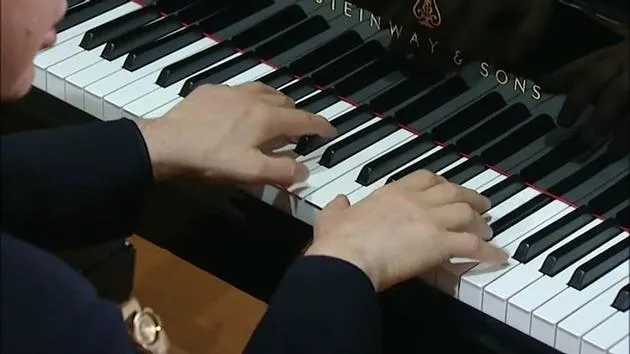
Transkript der Lektion
Beethoven's Opus 109: A Detailed Exploration
Overview of the Exposition
"The opening of Opus 109. That's the whole exposition. And it's probably, I would dare to say, the shortest exposition of any Beethoven sonata or any classical sonata. It's incredibly short and compact.
As you know very well in most classical sonata movements in sonata form, we usually have three distinct themes:
- The main theme
- The secondary theme
- The closing theme
We could use other terminologies, but this will do for the time being. In this movement, however, we only have two themes, which possess different tempo, different character, and a completely different world.
Beethoven's instruction for the opening of this movement is Vivace ma non troppo: lively, but not too much.
Most of you will be familiar with the G major sonata, Opus 79, and the third movement of that sonata. Let's play this now as the chorale, just the harmonies.
I've transposed it down a third to E major and added a few little figurations. I think it sounds quite familiar. However, it's not self-imitation because the G major movement started on the downbeat, and this one starts on the upbeat.
It's much more mysterious, much more elusive, much more poetic.
The Essence of the Movement
The magic of this movement to me is that it doesn't begin; it continues. It comes from somewhere.
You can imagine that Beethoven had this beehive of notes, a beehive of sounds in his head, and this just goes on and on. He also writes dolce (sweetly).
Dedication to Maximiliane Brentano
There is a dedication of this sonata to Maximiliane Brentano, the daughter of very good friends of Beethoven's, Franz and Antonia von Brentano.
We know with certainty that she was the mysterious Immortal Beloved. There are wonderful letters of Beethoven to the immortal beloved, and there has been speculation about who that might have been. Now, it is almost certain that it was this Antonia from Brentano.
Emotions Reflected in Music
So therefore, there is something incredibly loving and tender about this music, which really doesn't fit into the clich? of heroic and titanic Beethoven. It proves that Beethoven is the most colorful of the great composers.
You cannot typecast him; you cannot put him in a cage. There are really dramatic and heroic sonatas, but there are also very lyrical and intimate ones, such as this one and also the next one, Opus 110.
Structure and Development
So let me start it again. I hope you are not too bored with it yet.
We are on the dominant of the dominant, but that's not what comes now. Great music is about expectation and surprise. All musical listeners would expect something, and something quite different is going to happen.
Now he goes into the second subject, Adagio espressivo, with a much slower tempo. However, if you interpret it correctly, these two tempos are related in pulse and in proportion.
When I start, they are somehow related. After three bars of the Adagio, he gives us a variation of the same theme.
- First it was like this, and now the variation with new harmonies.
- Very daring, very chromatic, with all these tiny little note values.
It sounds like an improvisation, but it's very carefully thought out. It should sound spontaneous, and indeed from the score and from the autograph, we can see that he gives the tiniest detailed instructions to almost every little detail. He doesn't leave anything to chance.
The Development Section
Let me play the development section, which is again very, very short. The whole movement is very short. In the development section, he doesn't even touch the second subject; he is only using the first theme.
Here we are again at the recapitulation, which comes back triumphantly and gloriously in forte.
Also, the orchestration, if I may call it that, is using the extreme height and the extreme depth of Beethoven's keyboard, which was much shorter than the keyboard of a modern piano, about two and a half octaves shorter.
When Beethoven writes this, he wants to show us the distance between the earth and heaven. I'm talking about heaven because there is something incredibly spiritual in this music.
Spiritual Undertones
Beethoven was not an atheist, certainly not. We know it from his writings, from his letters, and he was working on the Missa Solemnis at this time.
The Missa Solemnis is one of his greatest masterpieces. He writes that it came from the heart, and it should reach the hearts. It is really a deeply religious piece.
We see that there are many elements in these late sonatas that remind us of the Missa Solemnis, so the metaphor of the ground and the skies or earth and heaven is not entirely wrong.
Conclusion of Recapitulation and Coda
Now, the recapitulation continues. Let me just come to the coda, where we hear the most beautiful chorale. He lets go of this constant semiquaver movement and just gives us the chorale.
To me, that could be the motto of the whole sonata, a concentrated form of the figurations that we heard before.
He goes back to this rocking semiquavers. He cannot decide between the minor and the major, so which one is going to be right? In the end, the major wins and he rests on this tonic chord.
However, very briefly, there is no break between movements in the last sonatas. This is also very important and very new.
In the earlier sonatas, we had separate movements very often, more often than not. Those could even be played separately. In these late sonatas, you cannot take any one movement out and separate it from the whole. They are durchkomponiert, composed through.
Transition to the Next Movement
What happens now from this E major chord? A complete change of mood. We stay in the tonality of E, but in the minor.
It's extremely fast in 6/8 time. Listen to the 6/8. If I play you a figuration, like very very fast, you couldn't sing it that fast.
Also, please try to follow always the bass line, which is the foundation. If I may come back to Dante, who is very dear to me, this is really Inferno. This is hell.
After that, we will have paradise. But first, we have to go through hell.
Intensity and Contrast in the Music
This is very dark, passionate, and tragic music. Let me play a little bit. There's a mysterious unison in the dark regions, very dangerous, very scary.
Here Beethoven writes espressivo, which means with expression, but he also means to hold back the tempo just a little bit because immediately after that he writes a tempo.
You can hear the chromatic line. We know from Baroque music and from Bach's Passions, for example, that when you have that kind of chromatic line, this is the passus duriculus in Baroque rhetoric, the hard way you have to go through difficulties and sufferings.
Description of Movements
This movement, by the way, is a scherzo-like movement, but it's a scherzo without a section, and it is in sonata form.
We had two very brief movements, first and second, both in sonata form, which is very unusual.
At this point, I would like to say that the proportions of a sonata, if you take a middle-period sonata like Opus 53 or the famous Opus 57, had the main weight of the sonata in the first movement, counterbalanced by the later movements.
Here, it is very different. You have two very short opening movements, and then the main weight of the sonata will be the last movement.
The Intricacies of the Final Movement
The last movement is a theme with six variations, and to me, this is the most wonderful movement in all Beethoven sonatas. This is my personal feeling and preference, of course, it's not compulsory to share that.
There is something uniquely touching about this Theme and Variations also because it obviously reminds me of one of my very favorite works, the aria of Bach's Goldberg Variations, which is an aria with 30 variations.
The theme of Opus 109 is a very simple song in 3/4 time, reminiscent of a sarabande, similar to Bach's theme.
Bach's theme is followed by 30 variations, at the end of which the aria returns, providing a wonderful sense of recognition and homecoming, also a sense of having completed a circle.
Beethoven's Homage to Bach
Beethoven does the same; however, in a much more concentrated form, with only six variations. It's obvious that his model had been the Goldberg Variations.
I don't know how on earth Beethoven could have known the Goldberg Variations because they were not played in his lifetime.
In Beethoven's time, the musical public wasn't interested in Bach's music; they only wanted to hear Beethoven's music. Not even what he wrote the day before yesterday, but what he wrote today.
Performance Tips for the Theme
Let me play you the theme of Opus 109, finale: 16 bars, which are then to be repeated. Then there are the further 16 bars of the second part, also repeated.
We have a very symmetrical structure in 3/4 time, resembling a baroque sarabande.
If I play you another Bach sarabande, also in E major, you can hear the connection.
Beethoven says, Gesang voll mit der innigster Empfindung. He felt during this time of his life that the Italian words were not adequate to express his innermost feelings.
Characteristics of Variations
Now let me characterize the variations briefly:
- First Variation: Gesang voll, In a singing manner reminiscent of an Italian opera aria.
- Second Variation: Like a series of mosaics reminiscent of the wonderful mosaics in Ravenna or Monreale, using particles and elements of the theme.
- Third Variation: A change in tempo and meter to double time, an Allegro vivace, a brilliant, virtuosic variation.
So, we were in triple time until now, and now we go to double time. You can hear the interplay among the voices, like a string quartet, with cells of melody and rhythm interacting.
- Fourth Variation: A fugato, paying homage to Johann Sebastian Bach.
- Fifth Variation: Right out of the Missa Solemnis, evoking the Credo, the choir starts to sing in a staggered harmony.
In the sixth variation, we have an explosion of ideas building to an apotheosis of the theme.
The Climactic Ending
Let me play this now in one line.
The trill wanders down to the bottom register. At this point, we should talk about the apotheosis of the trill. No other composer achieved this.
When you hear this trill in the bass, it's not decorative at all, it's like an earthquake. Beethoven is truly fighting with the elements here.
In contrast, the final appearance of the theme is played even more simply than the first time, with a sense of completion, a sense of homecoming.
And as this sonata had no real beginning, I find it also doesn't really have an ending. It ends with this wonderful feminine cadence, not really a closing statement, but it evaporates.
Reflective Silence
After this, it's very nice to be quiet for a little bit. So let's wait a few seconds now.
4 Lektionen
2 Std. 40 Min. strukturierte Videolektionen
Erweiterte Videofunktionen
Verlangsamen, Passagen loopen, mitlesen
Handy, Tablet & Desktop
Üben, wo du willst
100 % Zufriedenheitsgarantie
30 Tage Geld-zurück-Garantie
Lern deinen Guru kennen
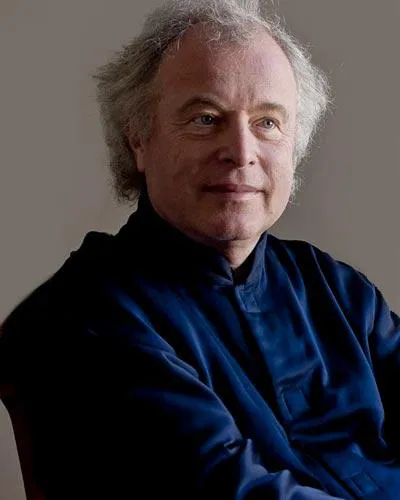
Lern deinen Guru kennen
András Schiff ist eines der herausragendsten Mitglieder einer Generation ungarischer Pianisten, die in den Jahren nach dem Zweiten Weltkrieg geboren wurden, neben Künstlern wie Zoltán Kocsis, Dezso Ránki und Jenő Jandó. Aus dieser bemerkenswerten Gruppe hat Schiff das größte internationale Ansehen erlangt, nicht nur wegen seiner Entscheidung, seine Karriere außerhalb Ungarns zu verfolgen, sondern auch dank seines fein abgestuften Anschlags und eines beeindruckenden Gedächtnisses, das es ihm erlaubt, in Konzerten und Aufnahmen große Teile des Œuvres eines Komponisten darzubieten.
Schiff wurde am 21. Dezember 1953 in Budapest geboren und studierte beim ungarischen Komponisten Pal Kadosa und bei Ferenc Rados (die beide auch Kocsis und Ránki unterrichteten) sowie beim englischen Cembalisten George Malcolm. Sein Debüt gab er mit 19 Jahren in Budapest, gefolgt von Konzertauftritten in ganz Europa und den Vereinigten Staaten. Sein Ansehen wuchs mit preisgekrönten Auftritten beim Moskauer Wettbewerb 1974 und beim Leeds Festival 1975.
András Schiff arbeitet mit den meisten großen internationalen Orchestern und Dirigenten, doch die meisten seiner Aufführungen von Klavierkonzerten von Bach, Beethoven und Mozart leitet er selbst. 1999 gründete er sein eigenes Kammerorchester, die Cappella Andrea Barca, mit der er jährlich als Dirigent und Solist arbeitet, ebenso wie mit dem Philharmonia Orchestra und dem Chamber Orchestra of Europe.
Schiffs Stil, in dem sich ein ungewöhnlich sensibler Anschlag mit einem Gespür für kontrapunktische Klarheit verbindet, hat ihn zu einem der bedeutendsten Bach-Interpreten der Gegenwart gemacht. Er hat die gesamte Klaviermusik von Bach eingespielt, ebenso wie die vollständigen Sonaten und Sonatenfragmente von Franz Schubert, dessen introspektive Klaviermusik Schiffs Temperament gut entspricht. 2009 vollendete er bei ECM einen Beethoven-Sonatenzyklus, und 2011 wurde ihm der Schumann-Preis der Stadt Zwickau für seine Interpretation und Förderung der Musik Schumanns verliehen. 2001 begann Schiff, die Werke Bachs erneut zu betrachten und neu einzuspielen. Neben den erwartbaren mitteleuropäischen romantischen Werken nimmt die Musik von Béla Bartók und Leos Janácek einen prominenten Platz in Schiffs Repertoire ein.
In seinen MusicGurus-Kursen zu Schuberts Moments Musicaux Nr. 1, 3 und 4, Bachs Partita Nr. 2 und Beethovens späten Klaviersonaten holt Schiff dich in diese interpretatorische Welt – er teilt, wie er über Stimmführung, Anschlag, kontrapunktische Klarheit und Struktur denkt, damit du diesen Werken am Klavier echte Tiefe und echtes Verständnis verleihen kannst.







