



Einführung in die Synthese, subtraktive Synthese
Mit
Aamir YaqubAamir Yaqub stellt die subtraktive Synthese in Logic vor: von einer obertonreichen Wellenform ausgehen und den Klang durch Herausfiltern von Frequenzen formen.
Das steckt im Kurs
20 Lektionen (1h 47m) · 1 gratis
01. Willkommen bei der Synthese
Gratis-Lektion0:53
02. Einführung in die Synthese, subtraktive Synthese
Du bist hier3:22
03. Erste Stufe - Klangerzeugung
4:09
04. Zweite Stufe - Klangformung & Filter
1:35
05. Lautstärke formen - ADSR
3:27
06. LFOs
1:54
07. Alchemy
4:11
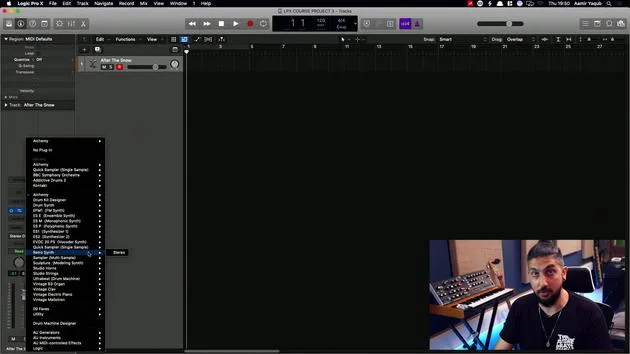
08. Retro synth
4:55

09. ES1- und ES2-Synths
4:00
10. ESP-Synthesizer
1:17
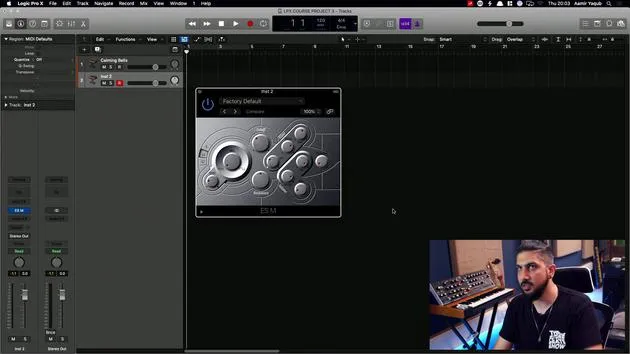
11. ESM, ESE, EFM1
8:54
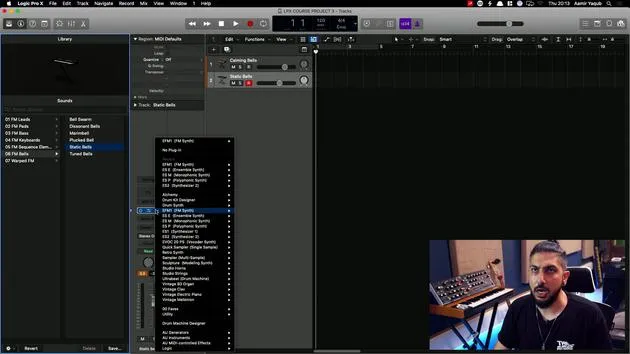
12. Sculpture, EVOC20 und Vocoding
7:53
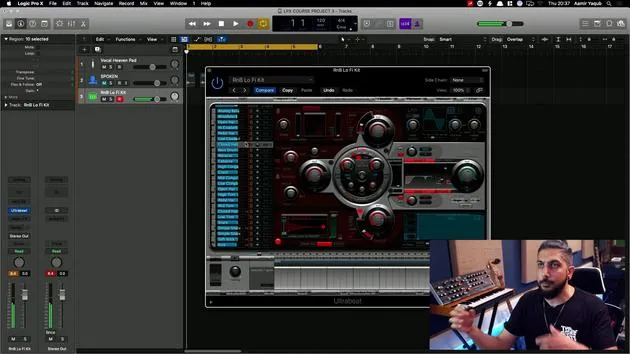
13. Drum Synth und Ultrabeat
7:11
14. Drum Kit and Drum Machine Designer
7:23
15. Keyboard-Synths: Vintage-Orgel, EP, Clav, Mellotron
9:03
16. Studio Horns und Studio Strings
4:48
17. MIDI-Effekte - Arpeggiator
21:21
18. MIDI-Effekte - Chord Trigger
5:45
19. Weitere MIDI-Effekte
4:33
Transkript der Lektion
Understanding Synthesis
So, let's talk about synthesis. We're in an age where the processing power of computers is beyond what we could have ever imagined.
The Golden Age of Sound
Plugins have become unbelievable at mimicking previous analog gear. We are truly experiencing a golden age of access to great synthesizer sounds, especially within Logic.
- Complete compositions in the box: It's now realistic for artists and composers to complete a whole musical composition entirely in the box.
- Hardware synthesizers: While hardware synthesizers haven't been completely replaced, synthesizers within Logic provide both the sonic quality and the convenience needed to achieve desired sounds.
The Art of Synthesis
One thing that hasn't been lost through the use of software synthesizers is the art of synthesis itself.
Even with infinite presets to scroll through, we might wonder from time to time what is going on under the hood. In days gone by, people sat and tweaked knobs and faders for hours on end to get the sound they were after.
- Learning through experimentation: In that process, they learned how to manipulate and control synthesizers to achieve their unique sounds.
- Creating unique sounds: People were able to create one-of-a-kind sounds using the same basic building blocks available to others.
Having an understanding of these concepts allows you to explore a vast world within music production: the world of synthesis.
Approaches to Sound Creation
Though we have many different approaches to sound creation with synthesizers, there are differences between synth models. However, we share a fundamentally similar architecture and signal flow based on subtractive synthesis principles.
How Subtractive Synthesis Works
In essence, subtractive synthesis involves taking away from a sound we've created.
- Filtering: We filter, or cut away, parts of the sound that we don't want to hear.
- Subtracting frequencies: We are essentially subtracting parts of the frequency spectrum.
Building Blocks of Subtractive Synthesis
At its core, subtractive synthesis is a three-stage process:
- Tone Generation
- Tone Shaping
- Volume Shaping
The distinctive timbre, intonation, and volume characteristics of a real instrument can theoretically be recreated by combining these three stages in a way that resembles the natural behavior of the instrument you're trying to emulate.
Emulation vs. Innovation
While you don't always have to emulate an instrument, it can be beneficial to look at how these stages relate to real-world instruments for better understanding.
Pitch Considerations
When we play a sound on a real instrument, one of the most fundamental aspects to consider is pitch. The pitch of your instrument is always determined by the notes that you play on the keyboard.
In analog synthesis:
- Raw sounds are generated by an oscillator.
- Tonal shaping is performed by the filter.
- Volume is controlled by an envelope generator.
20 Lektionen
1 Std. 47 Min. strukturierte Videolektionen
Erweiterte Videofunktionen
Verlangsamen, Passagen loopen, mitlesen
Handy, Tablet & Desktop
Üben, wo du willst
100 % Zufriedenheitsgarantie
30 Tage Geld-zurück-Garantie
Lern deinen Guru kennen
Lern deinen Guru kennen
Aamir Yaqub ist ein in London ansässiger Musikproduzent und Toningenieur. Er hat mit einigen der größten Namen der Musik gearbeitet, darunter Alicia Keys, David Guetta, Rihanna, Sia und will.i.am, und fördert außerdem unabhängige Künstler.
In seinen Kursen vermittelt er seinen kompletten Logic-Pro-Workflow – von der Oberfläche und dem Aufnehmen über Beatmaking, Synthese und MIDI-Effekte bis zum Mixing und Finalisieren eines Tracks.







