



ESM, ESE, EFM1
With
Aamir YaqubAamir Yaqub explores three of Logic Pro's built-in synths, the ESM, ESE and EFM1, and the bass, lead and textured sounds you can get from them.

What's in the course
20 lessons (1h 47m) · 1 free
01. Welcome to synthesis
Free lesson0:53
02. Intro to synthesis, Subtractive synthesis
3:22
03. First stage - Tone generation
4:09
04. Second stage - Tone shaping & Filters
1:35
05. Volume shaping - ADSR
3:27
06. LFOs
1:54

07. Alchemy
4:11
08. Retro synth
4:55

09. ES1 and ES2 synths
4:00
10. ESP synth
1:17
11. ESM, ESE, EFM1
You are here8:54
12. Sculpture, EVOC20 and vocoding
7:53
13. Drum synth and Ultrabeat
7:11
14. Drum Kit and Drum Machine Designer
7:23

15. Keyboard synths - Vintage Organ, EP, Clav, Mellotron
9:03
16. Studio Horns and Studio Strings
4:48
17. MIDI Effects - Arpeggiator
21:21
18. MIDI Effects - Chord Trigger
5:45
19. Other MIDI Effects
4:33
Lesson transcript
Music Lesson: Exploring ESM and EFM Synths
Loading ESM
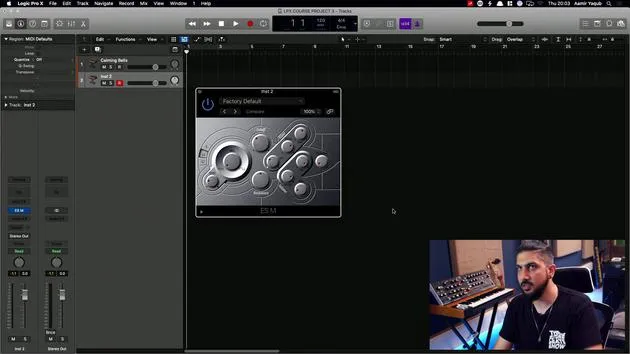
Okay, so next up, I'm going to load ESM. ESM is a monophonic synth. Remember, monophonic means one voice at one time. This is good for bass and lead sounds, particularly.
It really is a bit of a hidden gem. You can:
- Get bass that slides and glides
- Easily create textures and layers
One of my favorite settings here is the House Organ. There's a rich harmonic quality to this synth that is quite underrated. You could:
- Take a basic bass sound
- Play it higher up, and it sometimes works quite nicely as a lead.
If I was using a lead sound, I'd make the cutoff higher to get more of that sound out of it.
You also have some nice features like overdrive, which allows you to get more crunch and rich harmonics out of the sound.
Be careful of the level, though. It's quite loud. So, ESM is another great one to mess around with. When you work with the glide functionality, it's endless fun!
Pad Sounds: Loading ESE
Now, let's load up ESE, which you can see is an ensemble synth.
This one is really nice for pads. Because it's an ensemble synth, it sounds like there are more voices than there actually are.
You can hear it has that rich, rounded sound already. For instance, if I select a basic soft pad:
- This is a really good starting point for you to create your own sounds.
- Work further with synthesis and sound design.
The chorus effect on that pad makes it feel like it's moving. I might even increase the attack time here so it feels like it's creeping up.
You can do lovely things like that; it's basically a pad machine for me. Check it out on the basic soft pad and play around with some parameters, particularly attack and release, to give it that feeling of a string section coming in and out.
Exploring EFM1
Another one in the E series is EFM1. It's an FM synth, which is a form of synthesis. This one is great for sounds that are:
- A bit more bell-like
- More digital, yet rich
FM synthesis was very synonymous with the 80s. You can load any pad, and you'll get that same nostalgic feeling.
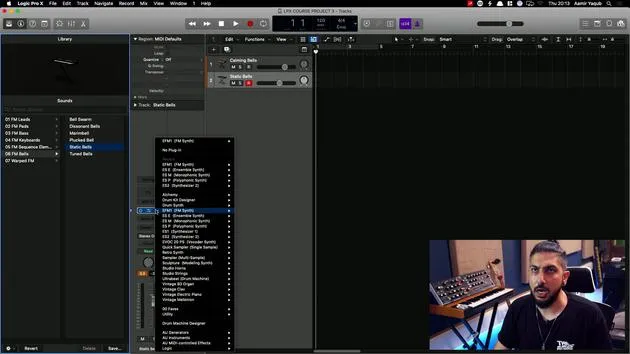
For example, if I select Static Bells, you get that very digital feeling in the top end. There is something about many synths from the 80s that have that quality.
You can also create nice lead sounds out of EFM1. It's versatile enough to produce bass sounds as well. Personally, I love creating some keyboard-like sounds on this synth because FM synths excel with those.
Navigating Logic's Presets
As you've seen me, I've been going through some of these presets by bringing this down and exploring different categories.
For instance, if I want to go into another section, let's check out the sequence elements.
I'm going to open the library, which is very handy when working with certain instruments and plugins:
- It shows you all available presets.
At this moment, this would change the patch and the entire channel strip. This little triangle here indicates that it will introduce a new patch.
If I want to stay in EFM1, I simply bring my mouse down, and a little gray triangle appears.
By clicking on that, I can look at all of the presets for EFM1. For instance, I can go back to Bells, click on Bell Swarm, and play around with it.
Using the down arrow, I can navigate to the next sound, and so on.
The library is brilliant when you're working within Logic's own plugins and synths!
20 lessons
1h 47m of structured video lessons
Advanced video features
Slow down, loop a passage, follow along
Mobile, tablet & desktop
Practise wherever you are
100% satisfaction guarantee
30-day money-back guarantee
Meet your guru
Meet your guru
Aamir Yaqub is a music producer and engineer based in London. He has worked with some of the biggest names in music, including Alicia Keys, David Guetta, Rihanna, Sia and will.i.am, as well as developing independent artists.
Across his courses he teaches his complete Logic Pro workflow - from the interface and recording through beat-making, synthesis and MIDI effects to mixing and finishing a track.







