



Adding the right hand/comping
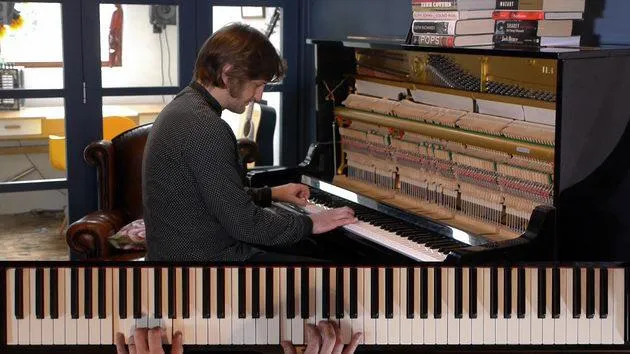
In this lesson, you'll get to bring the two hands together. Paddy also introduces simple right-hand rhythm ideas for added interest.
What's in the course
10 lessons (1h 49m) · 1 free
01. Getting Started: The 12 Bar Blues
12:20
02. The Engine Room: Left Hand Bass
9:31
03. Adding the right hand/comping
You are here11:47

04. Developing Harmony: 7th Chords & Inversions
15:27
05. Right-hand Riff #1 and variations
13:20

06. Right Hand Riff #1 Further Variations
14:39
07. The 'Blues Scale' & Uses
10:41
08. Ending #1 & Variations
9:26

09. Putting it all together
10:34

10. Dirty Dozen - The Twelve Bar Blues Challenge
1:59
Lesson transcript
12-Bar Blues: Bringing It All Together
Welcome back! In this lesson, we will:
- Bring the two hands together
- Elevate the 12-bar blues
- Make it more interesting
Getting Started
First, I'm assuming that you've got the left hand down pretty fluently and you can play this pattern throughout the whole 12-bar blues. You really need to master that before we can explore the more fun stuff in the right hand.
Putting It All Together
When we first looked at the 12-bar blues, we played it like this. Now, let's try combining the right hand with the left hand. It should sound something like this:
- Chord of C
- Right hand playing crotchet (quarter note) beats
- Left hand playing the bass pattern
The right hand will play on every other note that the left hand plays. If we play this over the whole 12-bar, it will sound like this:
- Bars 2-5:
Moving from C up to F (with a little variation in the left hand), then to G, back to F, and finishing on G before returning to C to start the whole sequence again.
Practice Tips
The aim is to get this as fluent and automatic as possible. Here are some tips:
-
Start Slow:
Begin at the slowest tempo that feels comfortable. -
Coordinate the Hands:
Ensure you are playing the right hand on every other note of the left hand. -
Smooth Transitions:
Practice changing between chords without breaks.
Specific Chord Changes
You can practice transitions between chords like we did in the previous lesson. For instance:
- C to F
- C to G
- G to F
Break it down to two beats each to improve your flow:
- One measure per chord: e.g., C to F, then back to C.
Feel free to develop your own practice routines.
Creative Practice Techniques
I encourage you not just to learn what I'm teaching, but to come up with your own creative ways to make music. Here are some additional practice tips:
-
Vary Volume:
Play at different volumes. This helps develop muscle memory and a deeper understanding of the music.- Practice quietly and then as loudly as you can.
-
Hands Independence:
Practice each hand at different volumes.- For example, play the left hand loudly and the right hand softly.
Exploring Rhythmic Variations
Once you've got the rhythm down fluently, let's explore playing the right hand on the offbeat. This creates a more authentic blues sound.
- Offbeat Playing:
Rather than playing on the beat, target the second and fourth notes of the left hand.
As you practice the 12-bar progression, it will instantly sound more blues-like. You can hear this style in many songs, especially in jump swing blues records by artists like Louis Prima and Louis Jordan.
Final Rhythmic Variation
Before we finish this lesson, let's look at one more rhythmic variation in the right hand.
- Two-Bar Cycle:
It starts off and smoothly continues with the corresponding chords.
Try to master this rhythm over the 12-bar blues. Remember, you can always rewind and watch it again; feel free to play along with me!
Get Creative
Experiment with your own rhythms. Keep these tips in mind:
-
Driving Forward:
Ensure the music maintains momentum. -
Improvise:
Reverse elements, double them up, or mix them.
This is all about improvisation and bringing your unique style to the music.
Looking Ahead
In the next lesson, we will explore some simple right-hand riffs to show you various techniques for developing and varying them. This will be a great addition to your left-hand patterns!
10 lessons
1h 49m of structured video lessons
Advanced video features
Slow down, loop a passage, follow along
Mobile, tablet & desktop
Practise wherever you are
100% satisfaction guarantee
30-day money-back guarantee
Meet your guru

Meet your guru
Paddy Milner is recognised as one of the leading blues piano players in the world - he is currently keyboard player of choice for Sir Tom Jones, following several years with the late, great Jack Bruce - but he is also a superb original songwriter and a distinctive singer. Just read the praise from the likes of Dave Brubeck below! His playing was featured on the soundtrack for the hit 2019 film 'Rocketman'.
He has twice won the award for Best Keyboard Player in the British Blues Awards, and he holds a long-standing residency as a founder member of the Ronnie Scott's Blues Explosion at the world-renowned Ronnie Scott's club.
His current group LONDONOLA plays homegrown British music with a strong dose of New Orleans spirit, and his collaborative group JAWBONE goes from strength to strength following the release of their self-titled debut album.
- "I love it... there's a guy who can really play the piano" - Dave Brubeck
- "I highly recommend it. Somehow things start to feel much better!" - Jack Bruce
- "The best blues piano player in Europe..." - Blues Access, USA
- "Impressive & original" - The Times
- "Dazzling" - The Independent
Across his courses, Paddy breaks down authentic blues shuffle, slow blues, boogie-woogie, rock 'n' roll and New Orleans piano - right down to three classic boogie-woogie songs - so you can learn these styles from one of the very best in the business.







