



The Engine Room: Left Hand Bass
Paddy Milner teaches a classic blues left-hand bass pattern over the 12-bar form, with practice tips and a variation to take it further.
What's in the course
10 lessons (1h 49m) · 1 free
01. Getting Started: The 12 Bar Blues
12:20
02. The Engine Room: Left Hand Bass
You are here9:31
03. Adding the right hand/comping
Free lesson11:47

04. Developing Harmony: 7th Chords & Inversions
15:27
05. Right-hand Riff #1 and variations
13:20

06. Right Hand Riff #1 Further Variations
14:39
07. The 'Blues Scale' & Uses
10:41
08. Ending #1 & Variations
9:26
09. Putting it all together
10:34

10. Dirty Dozen - The Twelve Bar Blues Challenge
1:59
Lesson transcript
Introduction to Blues Piano: Lesson on Left Hand Pattern
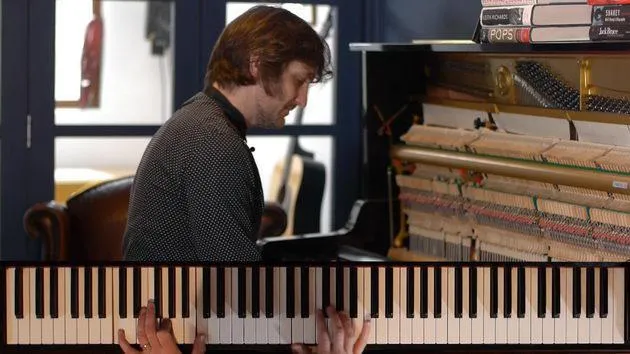
Welcome back to this Introduction to Blues Piano course. In this lesson, we're going to be looking at our first left hand pattern, which is a very authentic left hand pattern that piano players have been using for decades.
Historical Context
This pattern is featured on loads of classic records by renowned artists like:
- Johnny Johnson
- Pine Top Perkins
The Left Hand Pattern
The left hand pattern is very simple, and it goes like this:
- Start with two notes together: C and G
- Followed by another two notes together: C and A
We are playing it with a shuffle rhythm:
- Two notes together, then another two notes with that interval.
Technique
- Keep the bottom note: Stay on C.
- Change the top note: Alternate between G and A.
Note: Using different fingers for the top notes requires no hand movement. While you could use your thumb for the G, that movement is best to avoid, as a good piano player is an efficient one. Less movement requires less energy.
Applying the Pattern to 12 Bar Blues
To apply this pattern to our blank canvas of the 12 bar blues, we play:
- 4 bars of C
- 2 bars of F
- Then transpose the bass line up to F:
- Move the pattern up to the F chord: F (fifth) and D (sixth).
- Up to G: G (fifth) and E (sixth).
Example Playthrough
If I play that bass line over the whole 12-bar sequence, it sounds like this:
- 1, 2, A
- 1, 2, 3...
- 4 (3 bars)
- Up to F6
- Down to C (7, 8)
- Up to G9
- Down to F
- Back to C
- G for the last bar
- Back to C to start the sequence again.
So there you go! That is an authentic left hand pattern.
Practicing the Pattern
To practice:
- Make it automatic and fluent.
- Changing between chords should have no gaps.
Practice Tips:
- You can practice the whole sequence.
- Focus on a bar of each chord:
- Example: A bar of C (2, 3, 4), then a bar of F, then back to C.
Once it feels natural, try not to look at the keys.
- Start at a slower tempo. Using a metronome can help.
- Ensure a steady tempo; master the changes before increasing speed.
As you practice:
- Start slowly, focusing on the transition to F, ensure there is no break.
- Gradually increase speed while maintaining fluency.
Importance of a Steady Left Hand
This left hand is essential as it serves as the engine room and rhythm section underneath what you will learn for the right hand. Ideally, if you can read a book while playing the left hand pattern, you're in a good place!
Additional Practice
- Change between chords: Focus on transitions like C to G and G to F.
- You can also reduce practice to two beats each to get accustomed to the chord changes.
Adding Variations
As you become comfortable, consider adding a seventh:
- In the key of C, this would be B flat.
- In F, it's E flat.
- In G, it would be F.
Demonstration
I'll demonstrate this with some right hand ideas (not for you to learn yet) to show how the left hand fits in with it.
Listen for the little variation in the left hand, it's not every time, but you'll hear it.
Conclusion
You've just learned how to incorporate a left hand pattern into your blues piano playing. Keep practicing those transitions and variations, and you'll be right on track!
10 lessons
1h 49m of structured video lessons
Advanced video features
Slow down, loop a passage, follow along
Mobile, tablet & desktop
Practise wherever you are
100% satisfaction guarantee
30-day money-back guarantee
Meet your guru

Meet your guru
Paddy Milner is recognised as one of the leading blues piano players in the world - he is currently keyboard player of choice for Sir Tom Jones, following several years with the late, great Jack Bruce - but he is also a superb original songwriter and a distinctive singer. Just read the praise from the likes of Dave Brubeck below! His playing was featured on the soundtrack for the hit 2019 film 'Rocketman'.
He has twice won the award for Best Keyboard Player in the British Blues Awards, and he holds a long-standing residency as a founder member of the Ronnie Scott's Blues Explosion at the world-renowned Ronnie Scott's club.
His current group LONDONOLA plays homegrown British music with a strong dose of New Orleans spirit, and his collaborative group JAWBONE goes from strength to strength following the release of their self-titled debut album.
- "I love it... there's a guy who can really play the piano" - Dave Brubeck
- "I highly recommend it. Somehow things start to feel much better!" - Jack Bruce
- "The best blues piano player in Europe..." - Blues Access, USA
- "Impressive & original" - The Times
- "Dazzling" - The Independent
Across his courses, Paddy breaks down authentic blues shuffle, slow blues, boogie-woogie, rock 'n' roll and New Orleans piano - right down to three classic boogie-woogie songs - so you can learn these styles from one of the very best in the business.







