



Fishin' In The Wind (lesson)
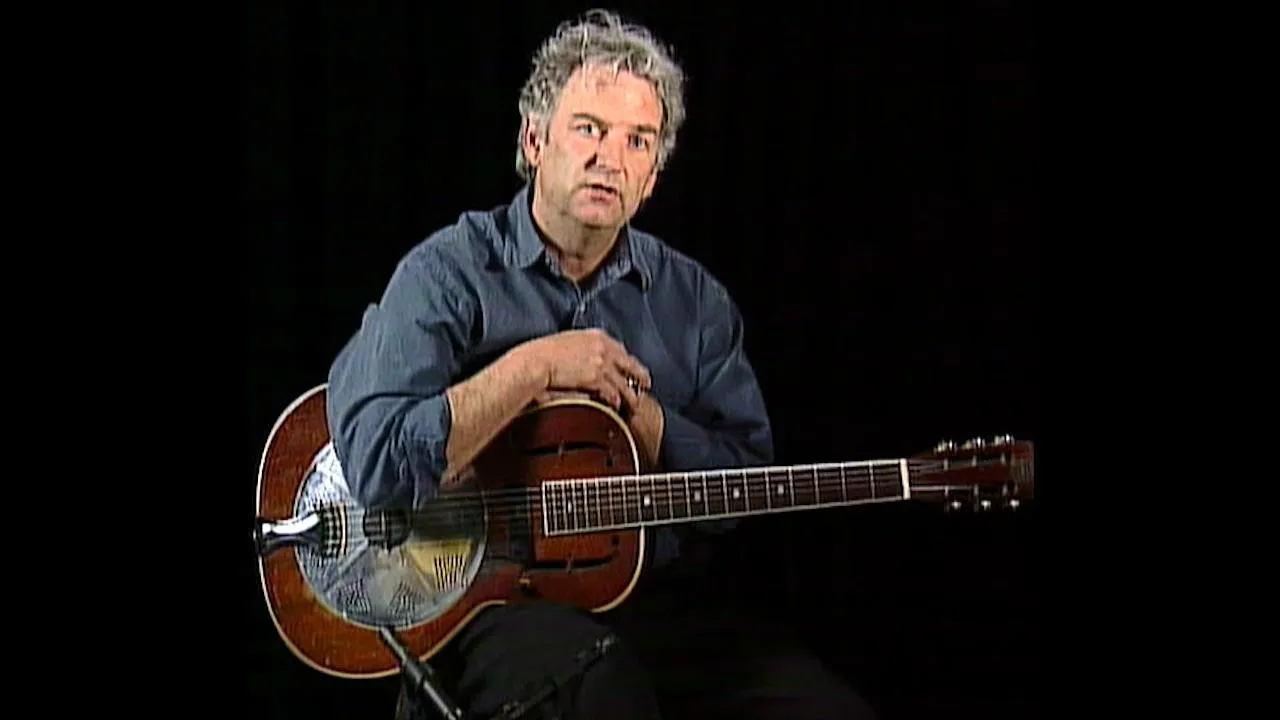
Lesson time: (10min 15sec)
Mike Dowling teaches Fishin' In The Wind on acoustic guitar, breaking down the hybrid picking that lets a flatpick stand in for the fingers and a thumb pick.
Course preview
This lesson is part of the course Uptown Blues (American Roots Guitar)
Watch a preview of the full course below.
Lesson transcript:
Music Lesson: Hybrid Picking Explained
Introduction to Hybrid Picking
All right, let's take a look at this tune that involves some hybrid picking. Hybrid picking is when you hold the flat pick and then use your fingers to simulate some fingerpicking passages. So be it!
Overview of the Tune
This tune was originally sketched out to be a duet, so I've kind of pared it down here. Let me play it again for you or the main passage. Let me do that slowly.
"It's kind of hard to slow this down and play it. Who am I kidding? It's kind of hard to speed it up and play it too."
Breaking Down the Phrases
The second little phrase where I come up and do some plectrum playing is a little bit different. Here's the first one:
- Pinch.
- Here's the second one.
My flat pick is just acting as if I had a thumb pick.
Development of My Playing Style
So far, what's happened with my playing is it's developed over the years. Maybe it comes from this kind of hybrid playing. I've learned to use my ring finger, so now when I'm playing with a thumb pick and two fingers, I'll quite often not even use my first finger at all.
"Maybe it's because that finger just seems a little too short for me after all those years. Or maybe I've just developed a little acuity with the ring finger."
As you watch me playing, it may look like I'm not using my index finger at all to play, and you'd be right about that.
Returning to the Tune
Let's get back to this tune.
- Pull off G7, kind of the same motif on the B string.
- C with a G up high.
- C diminished, G7, diminished G7, C.
I'm setting up the second part of the tune now. This song is in the key of C and also in the key of E.
Here's my transition:
- When I go to the key of E, it's very blatant. I just hit the dominant chord for my new key.
- New key is E.
- I hit B7 to set it up.
- B7 up high, 9th position, B7.
- Repeat that up high.
"See, it's very pinchy here."
Transitioning Back
One more. I got us out of context. Let me start over. Repeat it up high. Time to get back to the new key.
Here's my transition:
- Okay, that's all E, isn't it?
- Now I'm going to play B7 or G7.
- Just a partial little chord and use my open G string and start walking up.
"A little more disguised, that modulation there to get me back to the key of C."
Not as heavy-handed as using that B7 to get to the key of E.
Triplet Patterns
Okay, here we go. Here's a little triplet:
- I could go just get my right hand here.
- Angle in on that.
There's the triplet right away or save it till there at the second fret I'm on G7 is what I'm thinking and then back into the theme.
Next Part of the Tune
Going to the next part of the tune, the next whole chorus of the song using it as a flat picker would.
Now, G.
"That's a big stretch. If you've got your guitar up like this, you'll be more able to easily grab those chords."
A friend of mine looked at what I was doing and he said, "Why, that's a three-dot grab." You go from that dot to that dot to that dot. He was pretty impressed by that three-dot graph.
Now every time I play about that thing, I think of the 3-dot graph. Anyway, and then come back to C.
- Nice big G.
- G13, add nine right there and then C.
Second B Part of the Tune
Now I'm going to the second B part of this tune.
- I'm just going to do this:
- I'm going to take my chords that I outlined before.
- There's E with a third in the bass.
- I'm going to stay off my A string.
- I probably won't even play anything on it.
Breaking my chord, thinking of that as B9 in a way.
Here's what I'm thinking:
- I'm thinking along the same lines.
- The underlying chords: E, B7, E, B7.
- And in a way, I'm harmonizing my chord forms down low, just using different inversions: E, B, E, B, E, G.
And that's my transition back a little more disguised.
Chords and Progression
I think I played what I played in performance here again:
- E with a third in the bass.
- B7 with an F sharp in the bass.
- B9 if you will, with an A in the bass, seventh in the bass.
- E,
- E major,
- B7B with a third in bass,
- E6.
Here's what I wanted to do, but it still worked the other way:
- E sixth, C sharp minor seventh, B, E, G.
Ending the Lesson
And then picking it up again.
Okay, you can hear me implying some almost fast waltz time cadence there.
If I've got two measures:
- 1, 2, 3, 4.
- 1, 2, 3, 4.
I could spend my quarter notes going:
- 1, 2, 3, 3.
- 1, 2, 3.
- 1, 2.
Okay, that makes eight quarter notes. That's my measure. So that's going in the back of my head there. If I can keep it straight.
Now here, if you're doing that, it really helps to play along with a track or have somebody else playing those rhythm chords for you to try to get that waltz time cadence in there.
"It really goes a long way to giving your fingerpicking a nice kind of bounce. It's almost unpredictable."
Some of these patterns you come up with after a while. At first, it's kind of hard to keep it straight, but you can get it all right.
I basically just played the tune to end it, recapping what I did the first time around.
- Diminish.
- And then I grab a 6, 9 chord, C69.
Here it is:
- 8th fret,
- 8th fret,
- 7th fret,
- 7th fret.
Seems like I've been using a lot of those 69 chords to put a button on the tunes today.
Final Thoughts
Last passage...
"All right. That should take care of Fishing in the Wind."
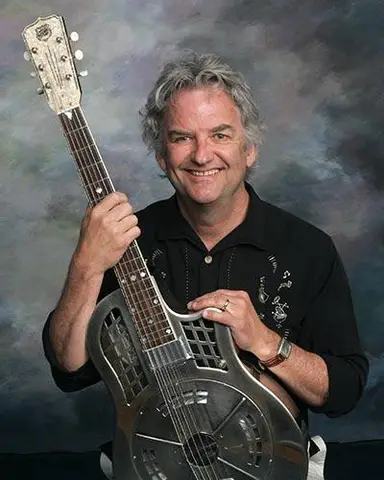
About the instructor
When the late, great Vassar Clements heard Mike Dowling play guitar back in 1975 he did the sensible thing. He hired him. Mike was the guitarist in Vassar's first touring band and can be heard on his Grammy-nominated “Nashville Jam”. Clements called him simply, “One of the finest guitarists there is, anywhere.” Echoing that sentiment is an ever-growing chorus of music critics, guitar students, and acoustic music fans from throughout the world. Mike digs deep into the musical bag of American roots guitar, favoring the melodic Piedmont style of acoustic blues masters like Mississippi John Hurt and slide great Tampa Red. But Mike can't be pigeonholed as a blues player, or even as a fingerstylist. He's far too versatile for that. From bottleneck blues to vintage jazz and much more in between, Mike's musicality, depth, and mastery of the instrument translates fluently to flattop, archtop, and resonator guitars alike. Performer, composer, instructor, session artist, inventor - everything guitarist Mike Dowling does reflects his love for and mastery of the instrument that has been the focus of his life for over forty years. In his lessons, Mike opens up the uptown blues bag for you: relaxed Piedmont fingerpicking, a steady alternating-thumb bass, swinging single-note runs and the slide and bottleneck moves that give American roots guitar its soul - taught with the same feeling he injects into every note. “An excellent instrumentalist who's comfortable with a wide range of musical styles. He injects feeling into every word and note.” --Hit List, Acoustic Guitar “Dowling is a fluid and precise guitarist and his gritty vocals have a sense of playfulness and bounce that's very appealing.” --Dirty Linen read more