



Fiddle Capo
With
Chris Haigh
What's in the course
22 lessons (1h 51m) · 1 free
01. Old time vs Bluegrass
Free lesson11:17
02. Bluegrass: melody and fills
7:52
03. Bluegrass: Kickoffs and solos
7:28
04. Bluegrass: Chubby Wise Licks
5:25
05. Bluegrass: Roll in my Sweet Baby's Arms (Chubby Wise solo)
2:02
06. Bluegrass: Benny Martin, Kenny Baker licks
5:50
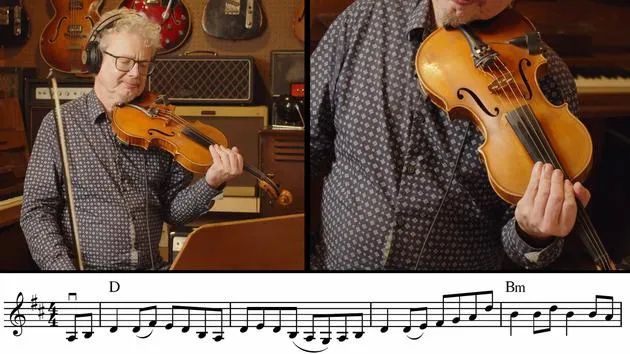
07. Bluegrass: Lost Indian (performance)
0:40
Lesson transcript
Fiddling in Challenging Keys
Early on in this course, we mentioned that to use open string drums and achieve the real old-time country sound, you need to play Rayleigh in the keys of G, D, or A.
Unfortunately, singers don't always prefer these keys. They may present songs in:
- Ab
- F#
- G#
... or some other such monstrosity.
What's a Fiddler to Do?
You have two options:
- Retune your fiddle: This is preferably done down a semitone or a tone, allowing you to play in an easier key.
- Use the fiddle capo method: This technique does not involve applying anything to the fiddle itself; instead, it utilizes a specific playing technique.
The Fiddle Capo Method
Let's say we're in the key of F# major, which has six sharps and can seem daunting. Here's how to approach it:
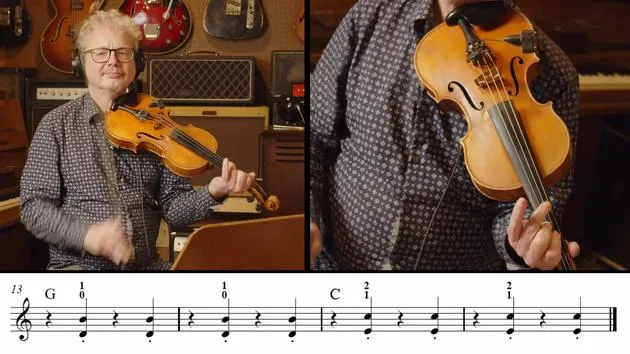
- Place your first finger on the root note (F#).
- You're now in a sort of second position.
- Along with F#, place that finger on the note above it, which is C#. This creates our "capo."
Playing the Scale
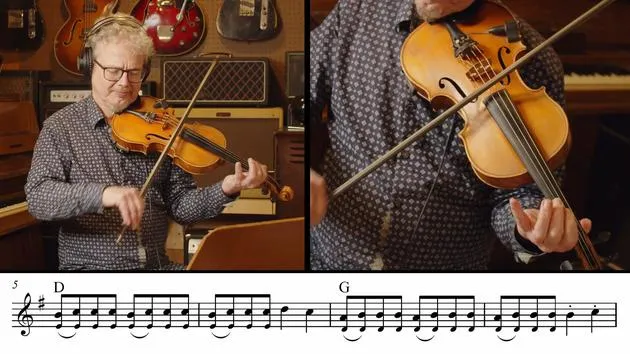
If you play the following sequence:
- 1, 2, 3, 1, 2, 4
You will create the F# major pentatonic scale.
- If you add the flattened third, you get the F# major blues scale.
Remarkably, by keeping your first finger across both strings, you can drone on those notes. You aren't confined to just one octave; there are certain notes below and above your capo, allowing for creative play.
Example with Drums
This technique produces a sound reminiscent of old-fashioned country music, even in a challenging key. I strongly recommend that when performing this with other band members or an audience, you find a subtle way to demonstrate that you're doing something difficult, all while making it appear effortless.
Remember, if no one knows you're playing in F#, they won't appreciate your cleverness.
Improvisation Exercise
Let's finish off with a little phrase demonstrating improvisation using this method.
Here we go ? slowly at first:
1, 2, 3, 4... and with the drone.
Your Assignment
For this lesson, your assignment is to:
- Use the F# backing track.
- Start with simple exercises.
- Progress to improvising over F#.
Try playing simple versions of:
- Red River Valley
- Yellow Rose of Texas
- Banks of the Ohio
...in F and even in G#.
Happy fiddling!
22 lessons
1h 51m of structured video lessons
Advanced video features
Slow down, loop a passage, follow along
Mobile, tablet & desktop
Practise wherever you are
100% satisfaction guarantee
30-day money-back guarantee
Meet your guru
Meet your guru
Chris Haigh has been a professional fiddle player for 25 years, with experience covering many different genres. He has played on over 75 albums, working with artists including Alison Moyet, Bob Geldof, All About Eve, Michael Ball, David Soul, Oumou Sangare, The Quireboys, Riverdance, Morcheeba, James Galway and Steps.
He has played swing jazz with The Kimbara Brothers, Diz Disley, Le Jazz, The Hot Club of London, and the Quecumbar Allstars, and leads a 7-piece Soviet swing band, The Kremlinaires.
Chris gives lessons and workshops on jazz violin technique and has taught jazz violin at Middlesex, Brunel and Newcastle universities and Truro College. His writing credits include nine fiddle books, among them The Fiddle Handbook.
He also runs Fiddling Around (fiddlingaround.co.uk), probably the most comprehensive and widely visited source of fiddle information on the web.







