



Honky Tonk : solo
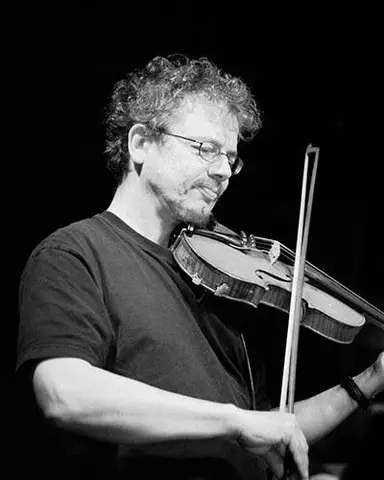
Lesson time: (5min 43sec)
Chris Haigh montre comment construire un solo de violon dans un morceau de honky tonk, en restant proche de la mélodie et en la décorant de sauts d'octave et d'ornements.
Course preview
This lesson is part of the course Fiddle bluegrass et country moderne
Watch a preview of the full course below.
Lesson transcript:
Honky Tonk Solo Lesson
Overview: In this lesson, we're going to explore how to develop a solo in a Honky Tonk song. This approach echoes the techniques used by early bluegrass players, emphasizing a close connection to the melody while incorporating creative variations.
Key Concepts
-
Stay Close to the Melody:
- To play authentically in the Honky Tonk style, it's important to remain close to the melody.
- There is room for a more progressive approach, but traditionalists should prioritize melody adherence.
-
Decoration Techniques:
- Finding ways to embellish the melody is essential.
- One effective technique is to go up an octave to enhance prominence.
- Employing harmonies, specifically a sixth below (equivalent to a third above, shifted down an octave), is commonly used.
-
The Scale of Sixths:
- This is a highly beneficial concept for creating interesting solos.
- For further insight, refer to my YouTube video on the Fiddle Channel discussing the scale of sixths.
Practical Application
- Starting the Solo:
- Count off and begin: 1, 2, 3.
- The only tricky part is the third line:
- 4 over 3, 2 over 1.
- Move both of those down a half step.
- 1 over open, followed by 4 over 3 slid down.
- Then, 2 over 1, sliding up a third.
- Let's repeat that segment before moving on: three over two.
Backing Track:
-
The backing track will have a distinctive feel, often referred to as the Ray Price beat.
- This approach was a progression within Honky Tonk music where the bass began to walk rather than just emphasizing a two-to-the-bar feel.
- The addition of drums gives the music a more rocking sensation.
-
Tommy Jackson's Evolution:
- Tommy Jackson's playing style evolved from his collaborations with Hank Williams to Ray Price, gravitating towards a more single line style.
- This style involves less use of double stops but incorporates a variety of drums and fourth-finger double notes.
- It aligns more closely with the Bob Wills style.
Assignment
- Listen to "Crazy Arms" by Ray Price.
- This song marks the introduction of the Ray Price beat, a staple in Honky Tonk music.
- Practice playing both the backing and a solo over this song.
Enjoy exploring the depths of Honky Tonk music, and remember to experiment within the framework provided!
About the instructor
Chris Haigh est violoniste professionnel depuis 25 ans et possède une expérience dans de nombreux genres. Il a joué sur plus de 75 albums, aux côtés d'artistes comme Alison Moyet, Bob Geldof, All About Eve, Michael Ball, David Soul, Oumou Sangare, The Quireboys, Riverdance, Morcheeba, James Galway et Steps. Il a joué du swing et du jazz avec The Kimbara Brothers, Diz Disley, Le Jazz, The Hot Club of London et les Quecumbar Allstars, et dirige un ensemble de swing soviétique à sept musiciens, The Kremlinaires. Chris donne des cours et des ateliers sur la technique du violon jazz et a enseigné le violon jazz aux universités de Middlesex, Brunel et Newcastle ainsi qu'au Truro College. Parmi ses ouvrages figurent neuf livres consacrés au violon, dont The Fiddle Handbook. Il anime également Fiddling Around (fiddlingaround.co.uk), sans doute la source d'information sur le violon la plus complète et la plus consultée du web. read more