



Bluegrass: Kickoffs und Soli
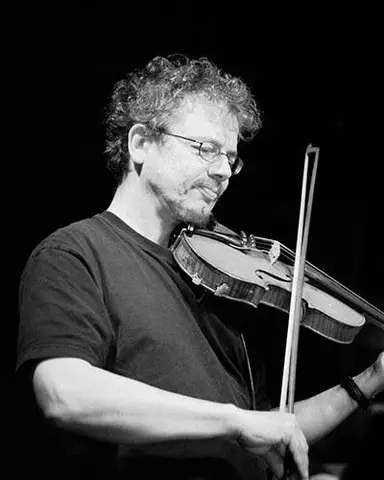
Lesson time: (7min 28sec)
Chris Haigh erklärt den Bluegrass-Kickoff - eine Drei-Noten-Intro, um ein Stück oder Solo zu starten - und wie du Fiddle-Soli aufbaust.
Course preview
This lesson is part of the course Bluegrass- und Modern-Country-Fiddle
Watch a preview of the full course below.
Lesson transcript:
Bluegrass Fills, Kickoffs, and Solos
In the last lesson, we looked at how to do fills during a bluegrass song. In this lesson, we're going to focus on kickoffs and solos.
Understanding Kickoffs
A kickoff is a three-note introduction that can serve various purposes:
- Beginning of the song: If the fiddler is going to play the melody the first time around, the kickoff is a great choice right at the start.
- Beginning of the fiddle solo: It can also be effectively used here.
Approaches to Kickoff
There are various approaches to the kickoff, especially for something in the key of C. Here's what we'll use:
- Typically played right down at the heel.
- Often involves a down bow and two up bows.
- Each note is very sharp, percussive, and attacking. This is a crucial aspect of executing the kickoff.
You can either play it:
-
Single notes:
- Start with a G and a G underneath it.
- Move to a second finger C with an E below it.
- Transition to a D with an F below it, and into the following notes.
-
Double stops:
- This uses the same notes as the single notes but with double stops.
Syncopated Kickoff
A good alternative approach is to syncopate right at the beginning. Instead of coming in after one beat, come in after half a beat like this:
-
-
- , Ba, ba ba ba.
-
Let's do that again:
This method gives a sudden punch, making it a powerful kickoff option.
The "Son of a Bitch"
Finally, there's a colloquial technique known as the son of a bitch. Here's how it goes:
- Instead of the first note, play three notes in a little triplet right down at the heel.
This creates a dynamic kickoff that can be used either at the beginning of a solo or the start of a melody.
Approaching a Solo in Bluegrass
Reflecting on my first introduction to bluegrass in the early 70s with Old and in the Way, this music represents very progressive bluegrass, although it's quite a few years old now.
Traditional vs. Modern Approaches
The traditional style of soloing in the 1940s involved the fiddler closely basing their solo around the melody, adding in decorative elements like double stops and fills. This is the approach we will take.
Example Solo
I'll give you an example of a solo rich in decoration yet clearly recognizable:
- Start off with the harmony kickoff.
- Move into a fourth finger, open E as your first bar.
- Transition from the fourth finger with the third finger below it and slide down a half step (third and second).
- Play a note that crosses two bars, punctuated with an extra note.
- Slide up to third position and use second and first fingers to play an E and a G, moving both down a semitone, and then back up.
- Practice the shuffle: second finger over the first finger, keep the second finger down, play open D and E.
- Incorporate a little blues scale and finish off with a smoother shuffle on F with an F over a C.
- End the passage with a little run to wrap it up.
The essence of the solo rests closely around the melody, yet there's a lot of complexity involved.
Practice with Backing Track
Let's go through the entire progression slowly and then try it with a backing track.
One, two, three...
Assignment for this lesson:
- Review some of the songs we've covered and work out kickoffs similar to those in this lesson.
- Listen to early Bluegrass Boys recordings and analyze:
- What is the introduction?
- What are the verses?
- Where are the solos?
- Is there an outro?
Happy playing!
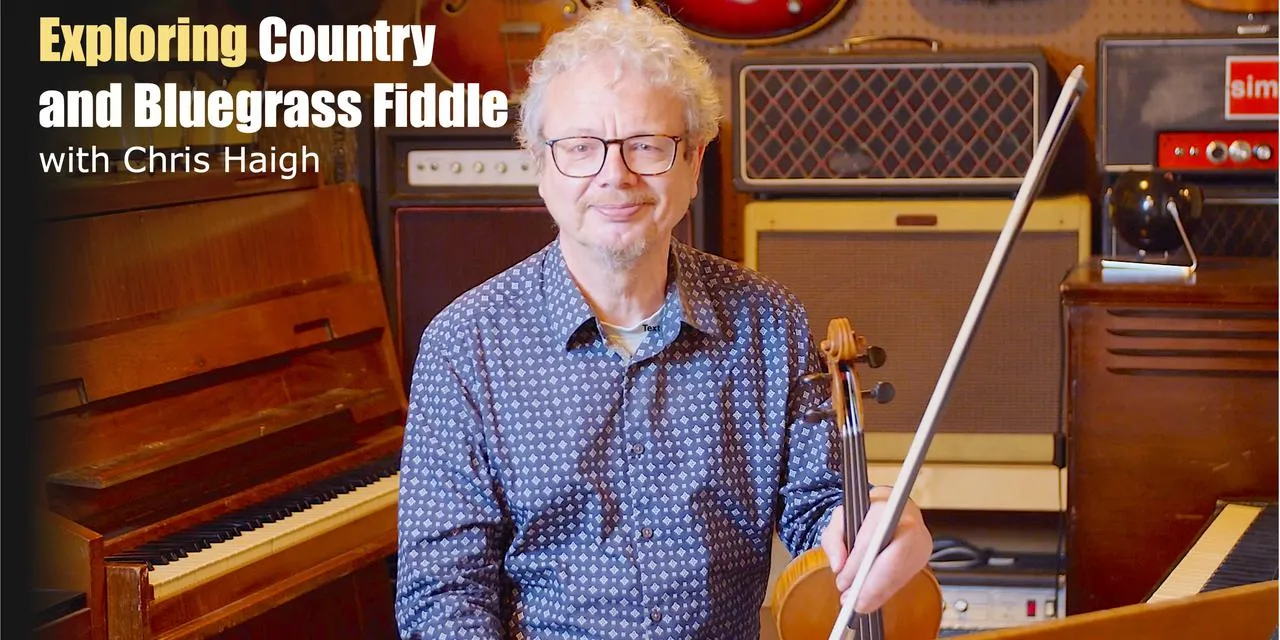
About the instructor
Chris Haigh ist seit 25 Jahren professioneller Fiddle-Spieler mit Erfahrung in vielen verschiedenen Genres. Er hat auf über 75 Alben gespielt und dabei mit Künstlern wie Alison Moyet, Bob Geldof, All About Eve, Michael Ball, David Soul, Oumou Sangare, The Quireboys, Riverdance, Morcheeba, James Galway und Steps zusammengearbeitet. Er hat Swing-Jazz mit The Kimbara Brothers, Diz Disley, Le Jazz, The Hot Club of London und den Quecumbar Allstars gespielt und leitet die siebenköpfige sowjetische Swing-Band The Kremlinaires. Chris gibt Unterricht und Workshops zur Jazzgeigen-Technik und hat Jazzgeige an den Universitäten Middlesex, Brunel und Newcastle sowie am Truro College unterrichtet. Zu seinen Veröffentlichungen zählen neun Fiddle-Bücher, darunter The Fiddle Handbook. Außerdem betreibt er Fiddling Around (fiddlingaround.co.uk), vermutlich die umfassendste und meistbesuchte Quelle für Fiddle-Wissen im Netz. read more