



Cajun meets Country
With
Chris HaighChris Haigh traces how Cajun fiddle from Louisiana - through players like Doug Kershaw and Michael Doucet - found its way into the country sound.
What's in the course
22 lessons (1h 51m) · 1 free
01. Old time vs Bluegrass
Free lesson11:17
02. Bluegrass: melody and fills
7:52
03. Bluegrass: Kickoffs and solos
7:28
04. Bluegrass: Chubby Wise Licks
5:25
05. Bluegrass: Roll in my Sweet Baby's Arms (Chubby Wise solo)
2:02
06. Bluegrass: Benny Martin, Kenny Baker licks
5:50
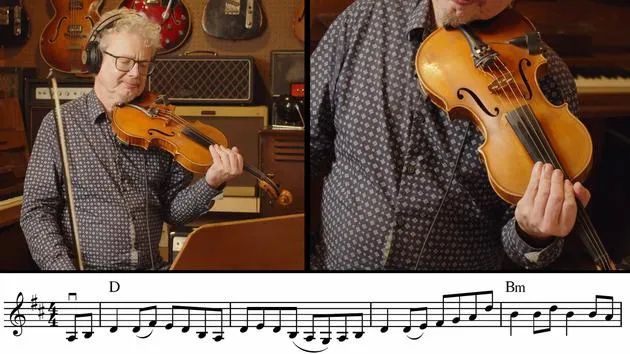
07. Bluegrass: Lost Indian (performance)
0:40
Lesson transcript
Cajun Music Lesson
Cajun music is something that had been going on in Louisiana for a good long while before anyone else in the country actually noticed it.
History of Cajun Music
- The Cajuns were French Canadians expelled by the evil Brits in 1755.
- Many moved to the relatively unpopulated area of Louisiana, bringing their own music, which included a lot of fiddle music.
- One of the early recording stars among Cajuns was Dennis McGee in the early 20th century.
- Doug Kershaw, a fiddle player in the 50s and 60s, brought Louisiana Cajun music to a wider public with songs such as "Louisiana Man" and "Diggy Diggy Low."
- He was known as a wild showman of a fiddler, always performing with his bow hairs hanging loose.
Notable Performers
- Michael Doucet is one of the current successful and influential performers. He's a fiddle player from Lafayette.
Fusion with Country Music
From Doug Kershaw's time in the 50s and 60s, there's been a bit of fusion between Cajun music and mainstream country music. The fiddle finds a very easy way to make itself heard in this genre.
The Cajun Shuffle
- There's a rhythm called the Cajun Shuffle, closely related to the Nashville Shuffle.
- This lesson will focus on that.
Example in the Key of G
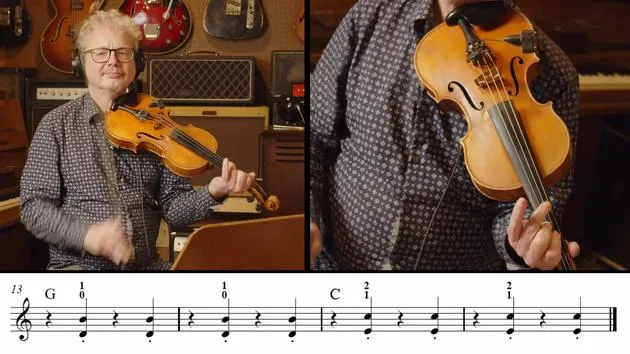
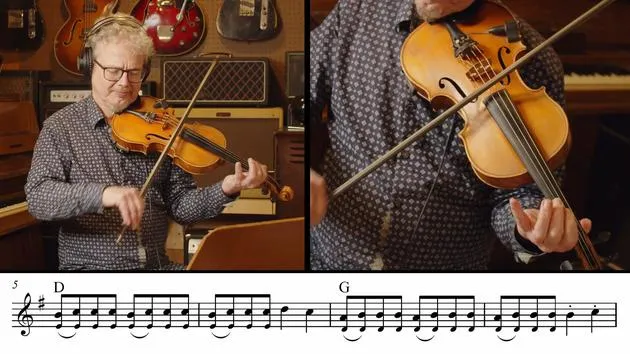
For the key of G, for example, we're going to do something like this:
- This is based on the Nashville Shuffle.
- We're alternating an accent on the up and down, but placing the accent on the third note.
- This coincides with the rock rhythm that would come from drums.
Following the chords G, C, G, D, etc., we have something like this:
1, 2, 3, 4.
Adding an Open String Drone
Now, if we add an open string drone, we get this. Also, we can add some little movements between the different chords.
- I haven't written all of those movements in or all of the drums, but it's quite flexible as to what you actually do.
Let's see what that sounds like with the backing.
Incorporating Slides
You can add some slides to enhance the authenticity:
- Here the first finger is sliding up from an open A to a B.
- You can slide your first finger up for your C or both fingers, giving it a more authentic Cajun sound.
Using Triplets
Another technique that sounds more authentic is triplets.
- In this case, we've got a G drone while going D and say open 1, 2 on the way up to a C.
- This variation makes it sound slightly more Cajun.
Note: The commercial country approach to Cajun is a gross oversimplification of what proper Cajun music actually sounds like, but this reflects elements you'll hear in country music.
The Cajun Kickoff
Finally, the Cajun kickoff is a very specific sound often found at the beginning of a Cajun song. It starts like this:
1, 2, 3, 4, 1.
- It always comes after a half beat and has a kicking sound with some drums.
Assignment
To finish off, let's hear a Cajun kickoff followed by a mixture of these different shuffle techniques.
Your assignment for this lesson is to listen to:
- Hank Williams' song "Jambalaya"
- Mary Chapin Carpenter's "Down at the Twist and Shout," which features Michael Doucet and his band.
Try playing along with these two songs using a Cajun shuffle.
22 lessons
1h 51m of structured video lessons
Advanced video features
Slow down, loop a passage, follow along
Mobile, tablet & desktop
Practise wherever you are
100% satisfaction guarantee
30-day money-back guarantee
Meet your guru
Meet your guru
Chris Haigh has been a professional fiddle player for 25 years, with experience covering many different genres. He has played on over 75 albums, working with artists including Alison Moyet, Bob Geldof, All About Eve, Michael Ball, David Soul, Oumou Sangare, The Quireboys, Riverdance, Morcheeba, James Galway and Steps.
He has played swing jazz with The Kimbara Brothers, Diz Disley, Le Jazz, The Hot Club of London, and the Quecumbar Allstars, and leads a 7-piece Soviet swing band, The Kremlinaires.
Chris gives lessons and workshops on jazz violin technique and has taught jazz violin at Middlesex, Brunel and Newcastle universities and Truro College. His writing credits include nine fiddle books, among them The Fiddle Handbook.
He also runs Fiddling Around (fiddlingaround.co.uk), probably the most comprehensive and widely visited source of fiddle information on the web.







