



Blues: Knox County Blues (Lesson)
With
Chris HaighChris Haigh explores the blues influence on country fiddle through 'Knox County Blues', covering note bends, slides and syncopation.
What's in the course
25 lessons (1h 30m) · 1 free
01. The Georgia Shuffle
5:42
02. Whiskey Before Breakfast (Performance)
0:44
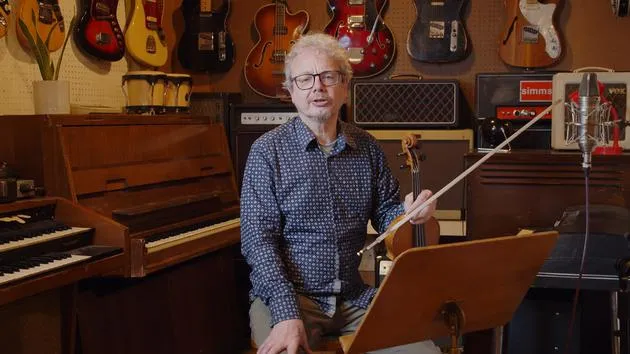
03. Double stops Wednesday Night Waltz
8:34
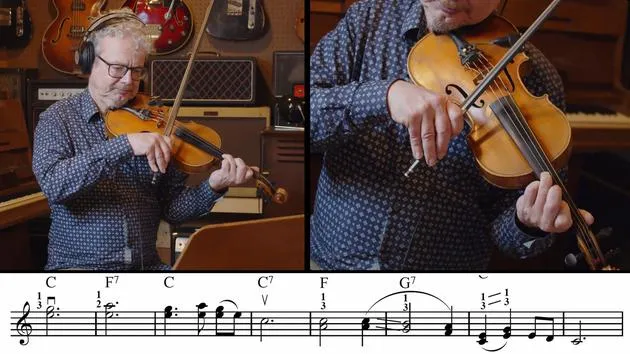
04. Wednesday Night Waltz (Performance)
0:54
05. More double stops: Cheatem County Breakdown
4:06
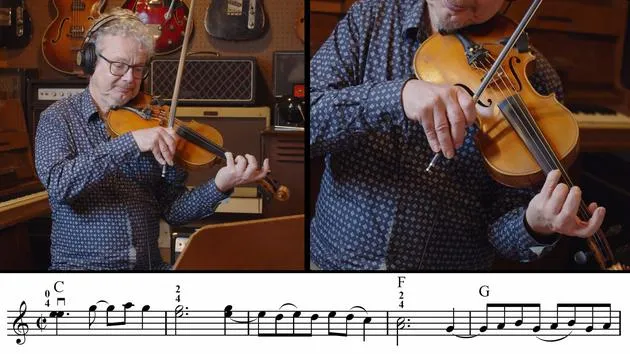
06. Cheatem County Breakdown (Performance)
0:44
07. Singing Cowboys: Yellow Rose of Texas
5:34
08. Yellow Rose of Texas (Performance)
0:22
01. Western Swing: Beaumont Rag
9:50
02. Beaumont Rag (Performance)
1:12
03. Bob Wills - Red River Valley
5:25
04. Red River Valley (Performance)
0:33
05. Twin Fiddling: scale, Goodbye Liza Jane
3:35
06. Western Swing soloing
5:06
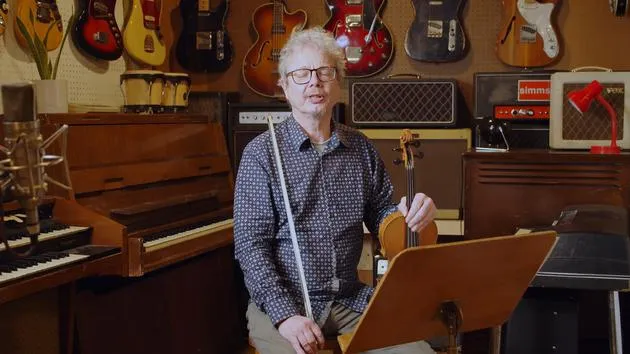
07. Goodbye Liza Jane (solo performance)
1:17
08. Western Swing licks
9:19
09. Girl I Left Behind Me (solo walkthrough)
2:33
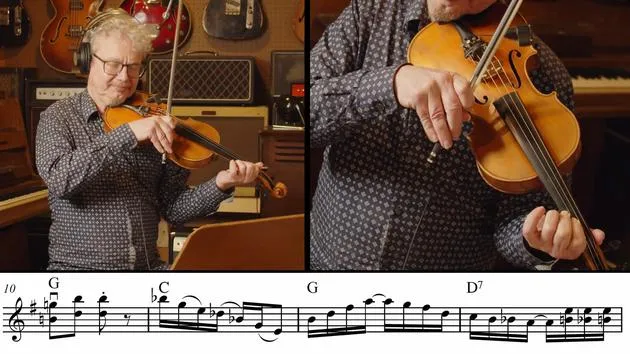
10. Girl I Left Behind Me (solo performance)
0:28
Lesson transcript
Music Lesson: The Blues
In this lesson, we're going to talk about the blues.
Importance of Blues in Country Music
Blues is a very important part of country music, originating from African American influences. Although country music is often seen as "white person's music," the African American contribution is essential. Here are four key elements we derive from African American traditions:
-
Bending and Sliding of Notes
This technique is fundamental to capturing the essence of the blues. -
Syncopation
Syncopation refers to when the accent in a bar comes in an unexpected place. For example:
(demonstrate with a rhythm)
This concept is crucial in old-time music and is heavily influenced by African American styles. -
12-Bar Blues Structure
The 12-bar blues is a sequence based on a specific set of chords. An example structure is as follows:- 4 bars of G
- 2 bars of C
- 2 bars of G
- 2 bars of D
- 2 bars of G
Any tune based on this chord sequence can be identified as a 12-bar blues.
-
Blue Notes
Blue notes, often flattened thirds, are a vital part of bluegrass, western swing, and country music.
All these features can be seen in the playing of early Black musicians.
The Knox County Blues
We're going to play a tune called The Knox County Blues, derived from the playing of the Tennessee fiddler Karl Martin, who recorded it in the 1930s. I strongly recommend checking out some of his recordings.
Chord Sequence of the Tune
Let's revisit the chord sequence of this tune:
- 4 bars of G
- 2 bars of C
- 2 bars of G
- 2 bars of D
- 2 bars of G
This is your standard blues sequence.
Playing the Tune
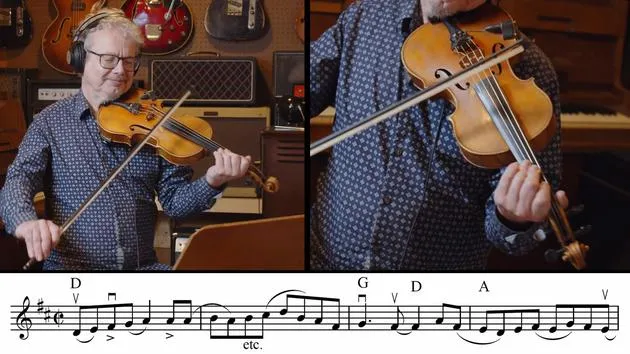
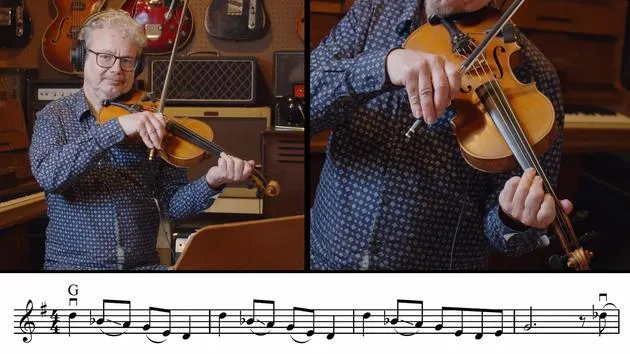
Now, I'm going to play through this slowly without backing and then we'll do it with backing. We'll incorporate lots of bending of notes.
Count:
1, 2, 3, 4.
For now, the hardest phrase is the last one:
- Start with the fourth finger playing a D on the G string.
- Slide down around a semitone, followed by an open G.
- Slur the three notes together.
- Use the second finger to play B flat and B for the last three bars.
Let's repeat that one more time slowly, and then we'll play with the backing.
Count Again: 1, 2, 3, 4.
Assignment for This Lesson
Your assignment for this lesson is:
- Listen to any blues music of your choice.
- Try to identify the key of what you're listening to.
- Follow along with the chords, identifying the I chord, the IV chord, and the V chord.
- Finally, attempt to play along with the blues song, particularly focusing on the roots of the chords.
25 lessons
1h 30m of structured video lessons
Advanced video features
Slow down, loop a passage, follow along
Mobile, tablet & desktop
Practise wherever you are
100% satisfaction guarantee
30-day money-back guarantee
Meet your guru
Meet your guru
Chris Haigh has been a professional fiddle player for 25 years, with experience covering many different genres. He has played on over 75 albums, working with artists including Alison Moyet, Bob Geldof, All About Eve, Michael Ball, David Soul, Oumou Sangare, The Quireboys, Riverdance, Morcheeba, James Galway and Steps.
He has played swing jazz with The Kimbara Brothers, Diz Disley, Le Jazz, The Hot Club of London, and the Quecumbar Allstars, and leads a 7-piece Soviet swing band, The Kremlinaires.
Chris gives lessons and workshops on jazz violin technique and has taught jazz violin at Middlesex, Brunel and Newcastle universities and Truro College. His writing credits include nine fiddle books, among them The Fiddle Handbook.
He also runs Fiddling Around (fiddlingaround.co.uk), probably the most comprehensive and widely visited source of fiddle information on the web.







