



Façons de jouer : accords de septième

Lesson time: (4min 18sec)
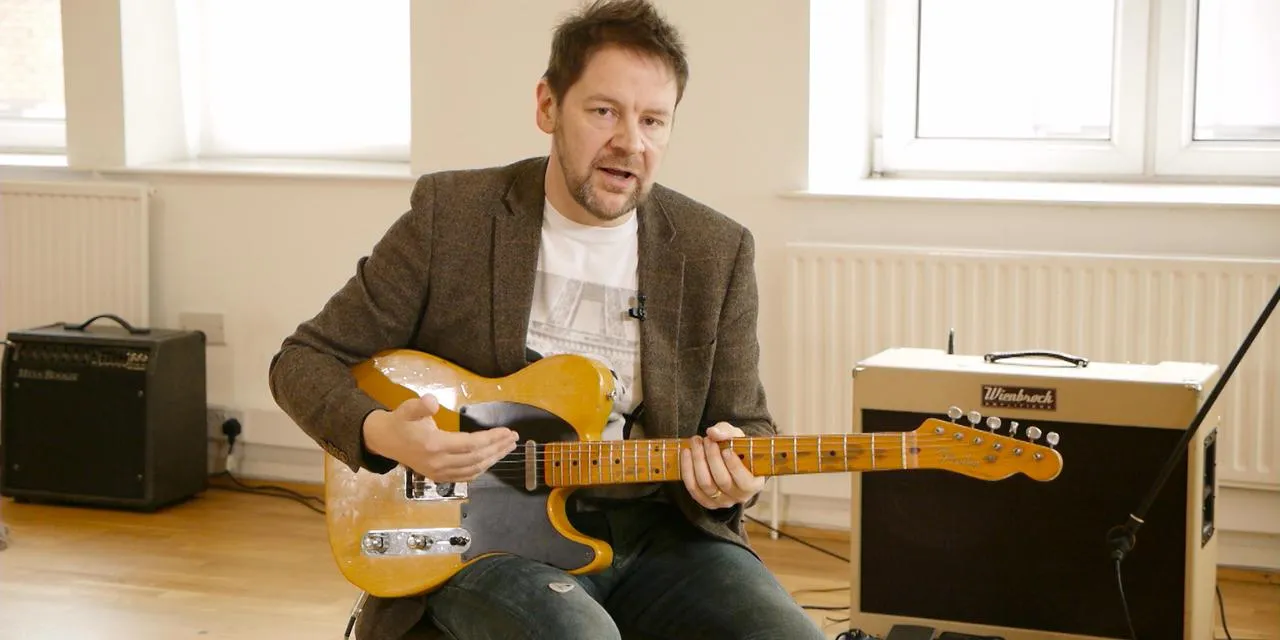
Ron Sayer montre quatre façons de jouer un accord de septième -en partant du A7 barré en forme de E à la cinquième case- et comment les intégrer à tes solos et vamps de blues.
Course preview
This lesson is part of the course Thinking Out Of The Box 1: Opening The Lid
Watch a preview of the full course below.
Lesson transcript:
Understanding Chords in Your Playing
Hello, me again. In this segment, I'm going to be looking at chords. I know we're exploring pentatonic scales and lead playing, but it's crucial to incorporate chords and harmony into your playing.
Revisiting Double Stops
We've already touched on double stops, so now let's focus on full chords within your playing. I want to start by ensuring you have some options in your chord playing.
Starting with Seventh Chords
I'm going to assume that you know how to play at least one seventh chord. We'll begin with a chord that most people tend to know: the E shape or E7 shape bar chord located at the fifth fret. This gives us an A7 chord.
Different Ways to Play a Seventh Chord
Here are four ways to play a seventh chord:
-
A7 - Fifth Fret
- You can enhance this chord by adding the seventh above, placing your little finger down on the B string (eighth fret) for a richer sound.
- Here's how it sounds in a vamp:
"Now what I'm doing there is hammering on my second finger from the fifth fret to the sixth fret on the G string to create a nice effect."
-
Implied A7 - Second Fret
- Another place to play a seventh chord is at the second fret.
- Take the top four strings and play across the second fret, then add the E on the third fret.
- This is an implied chord and works well in a vamp.
-
Implied A7 - Ninth Fret
- At the ninth fret, play the E on the ninth fret, the B on the eighth fret, and the G on the ninth fret.
- Again, this is an implied seventh chord.
-
Implied A7 - Twelfth Fret
- Finally, at the twelfth fret, play:
- A on the twelfth fret
- D on the eleventh fret
- G on the twelfth fret
- B on the tenth fret
- Finally, at the twelfth fret, play:
This gives you four primary seventh chord shapes to work with. You could count the little finger addition as a fifth shape, but I don't see it as a distinct chord.
Different Flavors of A7
So to summarize, we have:
- A7 at the fifth fret
- A7 using the implied chord at the second fret
- A7 using the implied chord at the ninth fret
- A7 using the implied chord at the twelfth fret
These chord shapes provide you with different flavors and placements for playing a seventh chord.
Comping with Seventh Chords
An example of doing a bit of comping using those seventh chords includes adding some techniques to enhance the sound.
- Sliding Up:
I have a habit of sliding up to a chord, which adds a nice touch.
Remember, when playing these chords, you can often move them up to their octaves. For example, the A7 chord down here can also be positioned up here.
Applying to Different Keys
These techniques can be applied in various keys. For instance, when you switch to D, you can create different options:
- Your D7 chord can also be played in several ways:
- D here, here, and here!
And of course, you can apply these to E as well.
Wrapping It All Up
In conclusion, throwing together a whole trell bar using these different chords adds depth to your playing and enriches your musical expression.
About the instructor
Ron Sayer est un guitariste de guitaristes du circuit blues britannique et un mentor pour des musiciens comme Oli Brown et Sol Philcox. Il a été nommé quatre fois aux British Blues Awards - pour l'album 'Better Side', le single 'Don't Make Me Stay' et sa coécriture sur 'Here I Am' d'Oli Brown - et a remporté le prix du guitariste de l'année. Dans ses cours, il décompose le phrasé, la sonorité et le feeling qui se cachent derrière le jeu solo de blues électrique. read more