



Utiliser les double stops

Avec
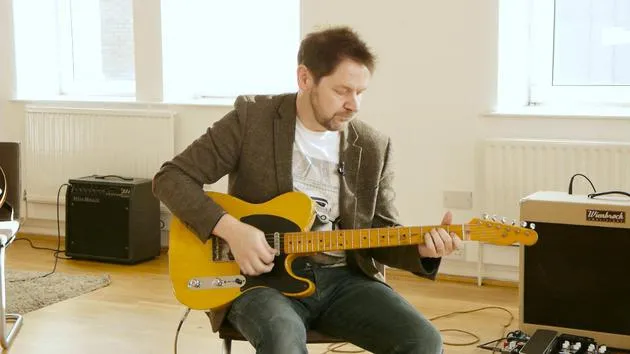
Ron SayerRon Sayer montre comment intégrer les double stops dans ton jeu blues, en parcourant la gamme A mixolydienne en tierces pour donner une couleur harmonique aux lignes à une seule note.
Le contenu du cours
12 leçons (1h 8min) · 1 gratuites
01. Formes de gammes pentatoniques et blues : une révision
Leçon gratuite6:59
02. Une autre forme de gamme pentatonique !
5:10
03. Ajouter la quinte bémol et la sixte majeure à la gamme pentatonique
3:45
04. Mélanger les pentatoniques majeures et mineures.
4:41
05. La gamme blues hybride
4:26
06. Utiliser les double stops
Tu es ici6:35
07. Double stops avec notes de passage
4:18
08. Façons de jouer : accords de septième
6:26
09. Façons de jouer : Accords de neuvième
4:49
10. Des accords cool
10:42
11. Variations de turnaround
5:25
12. RIFF BONUS : Apprends à jouer Pride & Joy de Stevie Ray Vaughan
5:30
Transcription de la leçon
Spicing Up Your Blues Playing with Double Stops
Hello, Ron, here again. This time, we're going to explore something to spice up your blues playing. Not so much soloing this time, but we'll be focusing on using double stops.
What are Double Stops?
I love using double stops! They help you step away from just single lead playing. Not that there's anything wrong with single lead, but it's nice to mix it up occasionally and introduce something a bit more harmonic.
Anytime you're using two notes together, you can call that a double stop. The flavour we're going to explore today will enhance your playing significantly.
The Mixolydian Scale in Double Stops
Scale Overview
We'll start by playing a Mixolydian scale using double stops.
- We're in A and the scale in double stops is as follows:
- Start with the A as your root note and play in thirds.
- First note: 5th on the E string and 6th on the G string.
- Next, move to:
- 7th fret (E and G)
- 9th fret
- 10th fret
- 11th fret
- 12th fret
- 14th fret
- 15th fret
- 16th fret
- 17th fret
- 18th fret
I'll play it one more time for clarity.
The Sound
This sounds nice over an A chord in the Mixolydian scale.
Just in case you don't know, the Mixolydian scale is essentially a major scale with a minor seventh in it. It works beautifully over an A7 chord.
Demonstrating the Scale
I'm going to demonstrate what you can do with that scale. It may sound simple by itself, but it becomes quite cool when you throw it over a vamp in A7.
- Let's try this rhythm:
- "One, two, three, four."
I got quite close to the dusty end there and almost ran out of frets.
Transitioning to Other Chords
Over the A chord, you can comfortably play that scale. However, as we've discussed before with pentatonic scales, you can change the scale when you reach the IV and V chords over the 12-bar structure.
Here's how to adapt it:
-
Transition to D:
- Just strum a D chord, please, Tom.
- Since I'm running out of frets, you can drop down an octave.
-
Transition to E:
- Do the same here.
Thank you for your help!
Using Your Ears
Using your ears and your understanding of that scale, you can easily change your double stops to fit the chords.
12-Bar Experiment
Let's do a 12-bar progression using that same feel, and I'll attempt to incorporate some double stops over the different chords.
- Let's go for it:
- "One. A, two, a one, two, three, sa."
You can see how you can create interesting sounds in your playing.
Incorporating Double Stops Into Solos
I was just playing double stops throughout that progression. However, you can also integrate them into your solos.
Let's run through that again, and I'll include some double stops in the middle of the solo so you can hear how it sounds.
- Here we go:
- "One, two, one, two."
Okay, cool!
12 leçons
1h 8m de leçons vidéo structurées
Fonctions vidéo avancées
Ralentissez, bouclez un passage, suivez la partition
Mobile, tablette et ordinateur
Pratiquez où vous voulez
Satisfaction garantie à 100 %
Garantie remboursement 30 jours
Rencontrez votre guru
Rencontrez votre guru
Ron Sayer est un guitariste de guitaristes du circuit blues britannique et un mentor pour des musiciens comme Oli Brown et Sol Philcox. Il a été nommé quatre fois aux British Blues Awards - pour l'album 'Better Side', le single 'Don't Make Me Stay' et sa coécriture sur 'Here I Am' d'Oli Brown - et a remporté le prix du guitariste de l'année. Dans ses cours, il décompose le phrasé, la sonorité et le feeling qui se cachent derrière le jeu solo de blues électrique.







