Une autre forme de gamme pentatonique !

Avec
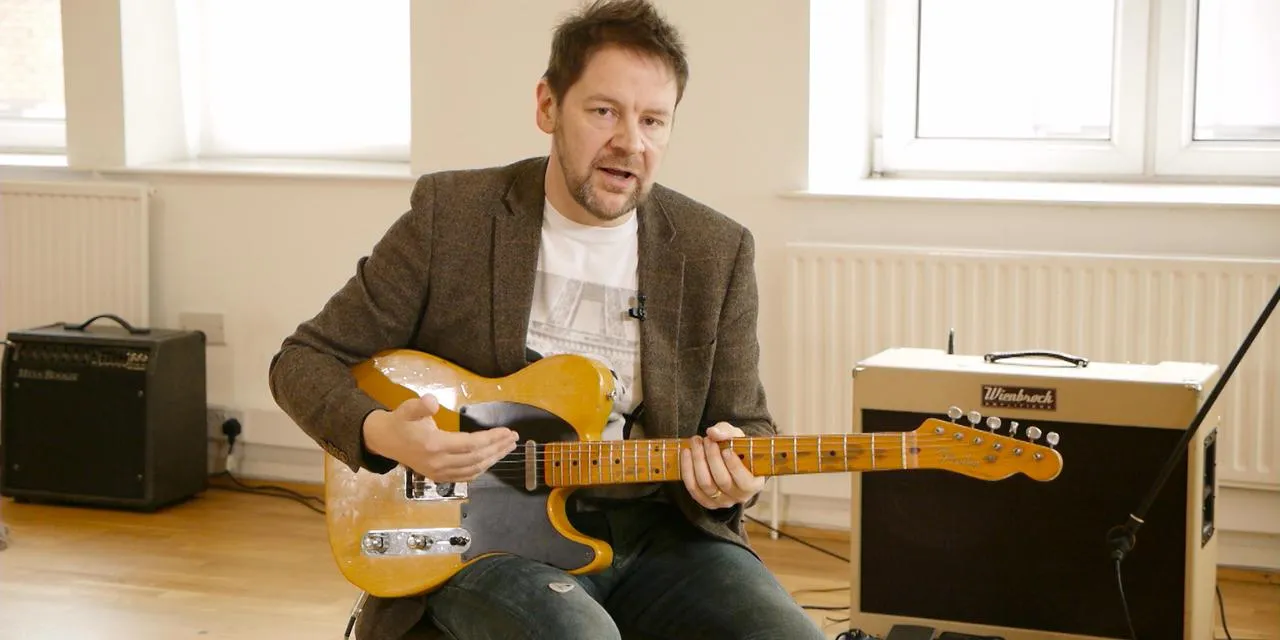
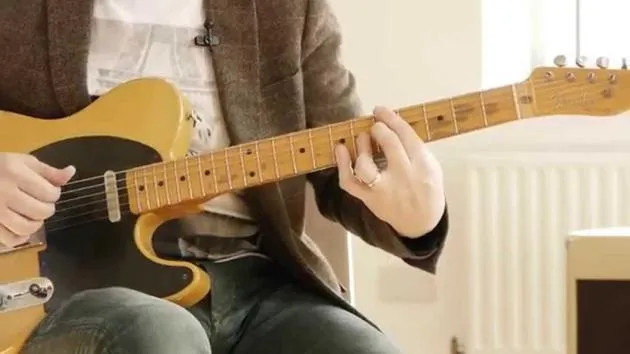
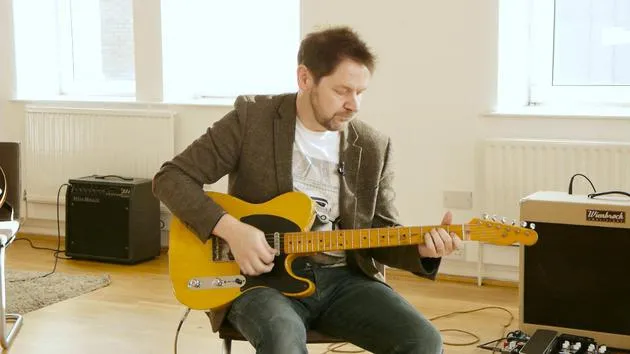
Ron SayerRon Sayer enseigne sa forme pentatonique préférée, la « gamme 2 et 3 » — deux frettes sur une corde puis trois sur la suivante — pour exploiter davantage le manche.
Le contenu du cours
12 leçons (1h 8min) · 1 gratuites
01. Formes de gammes pentatoniques et blues : une révision
Leçon gratuite6:59
02. Une autre forme de gamme pentatonique !
Tu es ici5:10
03. Ajouter la quinte bémol et la sixte majeure à la gamme pentatonique
3:45
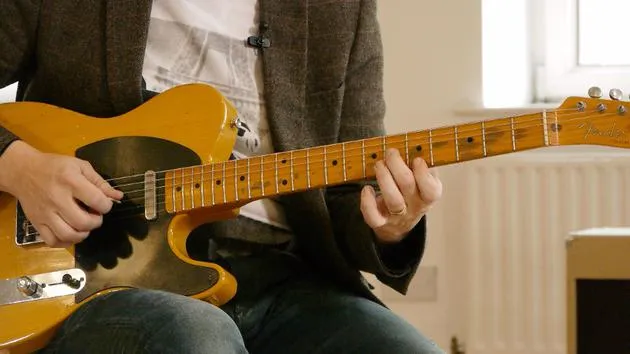
04. Mélanger les pentatoniques majeures et mineures.
4:41
05. La gamme blues hybride
4:26
06. Utiliser les double stops
6:35
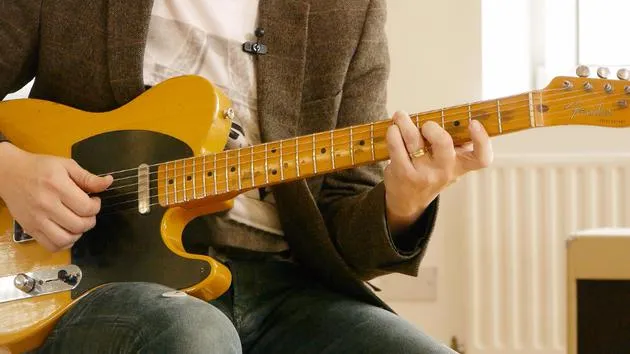
07. Double stops avec notes de passage
4:18
08. Façons de jouer : accords de septième
6:26
09. Façons de jouer : Accords de neuvième
4:49
10. Des accords cool
10:42
11. Variations de turnaround
5:25
12. RIFF BONUS : Apprends à jouer Pride & Joy de Stevie Ray Vaughan
5:30
Transcription de la leçon
Music Lesson: Exploring a New Pentatonic Position
Hello again!
Hopefully, you enjoyed the last lesson and you've worked on playing over the A, D, and E using the A minor pentatonic, D minor pentatonic, and E minor pentatonic scales. You should have a feel for that and have learned your pentatonic scales in five different positions to open up the neck.
Introducing the New Pentatonic Shape
What I want to look at now is a different pentatonic position that I really prefer. This shape opens up much more of the neck for me.
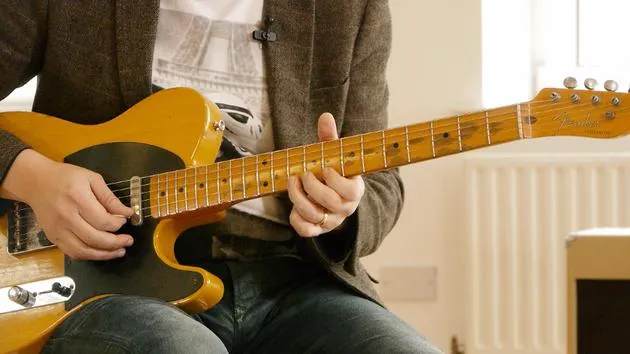
The 2 and 3 Scale
I call it the "2 and 3 scale" for reasons that will become clear:
- It uses two frets on one string.
- Then it moves to the next string and uses three frets.
Let's dive in and you'll see how it works.
Position One: The A Pentatonic
-
Start on the third fret of the E string:
- Start on G, then move to A.
-
Move to the A string:
- Play the third fret, fifth fret, seventh fret.
-
Next, the D string:
- Play the fifth fret and the seventh fret.
-
Now, the G string:
- Play the fifth, seventh, and ninth frets.
-
Next is the B string:
- Play the eighth and tenth frets.
-
Finally, the high E string:
- Play the eighth, tenth, and twelfth frets.
This is a normal pentatonic scale, but it encompasses from the third fret right up to the twelfth fret in one position.
Repetition in the Scale
You'll notice that you are repeating yourself three times:
- Play: 3, 5
- 3, 5
- 7
- 3, 5
- 5, 7
- 5, 7
- 9
- 8, 10
- 8, 10
- 12
So, the same thing is played three times, giving you some scope to play in a different way.
Adding Technique
What I want you to do is incorporate hammer-ons and slides into your scale practice to make it more valuable.
- Hammer on and slide:
- Go from 3 to 5.
- Hammer on, hammer on slide.
- Hammer on, hammer on slide.
- Hammer on, hammer on slide.
Once more, you'll find that sounds lovely.
Putting It All Together
Now, let's throw in a 12-bar progression, and I'll show you how you can use that to great advantage before we start adding some more notes to it.
Count In:
- One, two, three, four...
Lovely, thank you!
Conclusion
You can see that even by sticking to a pentatonic scale, the sound can be quite nice. This approach gives you more of the neck to explore, helping you to move beyond that initial box pattern while also providing techniques to use.
12 leçons
1h 8m de leçons vidéo structurées
Fonctions vidéo avancées
Ralentissez, bouclez un passage, suivez la partition
Mobile, tablette et ordinateur
Pratiquez où vous voulez
Satisfaction garantie à 100 %
Garantie remboursement 30 jours
Rencontrez votre guru
Rencontrez votre guru
Ron Sayer est un guitariste de guitaristes du circuit blues britannique et un mentor pour des musiciens comme Oli Brown et Sol Philcox. Il a été nommé quatre fois aux British Blues Awards - pour l'album 'Better Side', le single 'Don't Make Me Stay' et sa coécriture sur 'Here I Am' d'Oli Brown - et a remporté le prix du guitariste de l'année. Dans ses cours, il décompose le phrasé, la sonorité et le feeling qui se cachent derrière le jeu solo de blues électrique.