



Échauffement pour l'exercice cinq : faire glisser l'archet
Avec
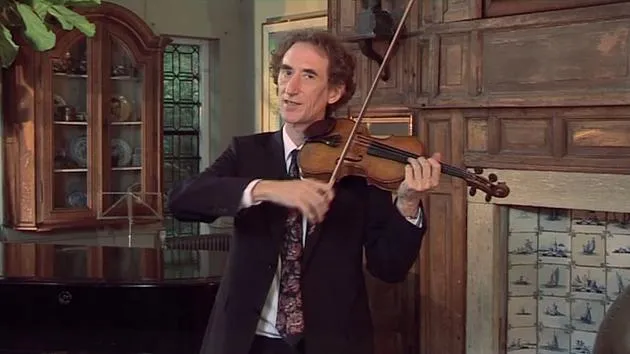
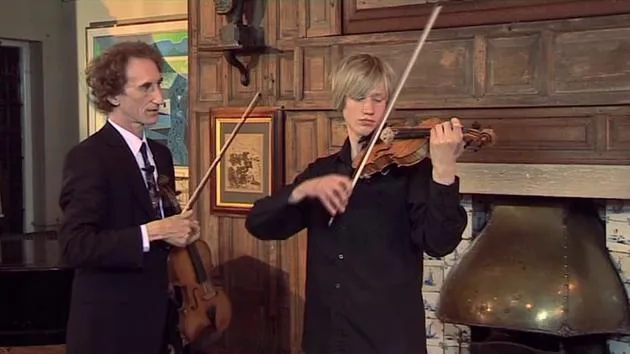
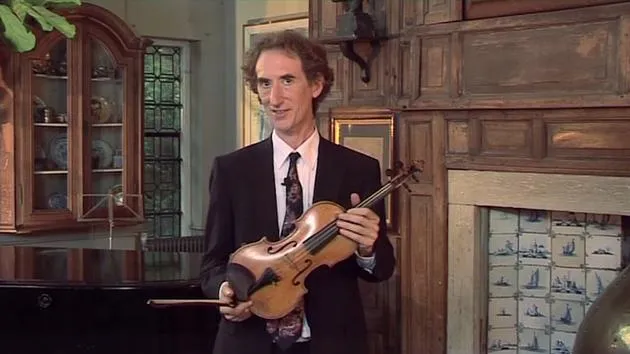
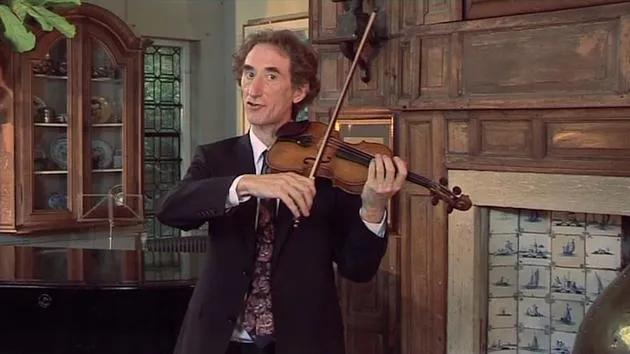
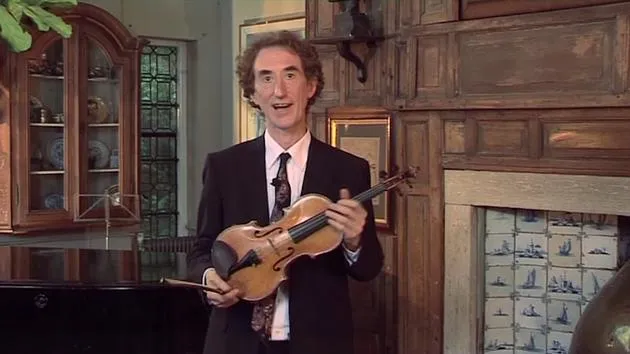
Simon FischerUn échauffement pour l'exercice 5 : fais glisser l'archet entre le chevalet et la touche pour ressentir un angle d'archet à la fois avant de les combiner.
Le contenu du cours
17 leçons (1h 15min) · 1 gratuites
01. Introduction aux combinaisons
0:18
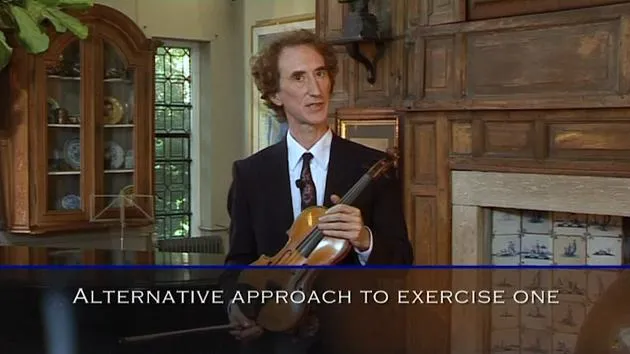
02. Approche alternative de l'exercice un
1:23
03. Exercice six : exercice de vitesse + exercice de pression
0:55
04. Exercice sept : exercice de vitesse + changement de point de contact
3:30
05. Exercice huit : Exercice de pression + Point sonore
1:44
06. Exercice neuf : Même poids, vitesse croissante
1:21
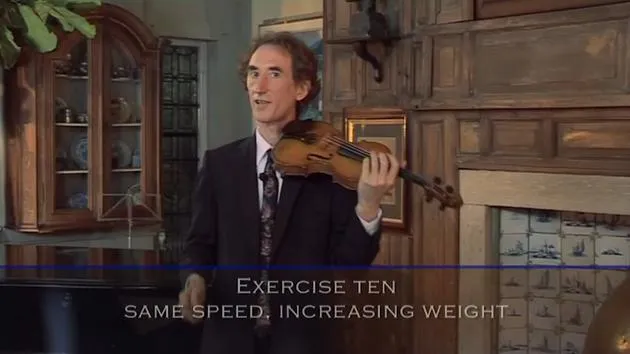
07. Exercice dix : même vitesse, poids croissant
1:14
08. Conclusion
1:33
Transcription de la leçon
Preparatory Exercise Breakdown
This preparatory exercise breaks Exercise 5 down so that you can explore the feel of one angle of the bow at a time.
You can use it as:
- An additional exercise in its own right
- A warm-up for Exercise 5
Exercise Instructions
What you do is this:
-
Place the bow on the string at the point and angle the bow inwards rather extremely.
-
Begin at sound point five:
- Slowly push the bow up-bow a few centimeters.
- Let the bow drift naturally to the bridge.
-
Arriving at the bridge:
- Do not change the angle as we do in Exercise 5 itself.
- Simply move the bow the other way and allow it to drift back towards the fingerboard.
-
Variations:
- You can also, of course, do it at the middle or lower in the bow.
- Repeat using longer and longer strokes in all parts of the bow.
-
Angle the bow outwards:
- Perform the exercise in reverse.
- So now you do deep out.
Focusing on Feel
Now, try this very nice feeling:
- Angle the bow this way.
- If you just turn your violin, keep the bow at this angle to the bridge.
On the down-bow, it will automatically go to the fingerboard.
- Keep the angle consistent
- Go right to the fingerboard:
- Heavy and light
- Heavy and light
If you turn the bow the other way on the down-bow:
- Let's do it in the upper half.
- On the down-bow, it takes you to the bridge.
Understanding Sound
Now, what caused that sound?
- Too much pressure?
No, it's not too much pressure.
- This is what everybody says:
- Everyone scratches when they play nearer the bridge.
- Ask them what caused that, and they always say "too much pressure."
- Nearly every time, they're wrong.
Listen to what too much pressure would sound like.
- No way are you doing too much pressure.
- It's not enough.
Harmonics and Weight
All these high, silvery, harmonic sounds mean not enough weight or too fast a bow. But it's the low-frequency tearing sounds that signify too much weight:
- So just do this:
- Heavy and slow.
- Away.
Brilliant. Excellent.
- Heavy and slow.
- Careful: I could see you going too fast.
- Slow down into the bridge.
It was almost fantastic, but we want total purity of sound.
Cause and Effect
Everything in life is about cause and effect:
- For every effect that we experience, there's always a specific cause.
- If you carry on making the same cause, you get the same effect.
- If you try even harder, you just get even more of what you're already getting.
Do you need to do it slower?
- You need to change something. If you want a different result, you've got to change something.
Fantastic. Bravo. Go slow.
- It's such a nice feeling to just hold in there before you come away.
- Feel the tension of the string.
- Really explore that feeling.
Angling the Bow
Angle it:
-
Don't angle it too much, though.
-
We often do these things too extremely.
-
You're bowing the wrong way.
-
On the down-bow, that goes to the bridge.
-
On the up-bow, it takes you away.
Now explore here even more deeply.
- Nearly clean!
- That was getting there; 99% clean.
- Almost.
Bravo, Bravo! Well done!
You can do it more cleanly, can't you?
- Want to have one more shot?
- Let me have a go.
- I'm not promising.
Weight and Speed
It's about more weight, slower and more weight.
- When you think it's going to break:
- Slower and more weight.
- Watch this: Even slower here.
You see, it's the very last moment, last millimeter.
- If you put the bow on the string at that angle to the bridge on the down-bow, it naturally wanders to the bridge.
Try it:
- Just pull the bow. That's it.
- As you do so, you really need to increase the weight.
Keep the angle the same and just push the up-bow. Let it travel to the fingerboard.
- You're completely ignoring the string there.
- You're over-pressing near the fingerboard and under-pressing near the bridge.
Breathing Technique
Go heavy and keep the angle the same:
- Just go in and out, heavy and back like breathing.
- Breathe in and out.
Beautiful, beautiful.
Now, if you angle the bow the other way:
- Start near the bridge and just pull the bow on the down-bow.
- It will go to the fingerboard.
Lighten as you do.
- Oh, and now light, light, light.
- Can you hear the pitch of the note change?
- Too much pressure changes the pitch of the note.
Lighter, lighter, lighter.
Final Adjustments
Now, slow, slow, heavy, heavy.
Just let it wander back. Again, you need to slow down at the change.
- Here we go: Slow.
Lovely. Well done.
So, you want to put the bow on the string at this angle and draw the down-bow.
- Good.
- What you want to feel is the tension of the string here.
Let the bow go to nothing there, and go deep and away.
What caused that sound?
- Was it a high frequency or a low frequency distortion?
- So is that fast? Too fast, or too slow?
- Too fast for the weight and the sound point.
Perfect.
- Not when you came back: Go deeper.
- Listen to this: Go deep into the string, heavy, heavy.
Better! Keep the angle right.
But what caused that sound there?
- Not enough speed.
- It was too slow, but it was also too heavy.
So the pitch of the note went down, and it sounded just heavy.
Then from here, just push back and make sure you go into the string.
Conclusion
You don't want to do this.
Okay, very good, very good.
- Your bow angle is good until here, and then you seem to start to straighten it.
- Can you keep it the same and just push and pull?
So easy, so easy.
Now look:
- If you put the bow on the string at this angle and just pull the bow, it will drift towards the bridge.
- Increase the pressure.
Right, stop there.
- Keep the angle the same and now push back.
- It will drift back.
Can you do that?
Just down, up.
Keep the angle like this:
- Heavy.
- And back.
Keep the angle.
Here we go.
- Deep in the string.
- Bravo.
Angle it the other way:
- Start near the bridge because it's going to go to the fingerboard.
- Light. Light here.
Now go heavy.
- Deep, deep, deep.
- Bravo!
So if you angle the bow this way, on the down-bow, the bow will naturally move to the fingerboard.
And on the up-bow, it'll naturally move back to the bridge.
Tim, can you just do this?
Look at this:
- Such a nice feeling.
- Let it go in, heavy at the bridge.
Slow. Slow and heavy.
Now you've got it.
Brilliant! Brilliant!
Now instead of this angle, do this angle.
- It works the other way around:
- On the down-bow, it takes the bow to the bridge.
- On the up-bow, it takes you away.
Remember, when you get to the bridge, slow down and get heavy.
Even that!
- I was just going to say wonderful.
- Then at the last moment, it broke.
Slow and heavy!
Believe it, you don't believe it goes slower than you'd imagined possible?
There, you see?
And again.
Well done! Fantastic!
17 leçons
1h 15m de leçons vidéo structurées
Fonctions vidéo avancées
Ralentissez, bouclez un passage, suivez la partition
Mobile, tablette et ordinateur
Pratiquez où vous voulez
Satisfaction garantie à 100 %
Garantie remboursement 30 jours
Rencontrez votre guru
Rencontrez votre guru
Simon Fischer mène une carrière remarquable et variée de concertiste, de pédagogue et d'artiste de studio.
Il s'est produit dans le monde entier en récital et a enregistré trois Sonates de Brahms, un enregistrement salué par la revue Gramophone.
Simon est reconnu comme l'un des professeurs d'élite au monde. Il est professeur à la Guildhall School of Music et a occupé des postes à la Yehudi Menuhin School, la Wells Cathedral School et la Purcell School, et a été pendant 15 ans professeur invité à la Royal Scottish Academy of Music. Après avoir étudié à Londres avec Yfrah Neaman et à New York avec Dorothy DeLay, l'approche de Fischer réunit les meilleurs éléments des traditions violonistiques française, russe et américaine.
Les publications de Fischer exercent une grande influence sur l'enseignement du violon. Rédacteur pour la revue The Strad depuis 1991, ses articles mensuels ont conquis un lectorat dans le monde entier. Publiés par Edition Peters, ses ouvrages techniques Basics and Practice (traduit en coréen, italien et allemand), Scales et The Violin Lesson, ainsi que le DVD The Secrets of Tone Production (désormais disponible en streaming via MusicGurus), sont devenus des références sur de nombreux continents. Son livre et DVD Warming Up a été décrit par la revue The Strad comme « 23 pages d'or technique à l'état pur ».
En 2014, Simon Fischer a reçu le prix de la European String Teachers Association « pour saluer une contribution à l'enseignement des cordes à l'échelle d'une vie ».
Dans son cours en quatre parties Secrets of Tone Production, Simon te guide pour apprendre à connaître ton instrument, puis pour travailler pas à pas ses exercices fondamentaux de sonorité, afin de produire un son plus riche, plus maîtrisé et plus beau au violon.







