



Raise the Bar (Décryptage)
Avec
Talia Girton
Le contenu du cours
19 leçons (0h 33min) · 1 gratuites
01. Qu'est-ce qu'une gamme et démonstration
Leçon gratuite2:27
02. Appel et réponse
0:58
03. Exemple 1 d'appel et réponse
1:09
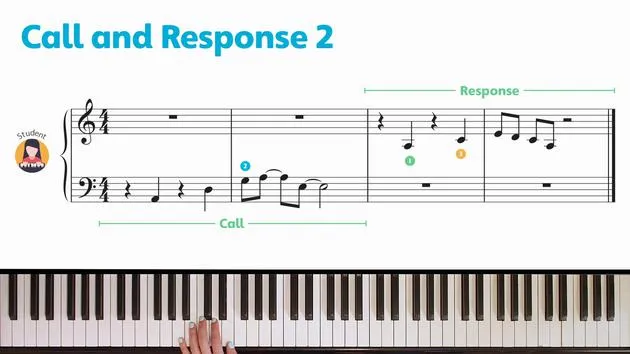
04. Exemple 2 d'appel et réponse
1:25
05. Improviser sur la pentatonique majeure
1:49
06. Jam en pentatonique majeure (interprétation)
1:05
07. Jam sur la pentatonique mineure
1:48
08. Minor Pentatonic Jamming (interprétation)
0:49
Transcription de la leçon
Music Lesson: "Raise the Bar"
Overview
Let's have a look at "Raise the Bar." There's actually a pattern at the very beginning that repeats almost exactly the same from bar five.
Pattern Details
-
Sound Structure:
- We've got a legato sound followed by a staccato sound in the first two bars.
- This pattern repeats in bars five and six, but the ending staccato bit is slightly different.
-
Dynamics:
- The pattern played the first time is going to be piano, and the second time it'll be forte.
Rhythm Breakdown
There's a tricky rhythm part that happens twice:
-
Locations: Bar 8 and then again in Bar 10.
-
Count:
- It starts with a half rest and then goes straight into it. So I'll count two first:
One and two and three and four. - The last note will be tied over to a whole note that's carried through to the next bar.
- It starts with a half rest and then goes straight into it. So I'll count two first:
-
Recurrence:
- It happens again from bar 10 to 11, but the notes are different. Just a step up:
1 and 2 and 3 and 4 and. - And then it carries through the next bar.
- It happens again from bar 10 to 11, but the notes are different. Just a step up:
Left Hand Rhythm
There's another tricky rhythm part in the left hand starting from bar seven. This pattern continues almost until the end of the piece.
Important Notes:
-
There are lots of tied notes here that you actually need to hold rather than play.
-
If I were to snap that for you first, it would sound like this:
- 1 and 2, 3, 4.
- I'll do that again: 1 and 2 and 3 and 4.
-
Pitch Progression:
- When we put the pitches in, you'll see that it's a succession of fifths.
- There will be three notes between the fingers:
- Sounds like:
One and two and three and four and
One and two and three and four. - Then it repeats a step up:
One and two and three and 4 and
One and two and three and 4 and. - And then it happens a final time for one bar on C and G:
1 and 2 and 3 and 4.
- Sounds like:
Practice Recommendations
I'm now going to play this for you with both hands together. However, I highly recommend that you first break this down into very small chunks, so maybe one or two bars at a time. Do separate hands after that.
Tips:
- When it feels comfortable, try putting hands together very slowly.
- Remember that you can use the interactive sheet music to slow down and speed up the track to help you practice here.
- You can also loop tricky parts so that you can practice it over and over again.
Sample Performance
Here's how this piece would sound:
One and two and three and four and
One and two and three and four.
One and two and three and four dot and
One and two and three and 4.
And one and two and three, and four.
And one and two, three and four.
And one and 2 and 3 and 4.
And one and 2 and three and four.
And one, two and three and four.
And 1 and 2 and 3 and 4.
And 1 and 2 and 3 and 4.
And 1 and 2 and 3 and four.
And 1 and 2 and 3, and 4 and.
Final Note
Now, let's try with the backing track.
19 leçons
0h 33m de leçons vidéo structurées
Fonctions vidéo avancées
Ralentissez, bouclez un passage, suivez la partition
Mobile, tablette et ordinateur
Pratiquez où vous voulez
Satisfaction garantie à 100 %
Garantie remboursement 30 jours
Rencontrez votre guru
Rencontrez votre guru
Talia Girton est musicienne et musicothérapeute agréée par le HCPC, et fondatrice de The Cycling Music Teachers. Son travail réunit la musicothérapie, l'accompagnement et l'éducation, et elle enseigne à l'international dans le cadre de la formation en musicothérapie de l'UDELAS au Panama, tout en contribuant au développement professionnel avec l'European Piano Teachers Association (EPTA). Sur MusicGurus, elle enseigne les cours Piano Method et Piano Foundations, guidant les débutants complets depuis les premiers pas à travers le rythme, les deux mains, la théorie et l'interprétation.







