



Introduction aux dièses et aux bémols
Avec
Talia Girton
Le contenu du cours
19 leçons (0h 33min) · 1 gratuites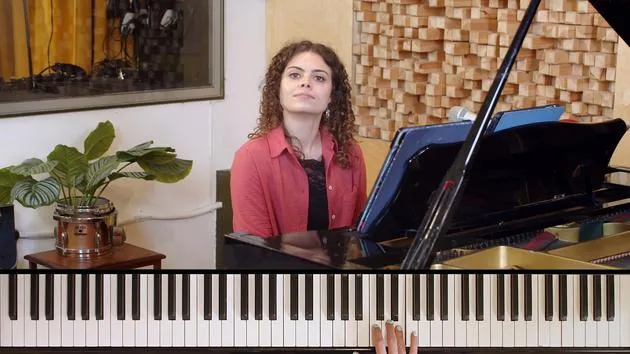
01. Qu'est-ce qu'une gamme et démonstration
Leçon gratuite2:27
02. Appel et réponse
0:58
03. Exemple 1 d'appel et réponse
1:09
04. Exemple 2 d'appel et réponse
1:25
05. Improviser sur la pentatonique majeure
1:49
06. Jam en pentatonique majeure (interprétation)
1:05
07. Jam sur la pentatonique mineure
1:48
08. Minor Pentatonic Jamming (interprétation)
0:49
Transcription de la leçon
Introduction to Sharps and Flats
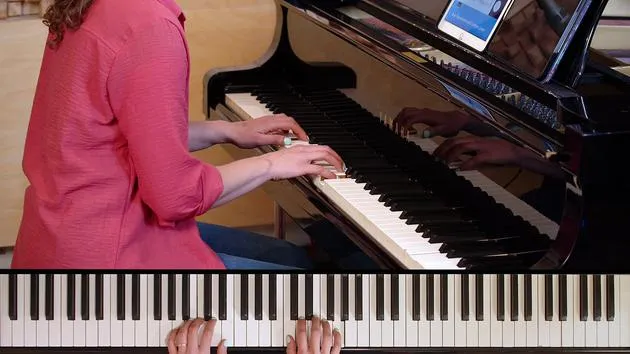
So far, we've been working only with the white keys on the piano, also known as naturals. Now, we're going to look at the black keys, which we refer to as sharps and flats.
Understanding Sharps and Flats
- Sharps are represented on the stave by a number sign (‚ôØ) or a little hash sign.
- Flats look like a little B (b).
Example on the Keyboard
If we look at the keyboard, I'll give you an example of what each of those looks like:
-
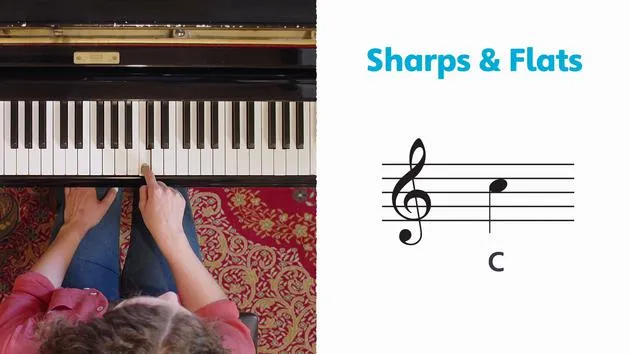
C: This note is a C.
-
C‚ôØ: If I go to the note directly to the right, this is a C sharp.
- Remember: If you step on something sharp, you jump up, and on the piano, we're moving up a semitone.
-
D: We know that this note is D.
-
Db: The note directly to the left is D flat.
- Remember: When a tire is flat, it moves down towards the ground, so we are moving down by a semitone.
Enharmonic Equivalents
I already know what you're thinking: How in the world is this note both C sharp and D flat? The answer is that they are enharmonic equivalents.
You don't need to remember that big fancy word; just remember:
- When you're moving to a black note on the right, it's going to be A sharp (from here to here).
- When you're moving to a black note on the left, it will be A flat (from here to here).
Sharps and Flats with White Keys
There are also some places where we have white keys that are named flats and sharps. This occurs when there is no black key in between two white keys:
- Between E and F
- Between B and C
Notes Related to Sharps and Flats
-
If you were to ask me what E sharp is, I would tell you that it's this note (the note above E).
- Reason: We are moving up a semitone.
-
Similarly, if you asked me about F flat, I would move down to this note (the note below F).
- Reason: We are moving down a semitone.
Conclusion
We'll have a look at using sharps and flats in a song in our performance piece a bit later on.
19 leçons
0h 33m de leçons vidéo structurées
Fonctions vidéo avancées
Ralentissez, bouclez un passage, suivez la partition
Mobile, tablette et ordinateur
Pratiquez où vous voulez
Satisfaction garantie à 100 %
Garantie remboursement 30 jours
Rencontrez votre guru
Rencontrez votre guru
Talia Girton est musicienne et musicothérapeute agréée par le HCPC, et fondatrice de The Cycling Music Teachers. Son travail réunit la musicothérapie, l'accompagnement et l'éducation, et elle enseigne à l'international dans le cadre de la formation en musicothérapie de l'UDELAS au Panama, tout en contribuant au développement professionnel avec l'European Piano Teachers Association (EPTA). Sur MusicGurus, elle enseigne les cours Piano Method et Piano Foundations, guidant les débutants complets depuis les premiers pas à travers le rythme, les deux mains, la théorie et l'interprétation.







