



Articulation et production du son

Lesson time: (3min 21sec)
Course preview
This lesson is part of the course Apprends les classiques de Noël au piano
Watch a preview of the full course below.
Lesson transcript:
Understanding the Bach Style
Because we're going to talk about the Bach style, we should be very careful about tone.
Historical Context
Now, Bach was written at a time when the piano was very underdeveloped; it was primarily the harpsichord. We are playing on a modern piano, so you need to decide whether you're going to play this as if you were playing on a harpsichord, where the tone is quite different, or whether you're going to play it on a modern piano.
I've decided to play it on a modern piano, which offers much more variety to really develop that kind of sweetness, the cantabile, the ringing bell-like, singing quality.
Refinement in Playing
We want real refinement.
- When you play the notes, rather than just allowing your fingers to execute downwards, which sounds quite harsh and percussive, we want to draw the sound out.
- I'm always a strong advocate for posture and freedom.
So, we need to have a very relaxed, moving elbow. I often tell my students to "air their armpits" to ensure freedom in their arms.
Avoiding Tension
We should strive for relaxation in the arms so that the muscles (since the fingers are connected to the arm) remain free and not tense.
- We never want to have repetitive strain injuries or tennis elbow.
- It's all about being very free!
In fact, it's well-known that pianists can play well into their 90s or even 100s because it's such a natural instrument; the fingers are literally an extension of the arm, unlike the more awkward position of a violinist.
Left Hand Importance
Looking more closely at the piece, apart from the very last chord, the left hand consists of single notes, as does the right hand.
- I believe the left hand is just as important as the melody that we all know.
- The left hand bass part, or if we were thinking in Bach terms, is a continuo, similar to a flowing bass line.
It drives the harmony through and twists and turns the phrase, but that doesn't mean we should play it louder.
Subtlety in Sound
It's about having subtlety and moving the direction of sound rather than being extremely prominent in volume.
- We could play this legato at the beginning, or we could incorporate the idea of footsteps, which I demonstrated later on, or you could do a combination of both.
I'm not necessarily playing staccato; I'm using what we call portamento, which is weighted and somewhat detached.
- I'm not lifting my hands off the keys; rather, I'm just lifting the finger from the key and allowing it to come up, without actually leaving the key.
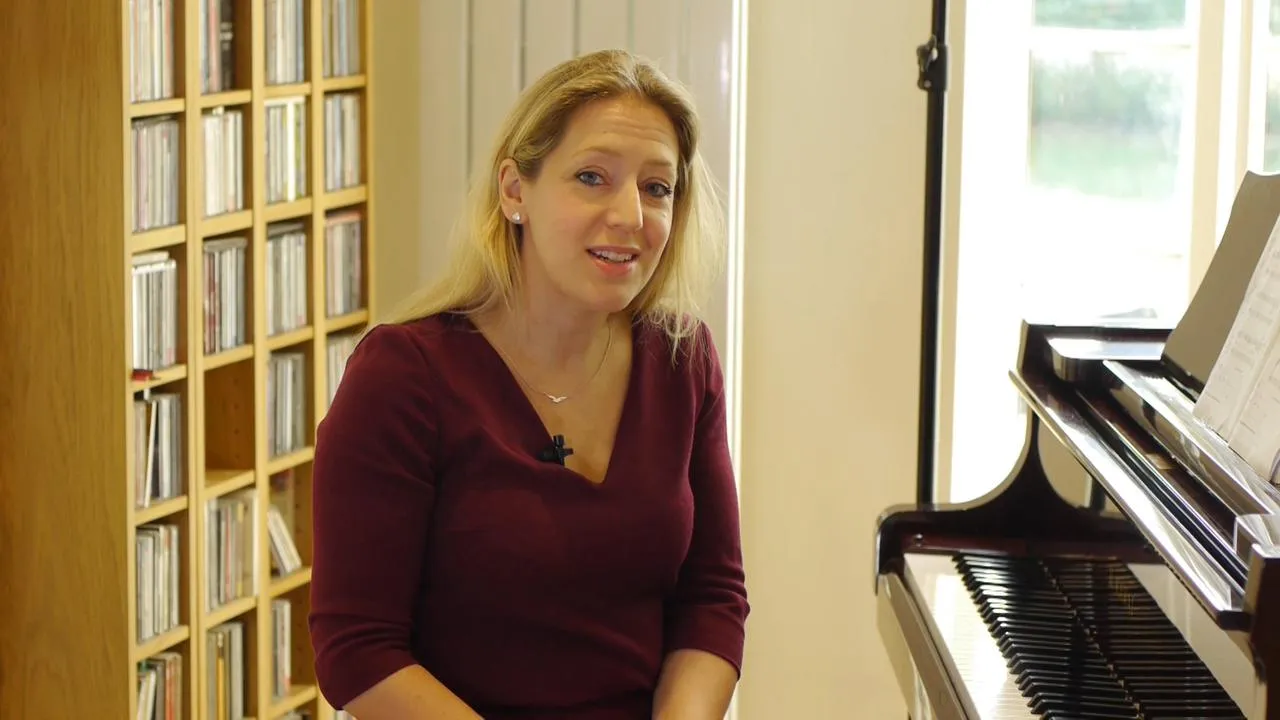
About the instructor
Reconnue comme l'une des pianistes les plus polyvalentes et charismatiques de Grande-Bretagne, Annabel Thwaite mène une carrière variée de soliste, de chambriste, d'artiste de studio, de pédagogue et d'examinatrice, et a remporté tous les grands prix d'accompagnement, dont les prestigieux Kathleen Ferrier, Gold Medal et Richard Tauber Piano Prizes. Elle a collaboré avec des artistes de renom tels que Roberto Alagna, Bryn Terfel, David Kempster et "Only Men Aloud!" Annabel a enregistré pour Universal records avec le "Scottish Tenor", dont l'album a été nommé aux Classical Brit Award et passe régulièrement sur Classic FM. Deux fois accompagnatrice du Festival of Welsh Male choirs, ses concerts au Royal Albert Hall ont été enregistrés par Sain et diffusés sur S4C. Elle est aussi pianiste de séance pour le cinéma, ayant enregistré à Abbey Road la musique du film "Awake", de la série de la BBC sur Jane Austen "Emma", de "The Secret Diaries of Miss Anne Lister" et, plus récemment, elle est apparue à la fois dans Blue Peter et dans "The Rob Brydon Show". "...aidée sans doute par les accompagnements de piano manifestement brillants d'Annabel Thwaite... un vrai plaisir." Dans ses cours MusicGurus — Learn Christmas Classics on Piano, Learn Classical Favourites on Piano et Growing Chamber Groups and Small Ensembles — Annabel partage la musicalité qui sous-tend cette carrière polyvalente. Tu apprendras à faire vivre au piano des pièces de Noël et classiques bien-aimées, à développer ton toucher et ton phrasé et, forte de son expérience primée d'accompagnatrice, à découvrir comment écouter, mener et jouer ensemble en faisant de la musique avec d'autres musiciens au sein de groupes de chambre et de petits ensembles. read more