



Décryptage de la mélodie

Avec
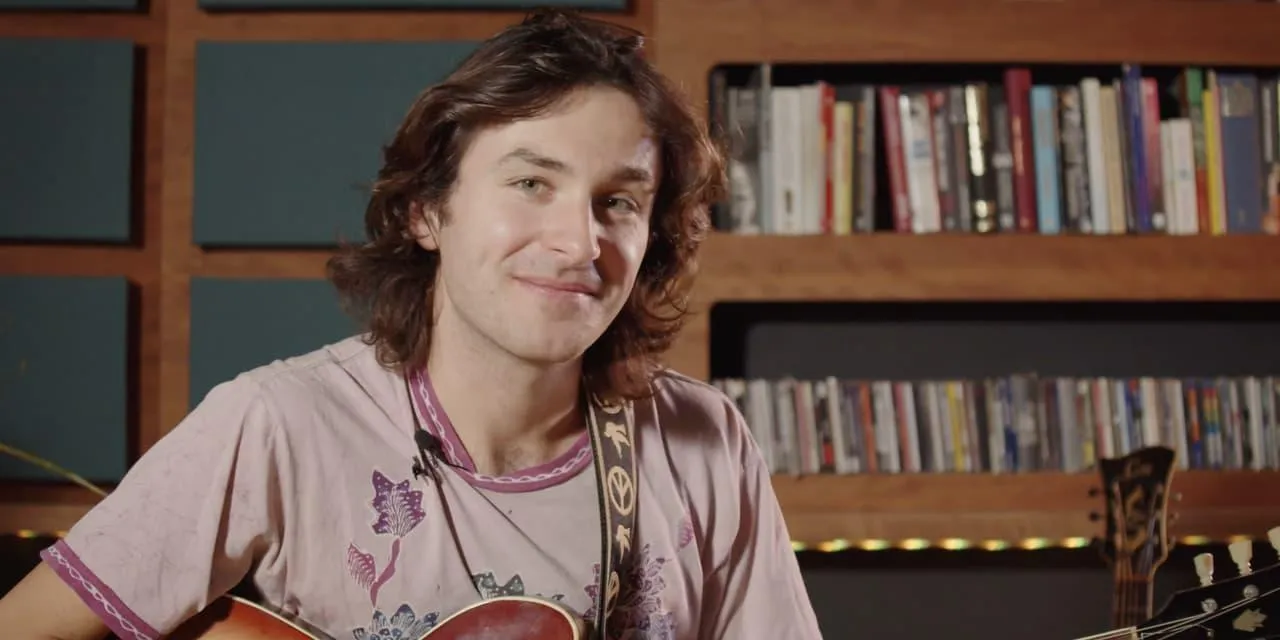
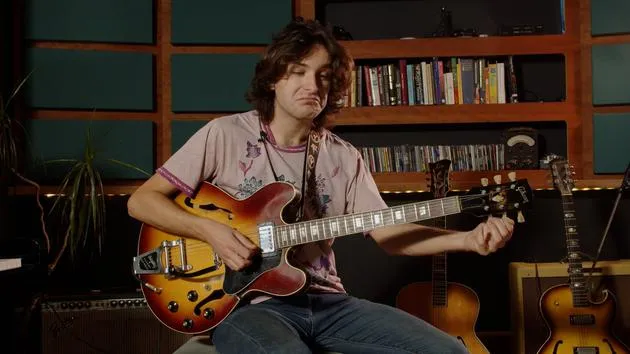
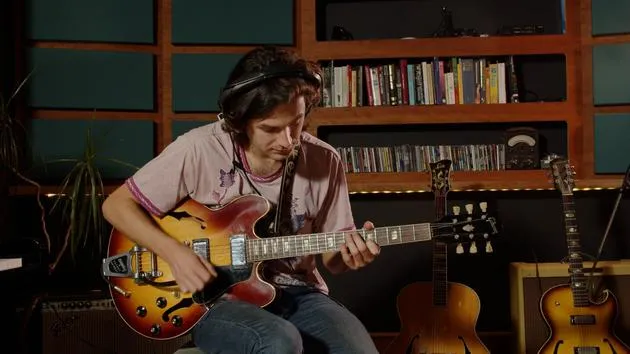
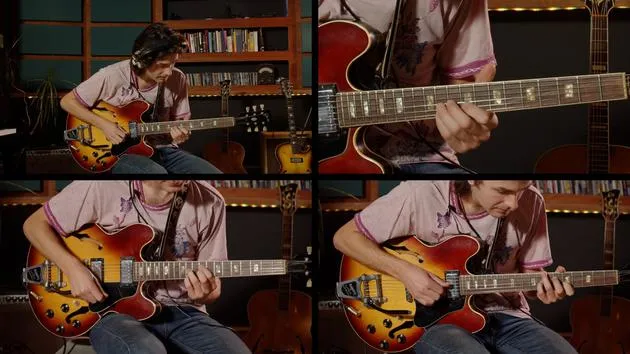
Rob LuftRob Luft parcourt la mélodie de 'Clouds', son morceau inspiré de Django Reinhardt, et explique comment il a retravaillé la célèbre phrase en harmoniques artificielles de Django en notes naturelles.
Le contenu du cours
28 leçons (2h 7min) · 1 gratuites
01. Pourquoi étudier Django Reinhardt ?
3:45
02. Accords et harmonie - Section A
11:06
03. Accords et harmonie - Section B
2:21
04. Techniques de main droite - Européenne vs Américaine
5:04
05. Comment créer le feel swing
1:51
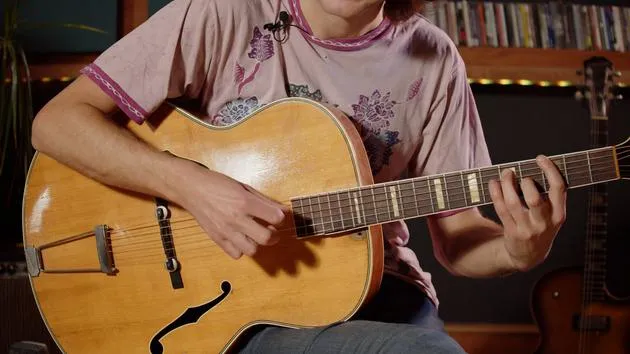
06. Décryptage de la mélodie
Tu es ici9:10
07. Improviser - Arpèges et enclosures
Leçon gratuite10:40
08. Improvisation - La gamme bebop mineure harmonique
8:27
09. Improviser en solo - Utilisation des pentatoniques
9:45
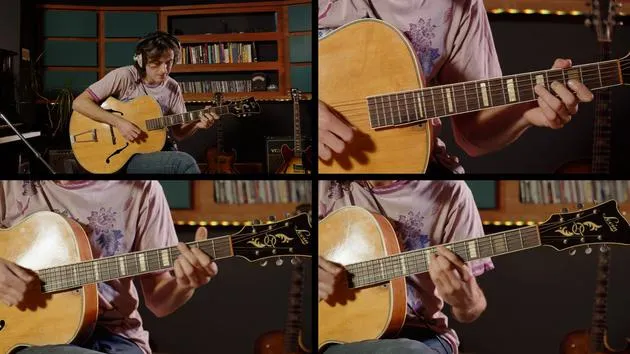
10. Clouds - Performance (écran partagé avec accompagnement)
3:48
11. Clouds - Interprétation
3:49
12. Clouds - Interprétation (version simplifiée)
2:40
01. Pourquoi étudier Joe Pass ?
2:23
02. Introduction au jeu en solo et à l'harmonie parallèle
4:00
03. Lignes diminuées et « tierces siciliennes »
5:19
04. Jouer en mesure avec des voicings pianistiques
5:22
05. Comment jouer la seconde moitié
5:06

06. Hybrid picking vs fingerstyle
5:57
07. November in Norway - Performance
2:29
08. November in Norway - Interprétation (simplifiée)
1:27
Transcription de la leçon
Melody for "Clouds"
So here we are talking about the melody for this piece, which we call Clouds, very much inspired by Django Reinhardt's original and most famous recording in the key of F.
I based my melody on the actual guitar solo from the original, which very famously uses artificial harmonics with the right hand. Django starts his solo with this beautiful phrase, which is a legendary sort of early use of artificial harmonics in the story of the guitar. I mean, you know, the recorded story of the guitar in the 20th century.
I don't think many people had played down harmonics in that way in an improvised solo before Django. So I've based my melody on that. Rather than playing the artificial harmonic, I've just played the melody in natural notes and slightly altered a few things.
My First Phrase
As you hear, my first phrase is very close to Django's, but I'm just altering a few notes here and there to fit with my accompaniment.
- I showed you those tricks in the chordal part that we recorded earlier.
- I've got this passing C7, sharp 5.
So there I've altered my melody to reflect that little tension resolution. I go, which creates a nice feeling, and it's a nice melody as well.
We must always remember that melodies are just that, they should be singable, they should be whistleable. With a guitar, it can be pretty difficult to compose melodies that are still singable because of the nature of the instrument. We want to run away with our fingers.
But in jazz, melodies often have to have this singing quality that someone could really get that hook stuck in their ear, which I think this does.
Moving to D Minor
So that's my first eight bars of melody. Then, when we move to the relative minor key, to D minor, we've got this pretty much sort of quote from the original melody.
So I'll break that down quickly. What we've got here is this great use of chromaticism around the fifth of the relative minor, around that A, resolving to the D minor. We've got this lovely sort of, you could call it enclosure.
When we take a chord tone like this, A, and we enclose each note of the chord. So rather than just playing a phrase like this, where they enclose each note, I'm kind of alluding to this concept, we're enclosing that G, and we're also using chromaticism around the A.
The same thing there with that F. The F is the third of D minor, and we're enclosing it. That sound of G, E, F is very typical in classical music as well. It's a trick borrowed from Bach, using chromaticism to enclose our arpeggios and our chord tones.
It creates a very nice and elegant way to add complexity to very simple harmonies.
Melody Development
So we get this melody here, and then we run down an arpeggio basically down to that third, that B, which is the third of the G7.
Then our melody just goes down a semitone to a G, to a B flat over the G flat seventh chord, reflecting the changing harmony. You get again back up again when it goes back to the G7 and runs up sort of a scale.
It's not really an A scale; it's more of F major minus the B flat from C to C, removing the B flat there. Then the melody cycles back on itself.
Transition to B Flat
It's going to change a little bit this time because we're going into B flat.
- We use this A, which is the ninth of the G flat seventh.
- Then we've got F7 and we use the seventh and the third to resolve into the B flat major chord.
And then we're up to B flat minor, the IV minor, a sound typical of the 30s, really emphasizing these tones, which is the sixth, the minor sixth, very common in B flat minor 6 in this era.
Counterpoint Element
Then we use a bit of counterpoint here.
- We get this sort of almost like a double melody; the higher note goes up and the lower note goes down, which is what we call counterpoint (or contrapunto in Italian).
It simply means notes going in opposite directions. When you add the bass note in, it's very satisfying.
Conclusion
Then we're going to just repeat the last phrase, the first phrase, as our concluding phrase. Just to create a resolution.
And then that four minor comes back again, which is the way we finish our melody.
So I'll just play you that from the last eight bars of melody. You're going to hear this.
So that's our melody, and it's really up to you guys how you phrase it rhythmically. It's very open-ended.
As you can see, it's pretty easy to compose your own melodies on a chord sequence like this, simply choosing an attractive chord tone or an extension like a sixth on that four minor and resolving it using those simple techniques such as:
- Counterpoint, where your upper melody note goes up and your lower melody note goes down, or vice versa.
- Using simple chromatic enclosures and other chord tones.
- Incorporating little scalic runs.
I think it's well within everyone's reach to compose their own melody over a chord sequence such as this one.
28 leçons
2h 7m de leçons vidéo structurées
Fonctions vidéo avancées
Ralentissez, bouclez un passage, suivez la partition
Mobile, tablette et ordinateur
Pratiquez où vous voulez
Satisfaction garantie à 100 %
Garantie remboursement 30 jours
Rencontrez votre guru
Rencontrez votre guru
Rob Luft est un musicien primé originaire de Londres, largement décrit comme l'un des guitaristes de jazz contemporain jeunes les plus en vue et les plus talentueux du Royaume-Uni. Salué par The Times comme destiné 'à accomplir de grandes choses à l'avenir', Rob a remporté le Kenny Wheeler Jazz Prize 2016 en association avec Edition Records, et a obtenu le 2e prix au Montreux Jazz Guitar Competition 2016. Son premier album, 'Riser', est sorti en juillet 2017 et a été largement salué par la critique dans les médias jazz européens. John Fordham a écrit dans The Guardian qu'il s'agit d'un 'premier album très abouti, mais compte tenu des accomplissements de vieille âme de Luft depuis le début de son adolescence, on aurait dû s'y attendre'.
'Si jeune et si talentueux !' - Jamie Cullum, BBC Radio 2 (UK)
'...un talent extraordinaire !' - Julian Joseph, BBC Radio 3 (UK)
'La virtuosité des trois [guitaristes Al di Meola, John McLaughlin et Paco de Lucia] rappelle celle du Londonien de 23 ans Rob Luft, célébré comme un nouveau "Wunderkind"' - Spiegel Online (D)
Dans Play Authentic Jazz Guitar, Rob dévoile le langage harmonique, le phrasé et les instincts d'improvisation qui se cachent derrière ce son de 'vieille âme', te montrant comment il pense réellement le manche afin que tu puisses commencer à trouver ta propre voix dans le jazz.







