



The West Wind (leçon)
Lesson time: (9min 48sec)
Course preview
This lesson is part of the course Celtique, blues et au-delà
Watch a preview of the full course below.
Lesson transcript:
Understanding Traditional Melodies and Their Variations
Many of the melodies that are considered traditional, believe it or not, are recognized across several different cultures. I discovered this early on when I started playing with a Scottish fiddler. She introduced me to certain tunes that I had heard played in bluegrass music.
Then I played with an Irish musician, and they were doing the same tunes but with different names. One of my favorite examples is a tune I initially heard played by a piper called the West Wind. However, I later learned from an Irish fiddler that this was actually not a Scottish tune; it was an Irish tune called the South Wind. Later on, while playing with an English group, they referred to it as a Christmas tune called the Michaelmas Wind.
So, I guess you could call it just about anything you want. People borrow melodies and make them their own.
Creating a Scottish Sound
Since I originally learned this tune from a piping recording, I thought it would be cool to create a sound reminiscent of that style within the tune. Here are a couple of techniques you can use to make it sound more Scottish:
-
Get a drone in the bass:
I initially started trying to play this in the key of D, which has a nice low sound. However, when you have the melody and the bass close together in that range, it can sometimes get a bit muddy. -
Use a capo:
I decided to use my trusty capo and experiment with different positions on the neck. For some reason, I found that the third fret position gave me my favorite sound for this tune.
The tuning lends itself well to using open strings in this modal sound, allowing you to back up major or minor tunes. This melody is primarily in the major key.
Structuring the Melody
As I play through the melody a couple of times in a lower register, the underlying chord structure becomes clear:
- Chords: 1, 1, 4
- Bridge Section: 5, 1, 5, then 6, 2, 5
Here, I substitute the third to create parallel movement.
A common technique in guitar arrangements of Celtic music is to fool the listener at the end of a phrase by shifting to the IV chord instead of resolving to the root.
You might play it like this:
- Transition:
- (Root chord)...
- (IV chord)
This works well, often aligning with the melody. Use this sparingly in your tunes for a nice change.
Exploring Different Melodic Styles
In this tuning, I can also play the melody in various ways:
- On one string
- Across the strings
This flexibility provides different choices while playing through the arrangement. For example, I can let the notes ring like a harp, or choose a contrasting quality.
A Creative Technique
Here's an interesting trick to enhance your arrangement:
- Take the melody and stretch to another string, maintaining the same note.
- Instead of just playing the note, try transitioning smoothly into a drone.
This can create a wonderful effect, especially when the melody repeats a note.
Higher Octave Challenges
When I reach the B section in a higher octave, I need to position myself higher to get the chords since the melody ascends. I might combine fingered notes with an open string as I transition back to the original sound.
In this context, I can also add:
- An octave for a fuller sound, which can provide a nice 12-string effect momentarily.
- Incorporating thirds back into the arrangement enriches the tune's texture.
Ending Techniques
When concluding, remember:
- Experiment with the snap effect, unique to Scottish playing.
You might not hear this inflection in Irish music, which is often much straighter. The distinction arises partly due to the way pipers move their fingers, creating a burst of air that precedes the notes.
To imitate this on guitar, aim for a slightly absent note while maintaining the rhythm.
In my last verse, I usually play it straight Scottish, maintaining the drone throughout to capture the essence typical of bagpipe music, with that distinctive snap ingrained in the melody.
Using these techniques can greatly enhance your understanding and performance of traditional melodies, showcasing their beauty and cultural variances.
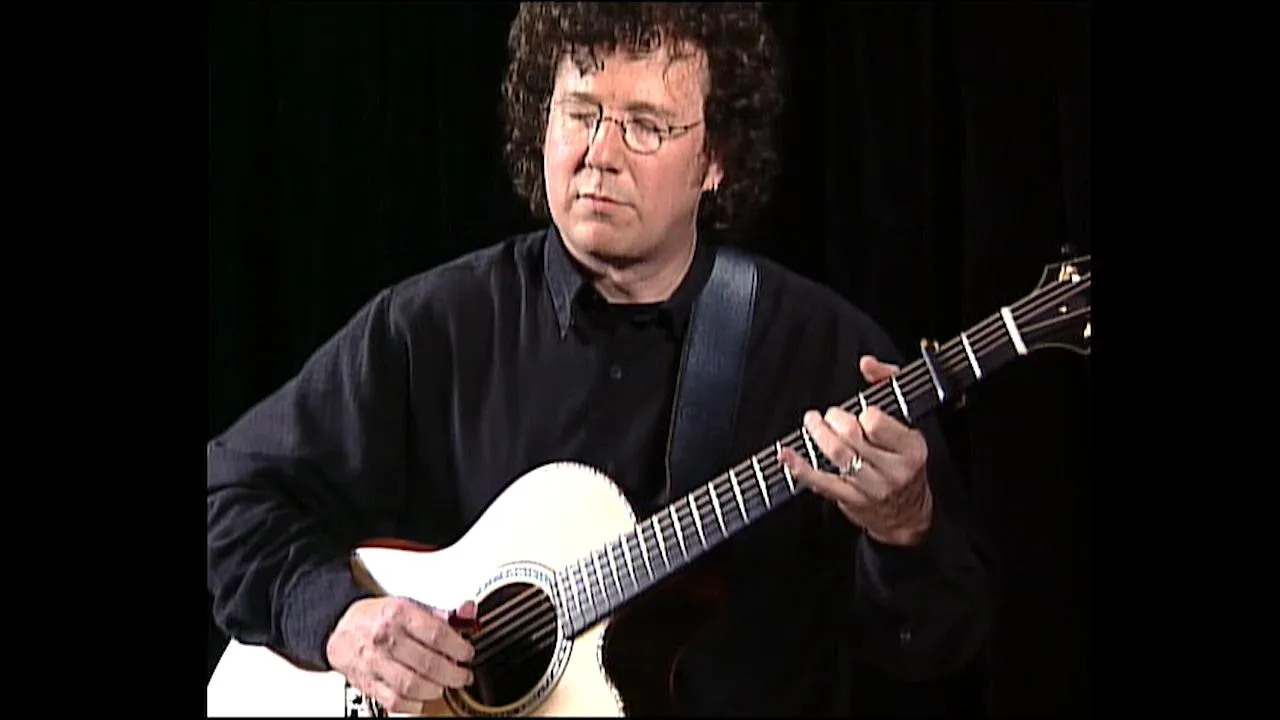
About the instructor
Artiste de studio et interprète lauréat d'un Grammy Award, Al Petteway a joué presque tous les types de musique populaire, folk et classique. Bien que son instrument principal ait toujours été la guitare, il a aussi étudié le luth, la contrebasse, la percussion et la composition musicale. Ses compositions pour guitare acoustique fingerstyle sont fortement influencées par son amour de la musique celtique et par ses propres racines dans le folk, le rock et le blues — précisément le terrain qu'il explore dans son cours MusicGurus, Celtic, Blues and Beyond. Dans Celtic, Blues and Beyond, Al partage les accordages ouverts, les techniques de fingerstyle et l'approche mélodique qui sous-tendent son son, te montrant comment fusionner le phrasé celtique avec le feeling du folk, du rock et du blues afin que tu trouves ta propre voix à la guitare acoustique. Al a reçu quarante-cinq "Wammies" de la Washington Area Music Association, dont les plus hautes distinctions d'"Artist of the Year" et de "Musician of the Year". Il a été récompensé par deux Maryland State Arts Council Individual Artist Awards de composition musicale et s'est produit à la résidence du Vice-président et à The White House. Son jeu figure sur plus de soixante enregistrements de certains des musiciens folk et celtiques les plus connus au monde. En 2005, il a été élu l'un des Top Fifty Acoustic Guitarists of all Time par les lecteurs d'Acoustic Guitar Magazine, et en 2008 il a remporté les médailles d'argent et de bronze aux Player's Choice Awards du magazine. Son CD "Caledon Wood" a été élu l'un des "Essential Albums of the Past Twenty Years" dans le numéro du 20e anniversaire d'Acoustic Guitar Magazine, et son album de 2012 "It's Only the Blues" a figuré sur deux des listes "Top Ten Essential Albums of 2012" des rédacteurs d'Acoustic Guitar Magazine. En 2014 et 2015, il a publié deux autres albums solo, "Mountain Guitar" et "Dream Guitars, Vol. II." "Instrumentiste novateur connu pour ses accordages ouverts, Petteway offre un son riche et suave qui allie l'ancien et le nouveau." --The Boston Globe read more