



Accords augmentés
Avec
Chris HaighL'accord augmenté sonne plutôt exotique et, comme le diminué, il est symétrique. Mais au lieu d'un empilement de tierces mineures, l'augmenté est un empilement de tierces majeures
Le contenu du cours
28 leçons (1h 46min) · 1 gratuites
01. Bienvenue dans le cours !
1:09
02. Les bases des accords
9:05
03. Accords major7, minor7 et flat7
Leçon gratuite9:48
04. Exercice à faire
0:40
05. Les II-V-I
6:31
06. Exercice : II-V-I
0:21
07. II-V-I mineurs
3:38
08. Exercice : II-V-I mineurs
0:18
09. Le cycle des quintes
7:08
10. Exercice : Cycle des quintes
0:26
01. Accords diminués
6:10
02. Exercice : diminué
0:17
03. Accords augmentés
Tu es ici3:48
04. Exercice : accords augmentés
0:19
05. Minor 7b5/7b9
2:24
06. Exercice m7b5/7b9
1:15
07. Accords slash et sus
6:18
08. Devoir : accords slash et sus
0:18
09. Substitutions et jouer 'outside'
7:21
10. Exercice : jouer outside
0:29
Transcription de la leçon
Understanding the Augmented Chord
In this chapter, we're going to look at the augmented chord.
Nature of the Augmented Chord
The augmented chord sounds rather exotic. Unlike the diminished chord, it's symmetrical. But instead of a pile of minor thirds, this is a pile of major thirds.
Notation
- G Augmented can be written as:
- G Aug
- G
- G7
- G7, 5
I have to apologize for the absolute mess of chord names, but no one accepts responsibility for the way this has been organized.
Scales and Patterns
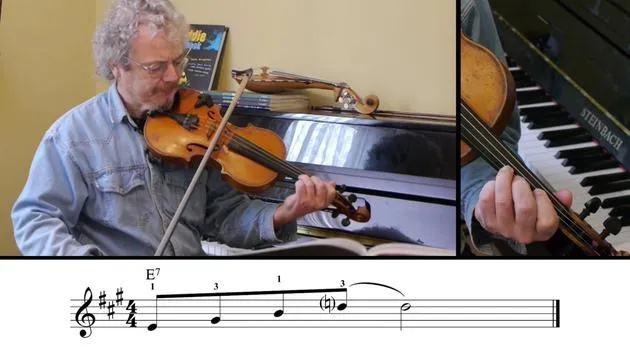
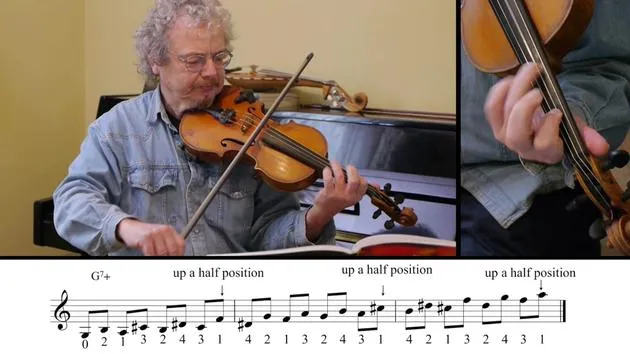
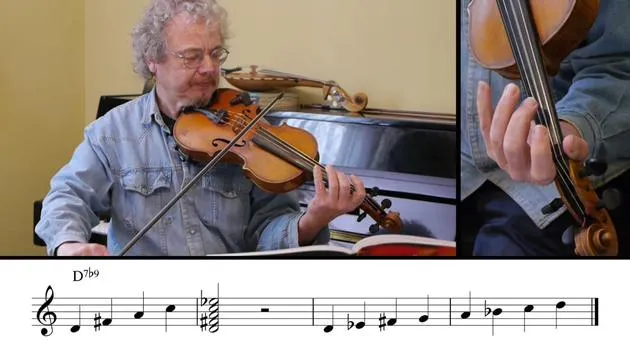
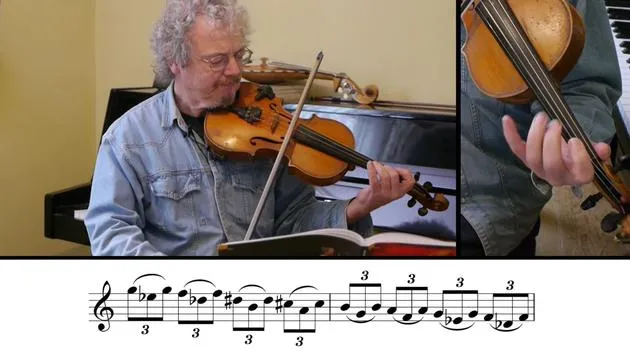
The scale that best fits the augmented chord is the whole tone scale. You can see from the arpeggio that it is a G7 with the fifth sharpened.
Learning Scales
From the point of view of learning scales, the augmented is even better than the diminished because there are only two to learn.
-
The G whole tone scale also works for:
- A
- B
- C sharp
- D sharp
- F natural
-
The AB whole tone scale works for all the others.
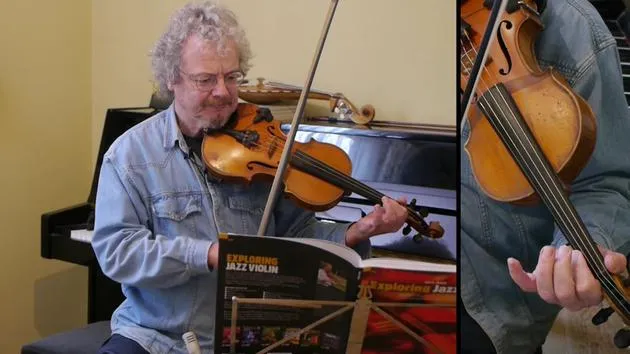
Like the diminished scale, the whole tone scale can use the same fingering on each string, but instead of moving down half a step as you go to the next string, you move up half a step.
Whole Tone Scale Movement
So here is the whole tone scale:
- Up half a position.
- Up half a position.
- Up half a position.
You can do the same thing with scale patterns. Over an augmented chord, you can play a phrase and then transpose it up or down a tone as many times as you like.
Popularity of Descending Patterns
For some reason, descending scales and patterns seem to be more useful and popular than ascending ones.
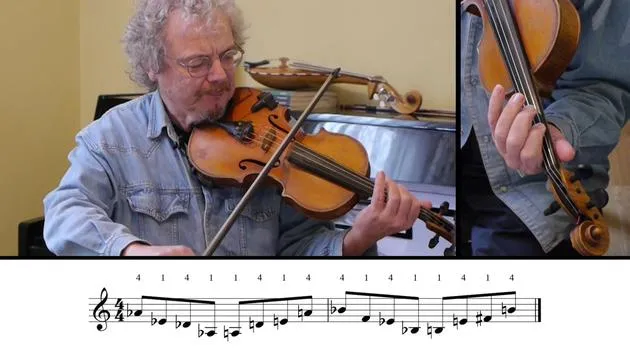
Here's a pattern:
Because it stays in first position, there's no logic to the fingering, so you have to just memorize it.
Use of Augmented Chords
Common Occurrence
Augmented chords are not very common. They usually occur as an alternative to the seventh chord, punctuating the end of a line, a section, or a sequence.
Example
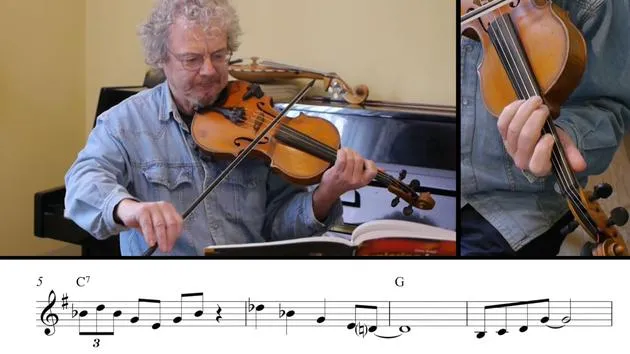
Here's an extended G augmented chord sequence.
28 leçons
1h 46m de leçons vidéo structurées
Fonctions vidéo avancées
Ralentissez, bouclez un passage, suivez la partition
Mobile, tablette et ordinateur
Pratiquez où vous voulez
Satisfaction garantie à 100 %
Garantie remboursement 30 jours
Rencontrez votre guru
Rencontrez votre guru
Chris Haigh est violoniste professionnel depuis 25 ans et possède une expérience dans de nombreux genres. Il a joué sur plus de 75 albums, aux côtés d'artistes comme Alison Moyet, Bob Geldof, All About Eve, Michael Ball, David Soul, Oumou Sangare, The Quireboys, Riverdance, Morcheeba, James Galway et Steps.
Il a joué du swing et du jazz avec The Kimbara Brothers, Diz Disley, Le Jazz, The Hot Club of London et les Quecumbar Allstars, et dirige un ensemble de swing soviétique à sept musiciens, The Kremlinaires.
Chris donne des cours et des ateliers sur la technique du violon jazz et a enseigné le violon jazz aux universités de Middlesex, Brunel et Newcastle ainsi qu'au Truro College. Parmi ses ouvrages figurent neuf livres consacrés au violon, dont The Fiddle Handbook.
Il anime également Fiddling Around (fiddlingaround.co.uk), sans doute la source d'information sur le violon la plus complète et la plus consultée du web.







