



Quartal Harmony Blues Scale

Con
Ron SayerRon Sayer muestra cómo apilar cuartas para formar acordes cuartales y lograr un sonido con toque fusión que puedes usar en un slow blues o un groove funk.
Qué incluye el curso
12 lecciones (1h 27m) · 2 gratis
01. Jam de bienvenida al curso
Lección gratis2:21
02. Usar arpegios en tu blues
Lección gratis8:23
03. Escalas de semitono/tono en tu blues
8:49
04. Arpegios de séptima disminuida en tu blues
10:14
05. Más arpegios de séptima disminuida
10:32

06. Deslizar acordes de 9ª a 6ª en tu blues
8:16

07. Quartal Harmony Blues Scale
Estás aquí4:46
08. Escala de blues con acordes de novena
3:24

09. Acordes de séptima menor y cuartales en tu blues
4:36

10. Arpegios de séptima mayor en tu blues menor
12:48

11. Escalas alteradas en tu blues menor
9:56
12. LECCIÓN EXTRA: Santana - Black Magic Woman
3:16
Transcripción de la lección
Understanding Chordal Harmony
Okay, we're going to look at something called chordal harmony. This posh name essentially refers to a chord that's created by stacking lots of fourths in a row. So, fourth, fourth, fourth, fourth creates our chordal harmony chord.
Why Use Chordal Harmony?
I really like this idea. It's nice to throw in to something like a slow blues or something funky, just to give things a bit of a fusion-esque sound. It's quite reminiscent of Robin Ford's style.
However, it was a guitarist named Greg Cork who actually showed me this nice little lick, so thanks Greg for that!
The Chord Structure
Finding the Chord
We're going to start with the following notes:
- F#
- B
- E
- A
This forms our chord, using A as the root note.
Concentration on Root Notes
What you need to concentrate on is that these notes move from the root note, allowing you to monitor where you're at.
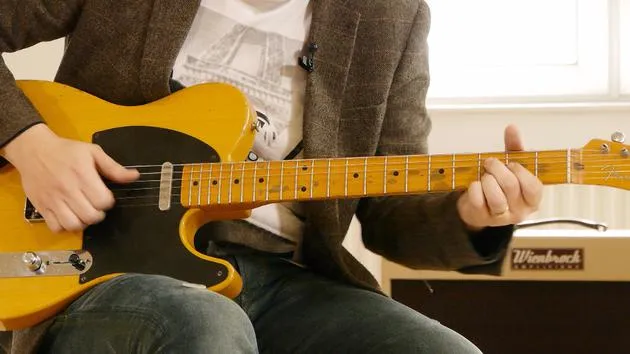
- D ? 4th fret
- G ? 4th fret
- B ? 5th fret
- A ? 5th fret
This forms a nice chord, but take that top note, A. That's the note you need to keep an eye on.
Blending with the Blues Scale
Now, what you're going to do is play a pentatonic scale or a blues scale on your E string. It's up to you. I'm going to play a blues scale because I think it sounds much nicer.
Incorporating the Chord
You're going to include all the other parts of that chord while you play it. So, you're going to play your blues scale and then combine it with the chord:
- Play up to the top of the blues scale.
- Use the chord alongside it.
Once more, here's our pentatonic scale up the E string, combined with our chordal harmony style chord, played over the blues scale.
Extending the Scale
Obviously, you can carry on if you can reach. That's as far as I'm going to go, but you can also go back down.
Practical Application
So, the entire blues scale is using that chord over it. Now, I'm going to give you an example of the sort of things you can do.
What you're trying to achieve is to play over a blues scale while incorporating an entire chord.
Let's Play
I'm going to get the guys to play me a vamp, and I'll show you what we can do over it.
A 1, 2, 3, 4.
12 lecciones
1h 27m de lecciones en vídeo estructuradas
Funciones de vídeo avanzadas
Ralentiza, repite un pasaje, sigue la partitura
Móvil, tablet y ordenador
Practica donde quieras
Garantía de satisfacción 100%
30 días de garantía de devolución
Conoce a tu gurú
Conoce a tu gurú
Ron Sayer es un guitarrista de guitarristas del circuito de blues del Reino Unido y mentor de intérpretes como Oli Brown y Sol Philcox. Ha sido nominado cuatro veces en los British Blues Awards -por el álbum 'Better Side', el single 'Don't Make Me Stay' y su coautoría en 'Here I Am' de Oli Brown- y ha ganado el premio a Guitarrista del Año. En sus cursos desglosa el fraseo, el tono y el feeling que hay detrás del blues eléctrico como solista.







