



Escalas alteradas en tu blues menor

Con
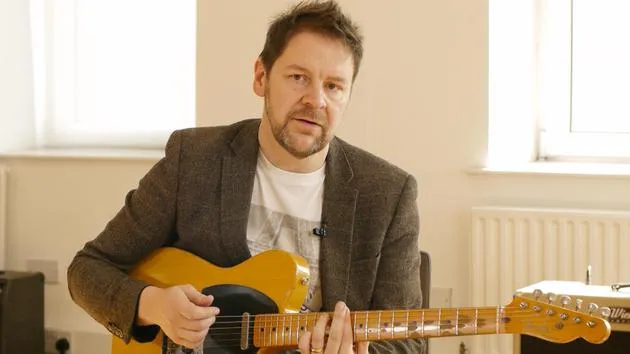
Ron SayerRon Sayer muestra cómo usar la escala alterada sobre el acorde V (dominante) en un blues menor para añadir tensión y color a tus solos.
Qué incluye el curso
12 lecciones (1h 27m) · 2 gratis
01. Jam de bienvenida al curso
Lección gratis2:21
02. Usar arpegios en tu blues
Lección gratis8:23
03. Escalas de semitono/tono en tu blues
8:49
04. Arpegios de séptima disminuida en tu blues
10:14
05. Más arpegios de séptima disminuida
10:32
06. Deslizar acordes de 9ª a 6ª en tu blues
8:16
07. Quartal Harmony Blues Scale
4:46
08. Escala de blues con acordes de novena
3:24
09. Acordes de séptima menor y cuartales en tu blues
4:36
10. Arpegios de séptima mayor en tu blues menor
12:48
11. Escalas alteradas en tu blues menor
Estás aquí9:56
12. LECCIÓN EXTRA: Santana - Black Magic Woman
3:16
Transcripción de la lección
Incorporating the Altered Scale Over the Dominant Chord
Okay, now we're going to have a look at ways we can incorporate the altered scale over the dominant chord.
The Basics
- So basically, when you get to the fifth chord in your 12-bar, or in any particular progression, when you go from A, say, for example, if you're in A minor, when you get to your E, it's an opportunity to use an altered scale.
The Altered Scale
- I'm going to begin by just showing you the altered scale so you can have a practice at it. This is the altered scale, and we're going to start it from E.
Here's how to play the altered scale from E:
-
A String
- 7th fret on the E
- 8th fret on the E
- 10th fret on the E
-
D String
- 6th fret on the D
- 8th fret on the D
- 10th fret on the D
-
G String
- 7th fret on the G
- 9th fret on the G
- 10th fret on the G
-
B String
- 8th fret on the B
- 9th fret on the B
- 11th fret on the B
-
High E String
- 8th fret on the E
- 10th fret on the E
- 12th fret on the E
-
You can obviously come back down, and I'll just quickly show you that:
- 10th on the E
- 8th
- 6th
- and 4th.
-
But we're going to mainly look at it from here because most of the licks we're going to learn start from this particular scale.
Demonstration
What I'll just do is we'll just do a little bit of a demonstration, and I'll show you how that altered scale sounds over the dominant chord.
- If I could just have that little vamp from the root to the fifth.
- 1, 2, 3, 4.
So there's an example of the sort of thing you can do using the altered scale over the dominant chord.
Example Licks
First Example
- I'm going to show you some example licks that you can play over that particular progression.
Lick Breakdown:
- All of these are going to be right on the nose of that E7 chord.
- Whatever happens during the A minor, you can ignore.
- The lick itself is going to start on the E7, and this particular lick goes like this:
- Start on G (10th fret)
- Go to B (9th fret)
- Then to E (8th fret)
- Finally, up to E (12th fret)
- The sequence is:
- 12, 10, 8,
- 9th fret on the B,
- 7, 8 on the E string,
- and then back to your A note on the B string, which is the 10th fret.
Let's just hear it against the backing.
- 1, 2, 1, 2, 3, 4.
Second Example
The next example is going to be slightly more ambitious, covering quite a lot of the strings. It goes like this:
- E String
- 12th fret to the 8th
- B String
- 9th fret
- G String
- 10th fret
- G String
- 9th fret (give it a little bend up and down)
- You can think of this in two halves, actually, that's like your first half of it.
Call and Answer
- There's our first half, and then we're going to go to the second part:
- G (7th fret), passing note
- D (10th fret)
- D (6th fret)
- A String (8th fret)
- D note (5th fret on the A string)
- E (7th fret), add a little bend.
- It's a bit like an answer if you like, to this one.
- So it happens twice, like so.
Let's hear that with some music.
- 1, 2, 1, 2, 3.
Final Example
Our next and final example using the altered scale over the dominant is going to be this one:
- It runs all the way down, back down to the low octave on the A.
- So it resolves again like so.
Breakdown:
- Start on G (9th fret) and give it a little bend (just a half bend, equivalent to the 10th fret).
- Bend down to the 7th fret.
- Run down the altered scale and resolve back on A.
Step-by-Step:
- From there, bend on the ninth to the seventh, then run:
- 10th, 8th, 6th on the D,
- 10th, 8th, 7th on the A,
- and then:
- 10th, 8th, 6th, 4th, up to the 5th to play that A on the final note of that run.
Let's hear that with some music so you can get what it's supposed to sound like.
- 1, 2, 3, 4.
Conclusion
There you go. That's our third and final example.
As with all of these ideas, it's up to you to go and make up your own licks and see if you can do something better. So go away, have a go at that. Learn the scales, learn the arpeggios, and learn everything that you can.
If you can bring those all together in one particular style, you'll be on your way to making sure that your blues playing doesn't sound pedestrian but sounds out there as it should.
12 lecciones
1h 27m de lecciones en vídeo estructuradas
Funciones de vídeo avanzadas
Ralentiza, repite un pasaje, sigue la partitura
Móvil, tablet y ordenador
Practica donde quieras
Garantía de satisfacción 100%
30 días de garantía de devolución
Conoce a tu gurú
Conoce a tu gurú
Ron Sayer es un guitarrista de guitarristas del circuito de blues del Reino Unido y mentor de intérpretes como Oli Brown y Sol Philcox. Ha sido nominado cuatro veces en los British Blues Awards -por el álbum 'Better Side', el single 'Don't Make Me Stay' y su coautoría en 'Here I Am' de Oli Brown- y ha ganado el premio a Guitarrista del Año. En sus cursos desglosa el fraseo, el tono y el feeling que hay detrás del blues eléctrico como solista.







