



¡Una forma pentatónica diferente!

Con
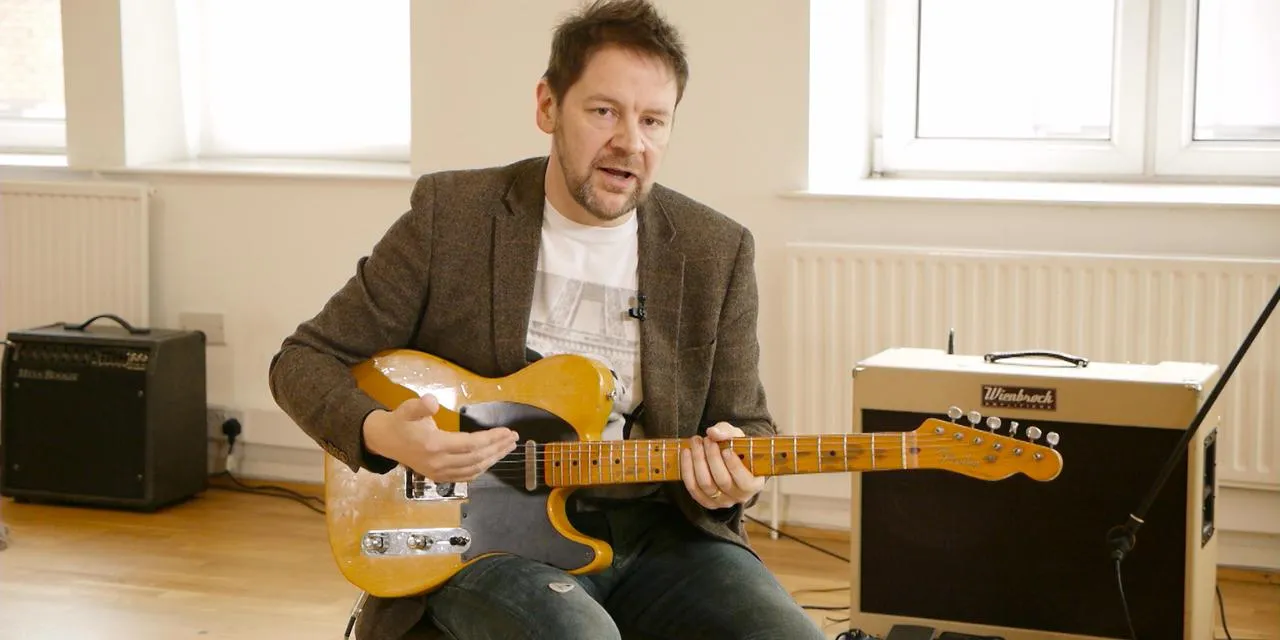
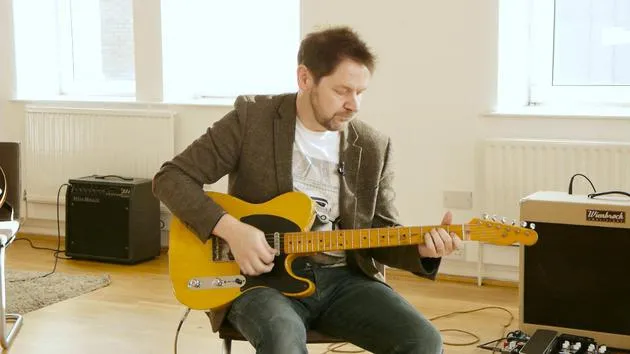
Ron SayerRon Sayer enseña su forma pentatónica preferida, la «escala 2 y 3» —dos trastes en una cuerda y luego tres en la siguiente— para abrir más el diapasón.
Qué incluye el curso
12 lecciones (1h 8m) · 1 gratis
01. Formas de escalas pentatónicas y de blues: un repaso
Lección gratis6:59
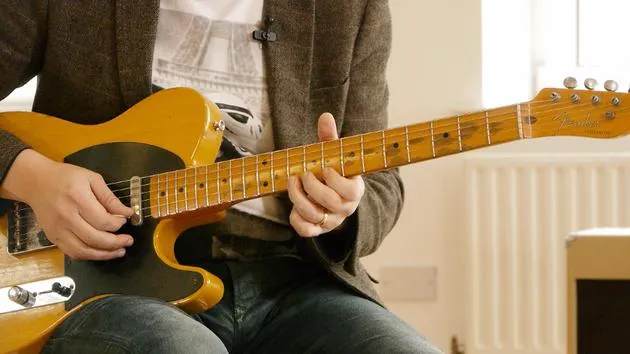
02. ¡Una forma pentatónica diferente!
Estás aquí5:10
03. Añadir la 5ª bemol y la 6ª mayor a la escala pentatónica
3:45
04. Mezclar pentatónicas mayores y menores.
4:41
05. La escala de blues híbrida
4:26
06. Usar double stops
6:35
07. Double stops con notas de paso
4:18
08. Formas de tocar: acordes de séptima
6:26
09. Formas de tocar: Acordes de novena
4:49
10. Acordes chulos
10:42
11. Variaciones de turnaround
5:25
12. RIFF EXTRA: Aprende a tocar Pride & Joy de Stevie Ray Vaughan
5:30
Transcripción de la lección
Music Lesson: Exploring a New Pentatonic Position
Hello again!
Hopefully, you enjoyed the last lesson and you've worked on playing over the A, D, and E using the A minor pentatonic, D minor pentatonic, and E minor pentatonic scales. You should have a feel for that and have learned your pentatonic scales in five different positions to open up the neck.
Introducing the New Pentatonic Shape
What I want to look at now is a different pentatonic position that I really prefer. This shape opens up much more of the neck for me.
The 2 and 3 Scale
I call it the "2 and 3 scale" for reasons that will become clear:
- It uses two frets on one string.
- Then it moves to the next string and uses three frets.
Let's dive in and you'll see how it works.
Position One: The A Pentatonic
-
Start on the third fret of the E string:
- Start on G, then move to A.
-
Move to the A string:
- Play the third fret, fifth fret, seventh fret.
-
Next, the D string:
- Play the fifth fret and the seventh fret.
-
Now, the G string:
- Play the fifth, seventh, and ninth frets.
-
Next is the B string:
- Play the eighth and tenth frets.
-
Finally, the high E string:
- Play the eighth, tenth, and twelfth frets.
This is a normal pentatonic scale, but it encompasses from the third fret right up to the twelfth fret in one position.
Repetition in the Scale
You'll notice that you are repeating yourself three times:
- Play: 3, 5
- 3, 5
- 7
- 3, 5
- 5, 7
- 5, 7
- 9
- 8, 10
- 8, 10
- 12
So, the same thing is played three times, giving you some scope to play in a different way.
Adding Technique
What I want you to do is incorporate hammer-ons and slides into your scale practice to make it more valuable.
- Hammer on and slide:
- Go from 3 to 5.
- Hammer on, hammer on slide.
- Hammer on, hammer on slide.
- Hammer on, hammer on slide.
Once more, you'll find that sounds lovely.
Putting It All Together
Now, let's throw in a 12-bar progression, and I'll show you how you can use that to great advantage before we start adding some more notes to it.
Count In:
- One, two, three, four...
Lovely, thank you!
Conclusion
You can see that even by sticking to a pentatonic scale, the sound can be quite nice. This approach gives you more of the neck to explore, helping you to move beyond that initial box pattern while also providing techniques to use.
12 lecciones
1h 8m de lecciones en vídeo estructuradas
Funciones de vídeo avanzadas
Ralentiza, repite un pasaje, sigue la partitura
Móvil, tablet y ordenador
Practica donde quieras
Garantía de satisfacción 100%
30 días de garantía de devolución
Conoce a tu gurú
Conoce a tu gurú
Ron Sayer es un guitarrista de guitarristas del circuito de blues del Reino Unido y mentor de intérpretes como Oli Brown y Sol Philcox. Ha sido nominado cuatro veces en los British Blues Awards -por el álbum 'Better Side', el single 'Don't Make Me Stay' y su coautoría en 'Here I Am' de Oli Brown- y ha ganado el premio a Guitarrista del Año. En sus cursos desglosa el fraseo, el tono y el feeling que hay detrás del blues eléctrico como solista.







