



Techno – John Scofield (Lección)
Pete Riley analiza la pieza de batería 'Techno' de Rockschool: su complicado backbeat ausente, su ágil tempo de 130 bpm y sus constantes single strokes alternados.
Qué incluye el curso
29 lecciones (2h 45m) · 1 gratis
01. Control – Chase & Status
3:12
02. Law – Richard Spaven
3:11
03. Cry Me A River – Justin Timberlake
3:06
04. Family Affair – Mary J Blige
3:27
05. What Is Hip? – Tower of Power
3:19
06. Techno – John Scofield
3:13
07. Razorhead
3:17
08. Buena Havana
2:38
09. The Bean
3:19
10. Eastern Adventure
Lección gratis2:48
11. Full English Breckerfest
2:35
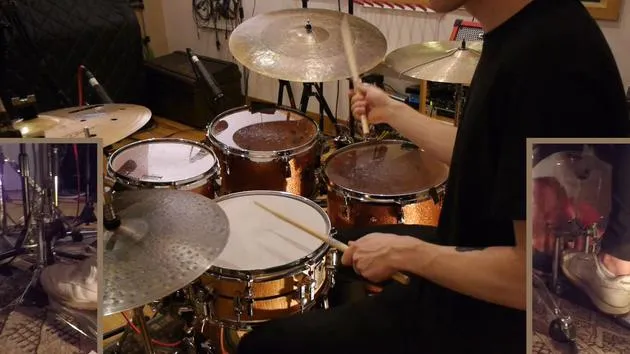
12. Kita's Five
2:59
01. Control – Chase & Status
13:17
02. Cry Me A River – Justin Timberlake (Lección)
15:05
03. Family Affair – Mary J Blige (Lección)
11:59
04. Law – Richard Spaven (Lección)
6:05
05. Techno – John Scofield (Lección)
Estás aquí10:43
06. What Is Hip? – Tower of Power (Lección)
10:54
07. Razorhead
7:23
08. Buena Havana
7:17
09. The Bean
9:50
10. Eastern Adventure
6:01
11. Full English Breckerfest
5:45
12. Kita's Five
7:03
Transcripción de la lección
Music Lesson: John Schofield's "Techno"
Hi! Here we're looking at the John Schofield piece "Techno," which is, as the name suggests, quite a technical piece.
Main Challenges
- Missing Backbeat: The primary challenge in this piece is the missing backbeat in the two-bar pattern on beat two of the second bar, creating an awkward basic pattern.
- Tempo: It's also set at a fairly rapid 130 bpm.
Throughout the piece, we maintain alternating single strokes. You can think of the fundamental pattern as your regular alternating single-stroke 16th note groove. However, the main difficulty arises from the fact that the backbeat in the second bar is replaced by either a space or perhaps a bass drum.
Improvisation Techniques
Drummer Omar Hakeem finds various ways of improvising around this theme:
- Occasionally, you'll hear different accent patterns on the hi-hat.
- Some different syncopations on the bass drum.
- Sometimes, double strokes on the hi-hat.
To give you a sense of that groove and how it works in the track, here are the first two bars played repeatedly to convey the basic feel. Within those first eight bars, you'll notice variations typical of what I play throughout the track:
- Different bass drum movements.
- Various accent patterns on the hi-hat.
- A five-stroke roll appearing in bar five.
Five-Stroke Roll
- The five-stroke roll moves between the "and" of beat two into beat three on the bass drum.
- Slashes through the stems denote they're played as two 30-second notes.
In bar five, we have:
- Open Hi-hats on: Beat 1
- Five-Stroke Roll on: The "end" of beat 2
Challenge: This is all played quite quickly, so those five-stroke rolls will be fast.
Structure of the Piece
I will play the first eight bars, including the two-beat pickup into the piece. At that point, we reach letter A, which is played twice. It's 24 bars long, but we only have the first eight bars notated. For the remaining 16 bars, you're expected to play something based around the grooves that you've heard previously.
Playing Through Letter A
Once again, I'll play those first eight bars. After that, it's up to you to interpret and play for the remainder of the 16 measures that come after that.
- Underlying Theme: As I mentioned earlier, we miss the backbeat on beat two in the second bar.
- The second time around the 24-bar form of letter A includes a one-bar fill, which is the transitional fill leading to the bridge (B section).
Transition to Section B
This is the second time through bar A, where we arrive at the bridge or B section. Here's what we do:
- Right Cymbal: Play eighth notes with a quarter note accented on the bell.
- Hi-Hat: Step the upbeat eighth note with the left foot.
Fill in Letter B
Here's the fill that appears in the last bar of letter B:
- Beat 3: Think of this as a six-stroke roll, but played with a triplet feel (right, left, left, right, right).
Returning to the Original Pattern
At this point, we reach letter C, where we revert to the original two-bar pattern with the 16th notes on the hi-hat. We play that for an additional eight bars before diving into the core of the track.
Drum Solo
The core section is a drum solo based around a two-bar vamp. Here's how to approach it:
- Familiarize Yourself: Start by getting to know the rhythmic figure that the band is playing.
- Orchestration: Try orchestrating that figure on the kit before improvising around it.
I'll demonstrate this by playing that two-bar rhythmic figure on different parts of the kit. The piece concludes with this figure but without the last two 16th notes on beat four, so we end on the last 16th note of beat two.
Final Bars
The last two bars would be played as follows:
- (Demonstrate the rhythmic figure)
Conclusion
This piece is a real challenge, but it's fantastic to have a drum solo to play over, particularly since it has that vamp that keeps going around and around. You can develop your ideas, and with that specific vamp, you find that over-the-bar line quality where ideas might not resolve on the downbeat.
I think you're going to enjoy playing along with the track!
29 lecciones
2h 45m de lecciones en vídeo estructuradas
Funciones de vídeo avanzadas
Ralentiza, repite un pasaje, sigue la partitura
Móvil, tablet y ordenador
Practica donde quieras
Garantía de satisfacción 100%
30 días de garantía de devolución







