



Ritmo y cambios de acordes estándar
Lesson time: (25min 57sec)
Partiendo de la lección anterior, Roy te enseñará ritmo y cambios de acordes estándar. Luego te pondrá a prueba con Rhythm Progression y Jazz Tune.
Course preview
This lesson is part of the course Teach Me Bass Guitar vol.5: Pro-Player Toolkit
Watch a preview of the full course below.
Lesson transcript:
Music Lesson: Rhythm Changes and Standards
Introduction to Rhythm Changes
Let's look at the first tune, and this is one that is based on rhythm changes. The A section of the tune is going to just be that 1625.
- Now, the little turn at the end of that is a B flat for a couple of measures.
- Then we go to the IV chord, which is E flat.
- After that, remember that diminished sound. We can go to that.
What that will allow me to do is lead me up to:
- F
- G7
- C minor 7
- F7
That happens twice. This is a 32 bar form. A lot of standard tunes are 32 bar forms.
AABA Progression
This is an AABA progression:
- A is that 1625 or 1645 that I just talked you through.
- That happens twice.
The bridge is a D7 chord because, remember, we're in the key of B flat. So, the bridge consists of:
- 2 bars of the 3 chord, which is D7.
- The bridge is all dominant seventh chords. Each one of them functions as a dominant chord leading to the next chord.
Bridge Chord Progression
- D7 leads to G7 (which is the next 2 bars of the bridge).
- C7 is the next 2 bars of the bridge.
- F7 is the next 2 bars of the bridge.
Think back to when we were working through the cycle of fourths. It's right there:
- D, G, C, F.
That's right out of the cycle of fourth progression. Once again, that's one of the real tools that you can use to hear a tune, especially hearing these rhythm changes, is to listen for the cycle of fourths when that occurs.
Playing the Progression
Okay, let's take your progression of rhythm changes, and you can follow along on the screen. I'm going to play this through really slowly, 60 beats per minute.
Look for some of those tricks and techniques I was talking about regarding the way that this bass line works.
Here we go:
- 2.
- 1, 2, 3, 3, 4.
Here's the bridge: D7, G7, C7, F.
Alright, we'll do it a little bit quicker, and then we'll go sit in with the band. This is 80 beats per minute.
-
- 1, 2, 3, 4.
Playing with the Band
Now, let's go over to the club and sit in with the band on these rhythm changes.
Now let's take a little bit of what we've been talking about in the Pro Bassist Survival Kit. We're going to go through these rhythm changes.
I'm going to mostly play roots in fifths and roots in thirds as a way to get through. But check it out; I'll be using some approach tones.
Remember, as long as you know where the root is, you can always go a half step above or below and lead into it, sounding like you're playing an absolutely great chromatic jazzy line.
Here we go!
Your Turn
Alright, now it's your turn for a little bit of extra added excitement.
- Try it without the chart first and just use your ears.
- Then, try my line.
Standard Tune Example
Now let's take a set of standard chord changes that you will see in what's called a standard tune.
When I refer to a tune as a standard, it means that it's something that a lot of musicians know. Typically, it's been around for a very long time.
A lot of times, if you're playing with jazz musicians and they say, "let's play a standard," they're looking for a variety of pop tunes or jazz tunes written between about 1930 and 1960.
Here's an example of one. I'm going to play the chord changes. You may know them, but then we'll look at how to do the bass line.
Here's the chord changes.
Now let's do the walking line I would play over that. We're going to do this at quarter note = 60. I'll count you in.
-
- 1, 2, 3, 4.
Alright, now let's try this a little quicker at 80 beats per minute, and then we'll sit in with the band.
-
- 1, 2, 3, 4.
Jamming with the Band
Alright, in a minute we're going to go over and play with the band on this tune. I'll give you a couple of homework assignments.
- Obviously, you can play the line that's going to be on the screen and in the loop section.
- But I want you to try making up your own line to this because that is really what you would be doing in a live performance situation.
Remember, time always trumps note choice. If you can just nail the roots after a time, nail the first note of each chord change consistently, then keep the flow of the quarter notes going.
Listening Skills
Remember, listen to Brian's ride cymbal. That's going to be your key. This will support the band quite a bit, and as you gain more experience, you'll be able to hear and choose more accurate and better notes.
This is a good tune to study for this, and once again, there are many, many standards that you can practice on.
Of course, don't just work with our lessons and loops. At this point, you should be finding a friend who plays guitar, a friend who plays piano, and maybe a drummer.
Try playing through some of these songs and get a feel for it.
Warm-Up
So, to warm you up for all that, let's go to the club.
Now we're going to try the same tactics with faking a tune that's kind of in the standard vocabulary.
I just want you to listen to my line. What I'm going to be doing is mostly using scale tones and some of the approach tones.
The main thing I want you to do is to try to catch the chord sounds as I'm playing this through.
Your Turn Again
Here we go.
Alright, now it's your turn. Remember, you might want to try coming up with your own line just using your ear before you try playing the line that I played.
Conclusion
Good luck!
Alright, now you've had a little experience in how to fake a tune and jam with a band playing standards.
Once again, just like I was saying before we went to that last jam session, practice with your friends. Work on this; it's going to take some time.
To tell you the truth, I've been playing for a very long time, and I still study these songs. There's just a lot of information and knowledge you can gain from learning how to play this well.
Stretching
Alright, we'll do a little bit of stretching.
Okay, everybody stretch. I'm going to do this little bend-back thing that I've been doing.
Remember, I'm just kind of lightly grabbing the fingers, pulling them back.
Upcoming Lessons
On lesson 18, we're going to look at some world music styles.
In particular, we'll study:
- Samba, which is a Brazilian groove
- An Afro-Cuban groove called a salsa groove
- We'll also go to the island of Jamaica and study reggae.
So stay tuned!
About the instructor
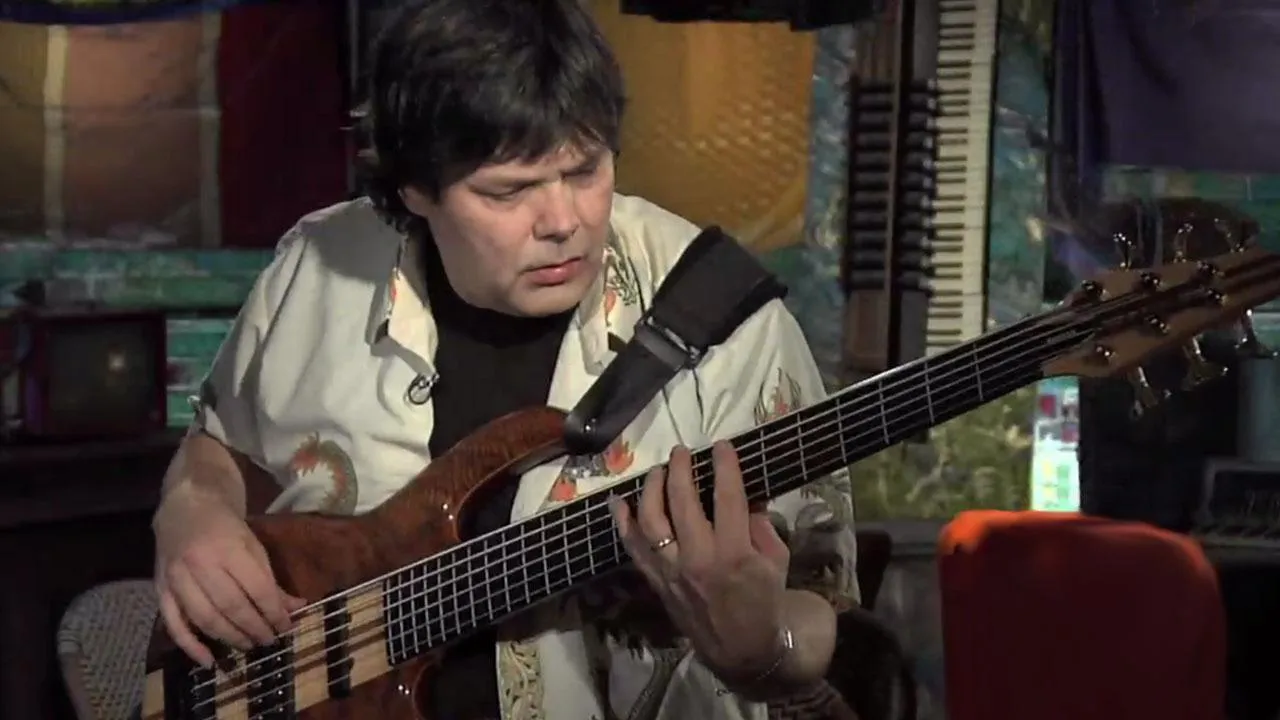
La carrera de Roy Vogt abarca una extraordinaria variedad de escenarios, desde el Headbanger's Ball de MTV, el Montreux Jazz Festival y el Montreal Jazz Festival hasta el London Palladium, el Grand Ole Opry y el Kremlin. Del punk al funk, de la sencillez del country y el blues a la complejidad del HyperJazz y el World Beat, lo ha tocado todo. Roy fue la primera persona en obtener un máster en Interpretación de Bajo Eléctrico, en la prestigiosa escuela de música de la University of Miami, y lleva más de cuarenta años dedicado al arte del bajo. Ha sido mentor de decenas de profesionales de éxito, incluido el legendario Willie Weeks. Eléctrico, sin trastes, contrabajo - lo que quieras: si toca notas graves y tiene cuerdas, Roy es un maestro tocándolo, y enseñando a otros a hacer lo mismo. A lo largo de su carrera de cuatro décadas, Roy ha grabado o actuado con una asombrosa lista de estrellas de primer nivel, entre ellas Larry Coryell, Victor Wooten, Dave Weckl, Tom Scott y la LA Express, Chester Thompson, Miroslav Vitous, Glen Campbell, BJ Thomas, Chet Atkins, Engelbert Humperdinck, Dickey Betts, Tony Joe White, Charlie Daniels, Jerry Reed y muchísimos más. Roy lleva treinta años enseñando a nivel universitario. Desde 1983 ocupa la cátedra de Bajo en la prestigiosa Belmont University (Nashville, TN), una de las poquísimas escuelas que ofrece un programa de grado en música comercial diseñado para convertir a los estudiantes en músicos profesionales que trabajen en lo más alto de la industria. Los alumnos de Roy han girado y grabado con estrellas notables como Trisha Yearwood, Faith Hill, Little Texas, Michael W. Smith, Lady Antebellum, Chick Corea, Sir Tom Jones, Blood Sweat and Tears, Yanni e incontables iconos más de la música. Su serie Teach Me Bass Guitar te acerca ese mismo enfoque de nivel universitario, llevándote desde un arranque rápido para principiantes absolutos (vol. 1), pasando por los fundamentos del ritmo (vol. 2), la búsqueda de tu propio estilo (vol. 3) y una musicalidad seria (vol. 4), hasta un kit de herramientas de intérprete profesional (vol. 5), para que desarrolles habilidades reales paso a paso. read more