



Hardware y mantenimiento: bajos, ecualización, efectos
Lesson time: (34min 27sec)
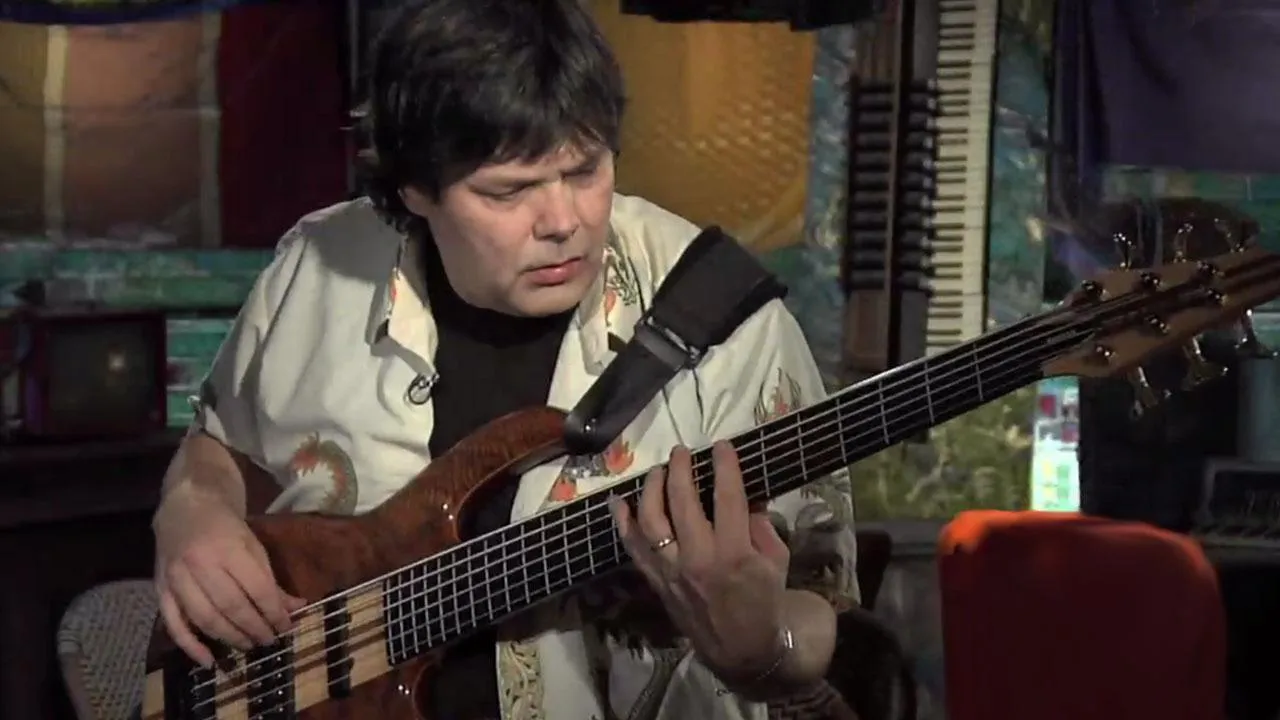
En esta última lección, Roy Vogt cubre la parte del equipo del bajo: bajos de 4, 5, 6 y 7 cuerdas, ecualización, efectos como filtros de envolvente y flangers, y el mantenimiento básico.
Course preview
This lesson is part of the course Teach Me Bass Guitar vol.5: Pro-Player Toolkit
Watch a preview of the full course below.
Lesson transcript:
Lesson 20: Exploring Musical Options
Introduction
Alright, here we are at lesson 20, the final lesson of your course. Hopefully, you've learned a lot from Teach Me Bass Guitar. I certainly enjoyed teaching it. For right now, I want to explore some of the other options you have musically. We'll start with effects, then move on to different bass guitars, the sounds they create, and how they can be used.
Effects Overview
Envelope Filter
Right now, I'm using an effect called an envelope filter. This effect causes a sweep of the tone quite quickly, giving it that "wow" sound, almost like I'm talking.
Flanger
Next, let's look at a couple of other effects, starting with a flanger.
- It makes everything a little deeper.
- It adds a filter sweep effect, which sounds great with a very bright sound.
- This effect is commonly used in funk and rhythm and blues.
There's a famous bass line that uses this.
Phase Shifter
Now, we'll move to the granddaddy of all effects: the phase shifter.
- You can hear some of these sounds on old Beatles records, created back in the '60s with tape machines.
- The phase shifter behaves like a little brother to the flanger, lacking its extremity but still producing a notable "whoosh" around the note.
This might be a good one for our little two-handed tapping exercise from earlier.
Octave Divider
For those of you interested in heavier sounds, we have the octave divider, sometimes called a suboctaver.
- What it does is double the bass note down an octave.
- There are several companies that manufacture these effects.
Distortion Pedals
There are also other devices, such as distortion pedals. While I don't have one here, I can overdrive a preamp section to get a very close approximation of this type of sound. Here's what a distortion pedal might sound like:
- Hear that clipping? That's the "dirty" sound.
- It's particularly useful if you're playing in metal bands.
Different Types of Bass Guitars
Fretless Basses
Now, let's look at some different basses.
- As you notice, there's something missing from this bass: it's fretless, meaning it has no frets on the neck.
- My tone is created by pressing my hand into the fingerboard, giving it a different sound compared to a fretted bass.
The challenge is playing it in tune.
Many fretless instruments have little notch markers, helping you sight in. This particular bass has fret markers on the top of the neck, allowing for some guidance.
- If I play higher up, over the fingerboard, I get a raspier sound often referred to as the "mwa" sound.
- You'll hear this sound on recordings by Don Henley with Pino Palladino and in Joni Mitchell's work with Jaco Pastorius.
It has a very characteristic vibe.
Playing in Tune Exercise
Here's a quick exercise for playing in tune with a fretless bass. I'll walk a G scale up the neck while checking against open strings:
- G - No problem; we're on an open string.
- A - Check it against the fifth, giving a perfect fifth interval.
- B - Check it against the open E.
- C - Check it against the A; a minor sound.
- D - Can check it against the string below, the E.
- E - Can check it against the open A or E (two octaves up).
- F# - Check it with chords from what we did in "Stanley's Secret."
- G - Finish the scale.
Advantages of Fretless Basses
Why Choose Fretless?
- The main advantage of a fretless bass is the expression you can achieve by sliding from note to note, approaching the sound of an upright bass.
"It has its own little vibe."
Among other things, you can hit bell tones, which are harmonics that you can also play on fretted bass guitars.
Closing on Fretless vs. Fretted
Although you can do some bending and sliding on a fretted bass, it doesn't quite have the same feel. I usually opt for fretless when I'm going for a broader tone, especially effective in ballads.
Five and Six-String Basses
Moving to Five-String Basses
Next, we explore five-string basses.
- If E, A, D, and G aren't enough, a low B string allows for a wider range.
- This can help emulate a keyboard bass.
One appealing aspect of a five-string bass is using the L-shape to cover two octaves easily with one shift.
Fretless Cousin
Now, let's take a look at the fretless cousin of the five-string bass.
- It has fret lines, which help you play in tune by pressing right behind the frets.
- Different playing positions, like near the back pickup or over the fingerboard, yield different tones.
Adding a String: Six-String Basses
What about six-string basses?
- This model typically has a low B, E, A, D, G, and a high C.
- Using the L shapes aids in achieving three-octave coverage.
Remember those three-note voicings? They sound cleaner when played higher up the neck.
The Seven-String Bass
Introducing the Seven-String
Now, this is a seven-string bass guitar.
- It starts with the low B of a five-string and adds a high C and a high F.
- This can produce a wide array of pitches without much movement on the neck.
Closing Thoughts on Instruments
While we've explored this "toy store" of bass guitars, remember:
"It's not the tools, it's you as a musician..."
Care and Feeding of Your Bass Guitar
Instrument Setup
At the Groove Chateau, I want to share a few tips on keeping your bass in tune and comfortable.
- Most instruments come un-set up, often with a bridge that has hex nuts allowing you to adjust the action.
- Remember: "Righty tighty, lefty loosey."
Adjusting Action
To adjust the action:
- Lowering a string too much can cause it to fret out, producing unwanted clattering.
Truss Rod Adjustment
One thing to note: a bass guitar neck has a certain degree of relief.
- You can adjust the neck tension using a truss rod adjuster. But, take care not to adjust it more than a quarter turn at a time.
Conclusion
Your strings should be changed when they feel too dead. Depending on your playing style and how much you sweat, this can range from a month to six months.
Remember:
- This course is just the beginning.
- Explore and learn about music and this wonderful instrument.
"Always feed the music within you, and it will come back out."
In closing, I wish you in-tune strings, good travels, and God bless!
About the instructor
La carrera de Roy Vogt abarca una extraordinaria variedad de escenarios, desde el Headbanger's Ball de MTV, el Montreux Jazz Festival y el Montreal Jazz Festival hasta el London Palladium, el Grand Ole Opry y el Kremlin. Del punk al funk, de la sencillez del country y el blues a la complejidad del HyperJazz y el World Beat, lo ha tocado todo. Roy fue la primera persona en obtener un máster en Interpretación de Bajo Eléctrico, en la prestigiosa escuela de música de la University of Miami, y lleva más de cuarenta años dedicado al arte del bajo. Ha sido mentor de decenas de profesionales de éxito, incluido el legendario Willie Weeks. Eléctrico, sin trastes, contrabajo - lo que quieras: si toca notas graves y tiene cuerdas, Roy es un maestro tocándolo, y enseñando a otros a hacer lo mismo. A lo largo de su carrera de cuatro décadas, Roy ha grabado o actuado con una asombrosa lista de estrellas de primer nivel, entre ellas Larry Coryell, Victor Wooten, Dave Weckl, Tom Scott y la LA Express, Chester Thompson, Miroslav Vitous, Glen Campbell, BJ Thomas, Chet Atkins, Engelbert Humperdinck, Dickey Betts, Tony Joe White, Charlie Daniels, Jerry Reed y muchísimos más. Roy lleva treinta años enseñando a nivel universitario. Desde 1983 ocupa la cátedra de Bajo en la prestigiosa Belmont University (Nashville, TN), una de las poquísimas escuelas que ofrece un programa de grado en música comercial diseñado para convertir a los estudiantes en músicos profesionales que trabajen en lo más alto de la industria. Los alumnos de Roy han girado y grabado con estrellas notables como Trisha Yearwood, Faith Hill, Little Texas, Michael W. Smith, Lady Antebellum, Chick Corea, Sir Tom Jones, Blood Sweat and Tears, Yanni e incontables iconos más de la música. Su serie Teach Me Bass Guitar te acerca ese mismo enfoque de nivel universitario, llevándote desde un arranque rápido para principiantes absolutos (vol. 1), pasando por los fundamentos del ritmo (vol. 2), la búsqueda de tu propio estilo (vol. 3) y una musicalidad seria (vol. 4), hasta un kit de herramientas de intérprete profesional (vol. 5), para que desarrolles habilidades reales paso a paso. read more