Progresiones de acordes y "fingir" un tema
Con
Roy VogtRoy Vogt te muestra cómo 'sacar' un tema de oído, usando progresiones de acordes estándar como el 2-5-1 para construir una línea de bajo sobre la marcha.
Qué incluye el curso
5 lecciones (2h 17m) · 1 gratis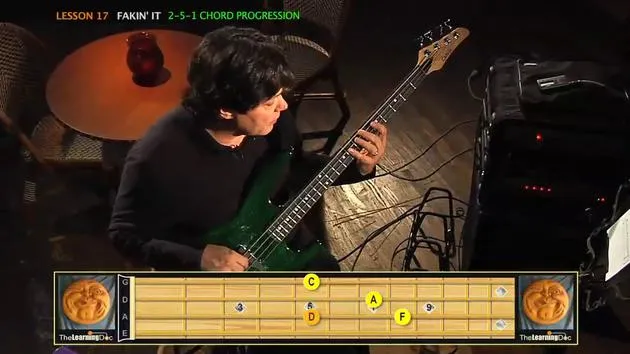
Transcripción de la lección
Music Lesson: Understanding Chord Progressions
Okay. Now, a lot of times when I'm working in a live music situation, I'll have to hear a chord progression and come up with a bass line on the spot. This is what's called faking a tune. It sounds like it's going to be a really difficult thing, but there are a few formulas that we can use to help hear the chord progressions.
These are called standard chord progressions, and they really do help you organize these tunes.
The 2-5-1 Progression
The first one is what is called a 2, 5, 1 progression.
- If we go back to our modal section, there was a two chord on the C, which was the D minor seven.
- There's your diatonic two, here's your diatonic five, and then here's your diatonic one: D minor seven, G seven, C major seven.
Common Use
A lot of standard tunes utilize this progression over and over again. For example, I just played:
- D minor 7
- G7
- C major 7
- C minor 7
- F7
- B flat major 7
- B flat minor 7
- E flat 7
- A flat major 7
- A flat minor 7
- D7
- G flat major 7
Playing Tips
When I start hearing those progressions, I don't really have to grab the third. If I can hear it, great! But one of the things I can do is just play roots and fifths.
- That's a good way to kind of get around this.
- If I have a chance to hear the third, I can put that in as well.
- Once again, just get used to hearing the two, five, ones, and so forth.
Turnaround Progressions
There are two different kinds of progressions that we call a turnaround that are used in different tunes.
1-6-4-5 Progression
One of them is called a 1, 6, 4, 5 progression.
- If you listen to a lot of 50s and 60s rock and roll, you'll hear this one.
- Essentially, a 1, 6, 4,5 progression in the key of C would be:
- C major (1)
- A minor (6)
- F major (4)
- G major (5)
Adding Sevenths
If I want to add sevenths to that:
- C major 7
- A minor 7
- F major 7
- G7
Chord Sound
Here's how the chords sound. That's how you might hear it in a 50s rock tune. A lot of times, you can hear that, and within a couple of passes, you'll be able to kind of figure out where things are.
Positioning with Piano Players
If there's a piano player, a lot of times I'll try to sit close to where his left hand is. This is particularly useful if the piano player is more familiar with the tune than I am; he can kind of feed me the roots.
- It's also a good idea to get some familiarity with the piano keyboard so that you can read the notes and then match once again.
- You can start with just the roots and you can add approach tones, particularly if you're walking.
1-6-2-5 Progression
Now, there's a cousin of this that you see more of in standard tunes. This is called a 1, 6, 2, 5 progression.
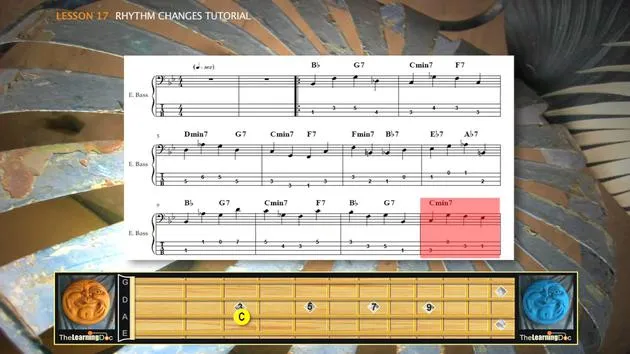
- I'll play one in B flat.
- This is sometimes called a rhythm changes progression because it's based on an old Gershwin tune called "I've Got Rhythm."
- Many jazz musicians use this as a standard progression for their tunes.
Examples
You get tunes like:
- The Theme by Miles Davis
- Olio by Sonny Rollins
- A lot of the 30s and 40s pop tunes as well
Walking Through Chords
If I'm going to be walking through that, a safe choice immediately, if I can hear the 1, 6, 2, and 5, would be to either play just roots.
- You want to break up the rhythm to avoid sounding repetitious.
- With a swing line, you want to randomize that stuff.
Adding Complexity
The next step here would be to add the fifth, followed by adding an approach tone (half step, half step, half step).
The 1, 6, 2, 5 can either be:
- A major to A minor: so it's like one major (B flat major seven) to six minor (G minor seven) to a two minor (C minor seven) to an F7.
Secondary Dominants
You can also use what would be called a secondary dominant.
- A secondary dominant is just kind of a five chord that leads to another chord.
Example
If I go from a B flat major 7 to a G7, that G7 is really functioning as a V chord of the C minor 7.
Even though we're still in the key of B flat, you would have: G7, C minor 7, and F7.
5 lecciones
2h 17m de lecciones en vídeo estructuradas
Funciones de vídeo avanzadas
Ralentiza, repite un pasaje, sigue la partitura
Móvil, tablet y ordenador
Practica donde quieras
Garantía de satisfacción 100%
30 días de garantía de devolución
Conoce a tu gurú
Conoce a tu gurú
La carrera de Roy Vogt abarca una extraordinaria variedad de escenarios, desde el Headbanger's Ball de MTV, el Montreux Jazz Festival y el Montreal Jazz Festival hasta el London Palladium, el Grand Ole Opry y el Kremlin. Del punk al funk, de la sencillez del country y el blues a la complejidad del HyperJazz y el World Beat, lo ha tocado todo.
Roy fue la primera persona en obtener un máster en Interpretación de Bajo Eléctrico, en la prestigiosa escuela de música de la University of Miami, y lleva más de cuarenta años dedicado al arte del bajo. Ha sido mentor de decenas de profesionales de éxito, incluido el legendario Willie Weeks. Eléctrico, sin trastes, contrabajo - lo que quieras: si toca notas graves y tiene cuerdas, Roy es un maestro tocándolo, y enseñando a otros a hacer lo mismo.
A lo largo de su carrera de cuatro décadas, Roy ha grabado o actuado con una asombrosa lista de estrellas de primer nivel, entre ellas Larry Coryell, Victor Wooten, Dave Weckl, Tom Scott y la LA Express, Chester Thompson, Miroslav Vitous, Glen Campbell, BJ Thomas, Chet Atkins, Engelbert Humperdinck, Dickey Betts, Tony Joe White, Charlie Daniels, Jerry Reed y muchísimos más.
Roy lleva treinta años enseñando a nivel universitario. Desde 1983 ocupa la cátedra de Bajo en la prestigiosa Belmont University (Nashville, TN), una de las poquísimas escuelas que ofrece un programa de grado en música comercial diseñado para convertir a los estudiantes en músicos profesionales que trabajen en lo más alto de la industria. Los alumnos de Roy han girado y grabado con estrellas notables como Trisha Yearwood, Faith Hill, Little Texas, Michael W. Smith, Lady Antebellum, Chick Corea, Sir Tom Jones, Blood Sweat and Tears, Yanni e incontables iconos más de la música.
Su serie Teach Me Bass Guitar te acerca ese mismo enfoque de nivel universitario, llevándote desde un arranque rápido para principiantes absolutos (vol. 1), pasando por los fundamentos del ritmo (vol. 2), la búsqueda de tu propio estilo (vol. 3) y una musicalidad seria (vol. 4), hasta un kit de herramientas de intérprete profesional (vol. 5), para que desarrolles habilidades reales paso a paso.