



El bajista profesional: conseguir un sonido ajustado en el estudio
Lesson time: (38min 51sec)
Roy Vogt muestra lo que hace falta para grabar una pista de bajo ajustada en un estudio de Nashville, desde tocar con un clic hasta escribir los temas con el Nashville number system.
Course preview
This lesson is part of the course Teach Me Bass Guitar vol.5: Pro-Player Toolkit
Watch a preview of the full course below.
Lesson transcript:
Country Music and Nashville Recording Studios
All right, well, we're going to take a look at an area of the country and a style of music that I work in often, and that is country music and working in the Nashville recording studios. So, we'll talk a little bit about that.
Warm-Up
First off, let's just warm up. All I'm going to do here is take the spider exercise that we did a little earlier.
- 1, 2, 3, 4.
- See, it's just diagonal across.
- 1, 2, 3, four.
- 1, 2.
- 1, 2, 3, Four.
- 1, 2, 3.
As I walk across the neck, everything's getting a little closer together in terms of the fret spacing, but a little farther apart in terms of the width of the neck. So you have two different sets of stretches going.
This is about the most technically advanced thing we're going to play in this chapter. But remember, playing successful sessions and successful country bass is not about how fast you can play; it's about where you put the notes.
Timing
The first thing we're going to do is look at the issue of timing. If I look at a typical drum pocket that a Nashville drummer might play, notice that the bass drum is on one and three. This would be real old school. Now, the whole idea of this is to place those half notes in the best place possible.
- If I place them too far ahead, it starts feeling really funny and won't settle in.
- So, what you have to do, I feel, is hear the attack of the bass drum and put your note slightly behind it.
Here's the difference:
- That's slightly behind.
- Here's on top.
See how different it feels? Let's go back to behind. That's really important. I've put together some timing exercises that have their own sets of challenges. These are good ways to really focus on your timing.
Timing Exercises
First Exercise:
- This first one has just one event happening: a kick drum on four.
- Let me show you how this works:
- One.
- One, two, three, four.
- One, two, three, Four.
- One, two, three, 4.
See, that way, if I push or pull, I'll lose where the kick is. I'm going to try a couple of different feels with this.
- Example:
- 1 and 2 and 3 and 4.
Sometimes what you have to do is just play the pulse that you're going to play and try to feel the subdivisions, like when we worked on the Rocco Prestia line.
Increasing Difficulty
Okay, let's make that a little more difficult. What I'm going to do now is put beat four on the second measure.
- 1, 2, 3, 4, 5, 6, 7, 8.
- 1, 2, 3, four.
-
- 1, 2, 3, Four.
- 1, 2, 3,4.
- 1, 2, 3, FOUR.
- 1, 2, 3, FAce.
- 1, 2, 3, FIle.
There it is. Oops, caught me.
Now, if you're working with a regular metronome at home, you can do little patterns like practicing on the "and" of one. This works well if you're trying to get tempos locked in on fairly busy patterns.
Practice with the Metronome
- Example:
- 1 and 2 and 3 and 4, and
- 1, 2, 3, 4.
- 1,
- 1 and 2 and 3 and 4.
Let's speed that up:
- 1, 2, 3, 4.
Now, basically, you can take anything that we've worked on up to this point and practice all your particular eighth and sixteenth note lines with a click on the upbeat. A lot of times, if all you do is practice with it on the downbeat, you get overly dependent on the click.
Internal Sense of Time
Those little exercises I was doing with dropping the beat, where I was responsible for the time for four beats or for eight beats, those are really important in developing your internal sense of time. You have to be able to play well with others, and you also have to be the one person who can be the Rock of Gibraltar. This is especially true if you're doing a country session.
Nashville Number System
Now let's look at "Both Kinds of Music."
What I want to show you are those little Arabic numbers that you're looking at and going, "What on earth is this?" Those are called Nashville number chart numbers. Consequently, we need to discuss how this came about and why it works.
We'll hear and see a demonstration of this later with my friend Janelle Mosser. The Nashville number system was developed in the 50s by a vocal group called the Jordanaires. You may be aware of them from singing background on the Elvis Presley records.
History of the Nashville Number System
They were one of the most recorded gospel quartets that did session singing in Nashville and indeed, in all history. They were doing so many recording sessions that they developed a system to learn tunes quickly.
Here's how the system works:
- Steps of the scale (C Major):
- C, D, E, F, G, A, B, C.
- Each step of the scale becomes an Arabic number:
- 1, 2, 3, 4, 5, 6, 7.
The assumption is that any chord is going to be major unless I specifically state that it isn't.
Diatonic Harmony vs. Nashville System
Notice when we did diatonic harmony, it doesn't work that way. My personal theory for why they do this is that if you think about the primary composing instrument for jazz and Tin Pan Alley-type songs, and classical music as well, it's the piano.
If you play piano, there are natural formulas that show up repeatedly with harmony, like:
- 1, 2 minor, 3 minor, 4, 5 dominant 7, 6 minor, 7 half diminished, etc.
With Nashville, the primary composing instrument is guitar.
Application of the Nashville Number System
So, if we're playing "Both Kinds of Music" in the key of C, the first four bars would be:
- 1 (C), 5 minor (G minor for two beats), 1 (C for two beats), 4 (F for four beats), 5 (G).
The typical way the session players write their own charts is in groups of four measures.
Example of Call-Out
If I was calling this progression out to someone, I would say, "Okay, first four bars, 1 5 minor split, 1 4 5."
This tells them:
- C chord (1),
- G minor chord (5 minor for two beats),
- C chord (1 for two beats),
- F chord (4 for four beats),
- G chord (5).
Changing Keys
If the singer thinks that's too high and wants to change it to B flat, all I do is plug in my numbers to a B flat scale.
- The numbers would be: 1 (B flat), 5 minor (F minor), 1 (B flat), 4 (E flat), 5 (F).
The reason why the Jordanaires and other country players adopted this system is that you can play a tune and adjust it to whatever key the singer needs. You can also learn the song quickly, and you see the harmonic function.
Structure of the Song
I like it when recording because I can see the form of the tune. This way, if I see the numbers on the chart, I can visualize where the bridge and solo are going to be.
In many successful songs, including pop and country, this structure takes advantage of the Golden Mean, where about two-thirds of the way through the song, there should be the most excitement.
Listening Practice
I encourage you to listen to your music collection and pay attention to how the bass players work, especially in country songs.
You'll often find two places where the bass player plays a lot:
- At that golden mean.
- During breakdowns where there might just be drums and vocals or one instrument.
Question for Clarification
Let me ask you a question: if you're dealing with a piece in which C is the root, and you want to go to the five minor unit just by counting up C, D, E, F, G, that's five.
What makes it the five?
Yes, it's all based on scale tones. When I first moved to Nashville, I noticed they call certain chords by their numbers (e.g., in the key of C, they call an E flat an A flat and a B flat a 7 flat).
In classical and jazz music theory, I think of that as a flat three chord and a flat seven chord. However, I realized the numbers substitute for the pitch.
Conclusion of the Lesson
In C minor, one is C, two is D, three is E, four is F, five is G, six is A, and seven is B. And then for eight, you just go back to one.
Let's play this song with just the click, and I'll demonstrate a typical line. I'm going to play nothing but half notes.
When I'm playing with Brian, I will listen to his bass drum. In this country style, reminiscent of traditional country in the vein of Merle Haggard, I'll primarily play half notes.
Bob Moore's Formula
Bob Moore, the most recorded bassist in history and a Nashville session player, suggested that when going from a I chord (C), double the root. When I go to the IV chord from the I chord, my fifth will be that C.
- So, when moving from the IV to the I, double the root for clarity on the chord change.
Final Run-Through
Now, let's look at the changes for both kinds of music.
- Start with C,
- Then to G minor,
- Then to C7,
- Followed by F and G.
This is critical for communication in a session. Let's play this one more time.
Preparing to Play with the Band
I encourage you to follow the chords and my baseline along with the numbers. Here we go.
1, 2, 1, 2, 3, 4.
Now let's head to the club and, as we say in Nashville, pick with the band.
Wrap Up
Great job, guys! Now, it's your turn. Remember, this may sound simple, but playing it in the pocket isn't. Good luck!
Now, let's work with Jonel Mosser. We'll prepare a chart, I'll call the numbers, and the band will play.
Song Example
Let's hear that tune! I can only play it in G, but we'll have to transpose it. Here we go.
“Never got along too well with Mom, I guess I was the child of a dream that never did come true. Must have made my mama blue, that I'm all that's left here to be seen. I'm all that's left of Mama's dream.”
[Continue with the song lyrics]
Conclusion
I hope that the footage with the band working on Jonel's song shed some light on how this system works. It's an easy one once you get into it and works well when you have to learn a lot of material quickly.
Let's do a couple of stretches now and cool down. I'll join you back at Chateau Groove for a wrap-up. See you soon!
About the instructor
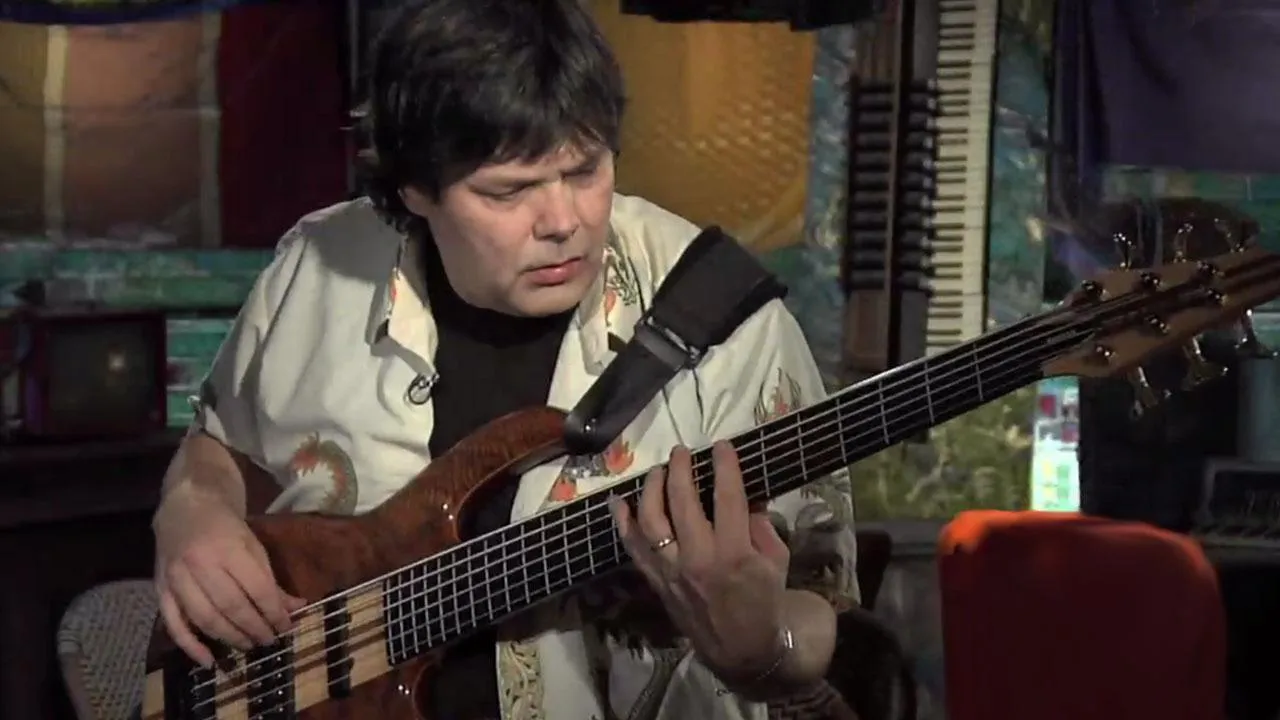
La carrera de Roy Vogt abarca una extraordinaria variedad de escenarios, desde el Headbanger's Ball de MTV, el Montreux Jazz Festival y el Montreal Jazz Festival hasta el London Palladium, el Grand Ole Opry y el Kremlin. Del punk al funk, de la sencillez del country y el blues a la complejidad del HyperJazz y el World Beat, lo ha tocado todo. Roy fue la primera persona en obtener un máster en Interpretación de Bajo Eléctrico, en la prestigiosa escuela de música de la University of Miami, y lleva más de cuarenta años dedicado al arte del bajo. Ha sido mentor de decenas de profesionales de éxito, incluido el legendario Willie Weeks. Eléctrico, sin trastes, contrabajo - lo que quieras: si toca notas graves y tiene cuerdas, Roy es un maestro tocándolo, y enseñando a otros a hacer lo mismo. A lo largo de su carrera de cuatro décadas, Roy ha grabado o actuado con una asombrosa lista de estrellas de primer nivel, entre ellas Larry Coryell, Victor Wooten, Dave Weckl, Tom Scott y la LA Express, Chester Thompson, Miroslav Vitous, Glen Campbell, BJ Thomas, Chet Atkins, Engelbert Humperdinck, Dickey Betts, Tony Joe White, Charlie Daniels, Jerry Reed y muchísimos más. Roy lleva treinta años enseñando a nivel universitario. Desde 1983 ocupa la cátedra de Bajo en la prestigiosa Belmont University (Nashville, TN), una de las poquísimas escuelas que ofrece un programa de grado en música comercial diseñado para convertir a los estudiantes en músicos profesionales que trabajen en lo más alto de la industria. Los alumnos de Roy han girado y grabado con estrellas notables como Trisha Yearwood, Faith Hill, Little Texas, Michael W. Smith, Lady Antebellum, Chick Corea, Sir Tom Jones, Blood Sweat and Tears, Yanni e incontables iconos más de la música. Su serie Teach Me Bass Guitar te acerca ese mismo enfoque de nivel universitario, llevándote desde un arranque rápido para principiantes absolutos (vol. 1), pasando por los fundamentos del ritmo (vol. 2), la búsqueda de tu propio estilo (vol. 3) y una musicalidad seria (vol. 4), hasta un kit de herramientas de intérprete profesional (vol. 5), para que desarrolles habilidades reales paso a paso. read more