



Spindrift (lección)

Lesson time: (9min 5sec)
Al Petteway enseña su tema de aire celta 'Spindrift' en guitarra acústica con afinación DADGAD, empezando por ese lick inicial.
Course preview
This lesson is part of the course Celta, blues y más allá
Watch a preview of the full course below.
Lesson transcript:
Lesson Overview: Exploring Dad Gad Tuning and the Tune "Spindrift"
Hi, I'm Al Pettaway, and I hope you enjoyed that performance. It's interesting to me that you can play all these different styles of music with one tuning. That's not standard tuning, and I'll be showing you a little bit about that.
Understanding Dad Gad Tuning
Dad Gad Tuning is my standard tuning. I'll start off by showing you a little bit about "Spindrift." This tune was inspired by the Celtic tradition, although it gets a little bit of that American flavor in it too.
Getting Started with "Spindrift"
Most people want to learn right off the bat, they want to learn that lick at the very beginning. It's actually way easier than it appears. Let's dive into that lick:
- Key: D Major
- The very beginning melody includes a roll across the strings to create a sweet sound.
- Followed by a pull-off and then another pull-off.
Note: If you've played pull-offs before, they're not that difficult. You just need to decide which direction you want to go:
- Some people push up, while others pull down.
- It depends on your playing style and comfort level.
Personally, I like to go down, but that's just my preference. You'll notice that I incorporate a lot of pull-offs and hammer-ons, which help to split the notes between my left hand and right hand.
Technique Breakdown
Here's that lick again:
- Visual Observation: People often comment that it looks like I'm not moving, and that's because I really don't move my left hand much.
- Movement:
- I stretch up to the same note, stretch down, and pull off again.
- I then play a little arpeggio: thumb, first, second, third, second, first, thumb.
Practice Suggestion:
Practice this technique while watching TV or just relaxing.
- Go up and down the fingers until they feel comfortable:
- Sequence: Thumb, first, second, third, second, first, thumb.
This can be handy for a lot of different tunes, and for "Spindrift," it's perfect.
Sweetness Over Attack
I'll do it slowly again: notice the roll I use to sweeten the sound. If I hit those notes straight on, it gives a different effect.
- This technique emphasizes sweetness over a hard attack, which is crucial in this style of music.
- The way you come off the strings with your nails and the rolls you play with your fingers will greatly affect the outcome.
Moving to the Next Section
Now, let's move on to the next part. It's simply a walking down of chords in Dad Gad tuning.
Chord Progression in Dad Gad
If you haven't played in Dad Gad before, the tuning is:
- D, A, D, G, A, D.
With a capo, I can play in the key of G, and you need to be aware of what key you're in when playing with others.
B Section Chord Progression
For the B section or the second half of the A, it goes:
- G → D (with F sharp) → E minor.
These three strings are exactly the same as standard tuning, while the other three are down a step. This gives you octaves to play and creates a wonderful freedom for the left hand.
American Influence and Travis Picking
The second half has more of an American feel, and it may sound like I'm doing Travis picking.
Key Technique:
To incorporate the melody, I have to leave out some notes.
- The goal is to maintain a flowing sound, similar to alternating fingers, but I need to ensure the melody is prominent.
- This can be thought of as a banjo roll.
I'll play that really slowly now. The trick is to keep a 16th note pattern going. If there's a gap, fill it with whatever finger is available, ensuring that:
- Melody: Always play the melody the loudest.
- Bass: Next loudest after the melody.
- Other notes: Played more softly in comparison.
This allows the melody to shine through the context of all the notes being played.
Reinforcing the Technique
To reinforce this, return to the first exercise:
- Practice Sequence: Thumb, first, second, third, second, first, thumb, and accent a different finger each time.
- For example, start with the thumb, then the first finger, second, and third.
This exercise can be done on any chord set and will help you learn to accentuate the melody.
Conclusion
That's "Spindrift"! You'll find that it's much easier than it sounds, and when you start playing any of this music in Dad Gad, it just falls right under your fingers. I think you'll enjoy it!
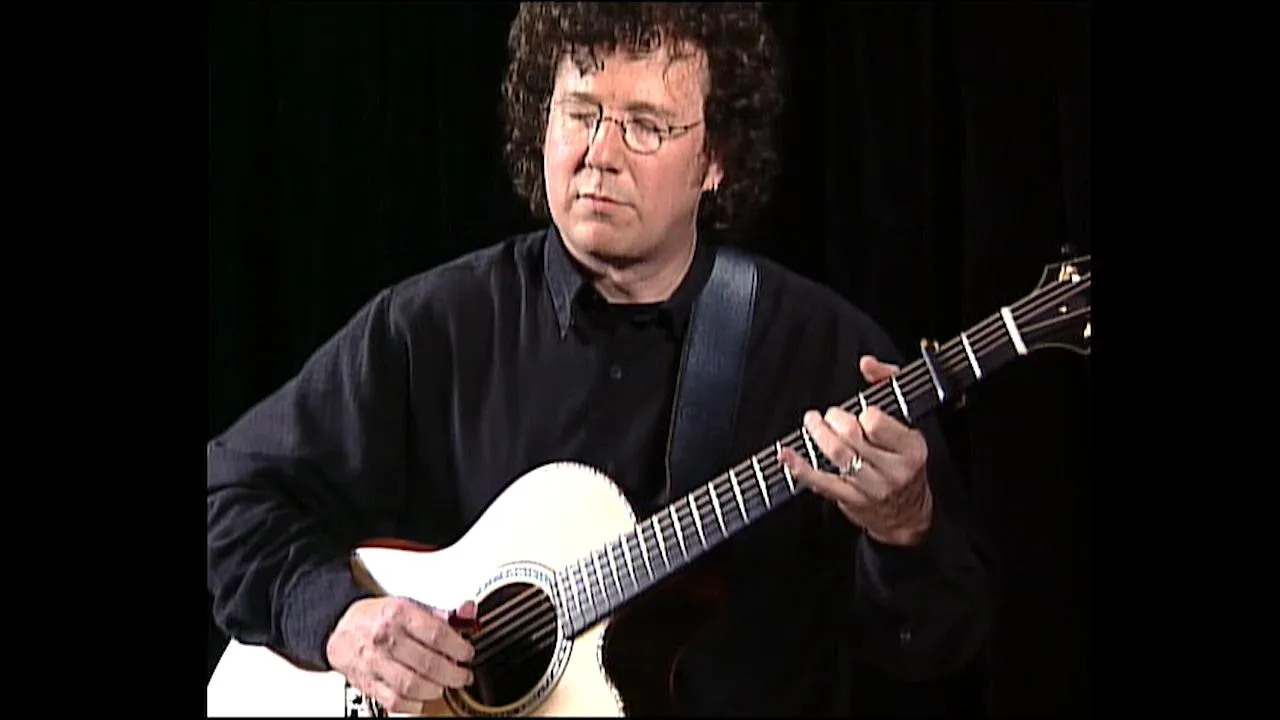
About the instructor
Artista de grabación e intérprete ganador de un Grammy Award, Al Petteway ha tocado prácticamente todos los tipos de música popular, folk y clásica. Aunque su instrumento principal siempre ha sido la guitarra, también ha estudiado laúd, contrabajo, percusión y composición musical. Sus composiciones para guitarra acústica fingerstyle están fuertemente influidas por su amor por la música celta y por sus propias raíces en el folk, el rock y el blues, exactamente el terreno que abre en su curso de MusicGurus, Celtic, Blues and Beyond. En Celtic, Blues and Beyond, Al comparte las afinaciones abiertas, las técnicas de fingerstyle y el enfoque melódico que hay detrás de su sonido, mostrándote cómo fusionar el fraseo celta con el feel del folk, el rock y el blues para que encuentres tu propia voz en la guitarra acústica. Al recibió cuarenta y cinco "Wammies" de la Washington Area Music Association, incluidos los máximos honores de "Artist of the Year" y "Musician of the Year". Fue galardonado con dos Maryland State Arts Council Individual Artist Awards de Composición Musical y ha actuado en la residencia del Vicepresidente y en The White House. Su forma de tocar aparece en más de sesenta grabaciones de algunos de los músicos de folk y celta más conocidos del mundo. En 2005 fue votado uno de los Top Fifty Acoustic Guitarists of all Time por los lectores de Acoustic Guitar Magazine, y en 2008 ganó medallas de Plata y Bronce en los Player's Choice Awards de la revista. Su CD "Caledon Wood" fue votado uno de los "Essential Albums of the Past Twenty Years" en el número del 20 aniversario de Acoustic Guitar Magazine, y su lanzamiento de 2012 "It's Only the Blues" figuró en dos de las listas "Top Ten Essential Albums of 2012" de los editores de Acoustic Guitar Magazine. En 2014 y 2015 publicó dos álbumes en solitario más, "Mountain Guitar" y "Dream Guitars, Vol. II." "Un instrumentista innovador conocido por sus afinaciones abiertas, Petteway ofrece un sonido rico y dulce que combina una fusión de lo antiguo y lo nuevo." --The Boston Globe read more