



Nit Pickin' (lección)
Con
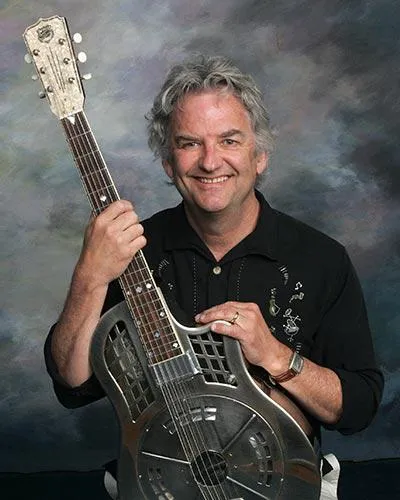
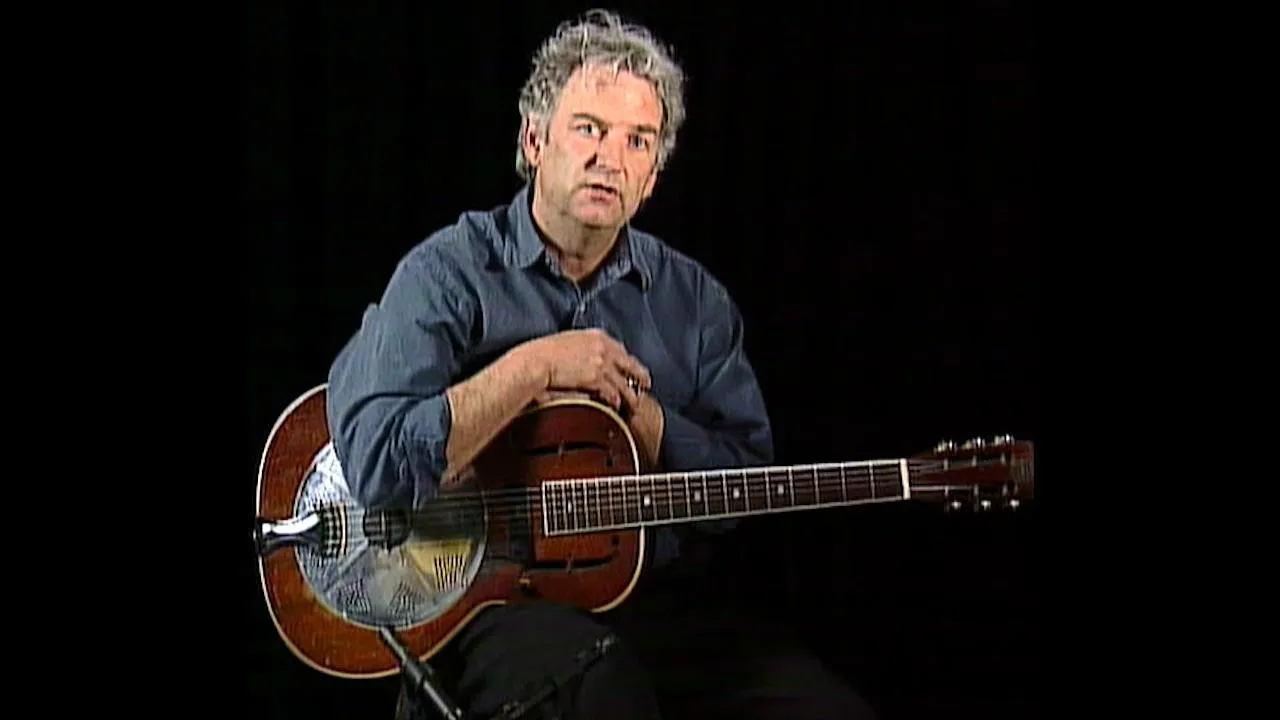
Mike DowlingMike Dowling enseña su tema de fingerpicking 'Nit Pickin'' a la guitarra acústica, trabajando el roll de pulgar alternado y su complicada síncopa de tres contra dos.
Qué incluye el curso
14 lecciones (1h 30m) · 1 gratis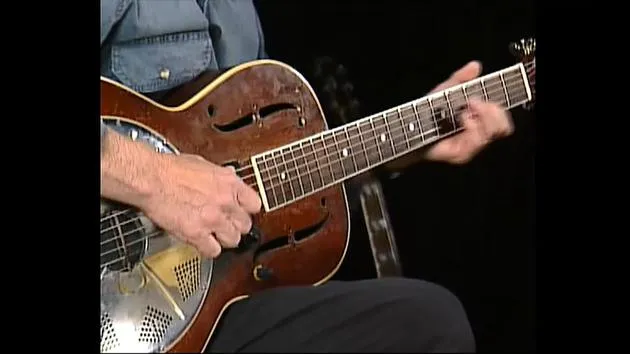
01. Rosalie (interpretación)
Lección gratis4:58
02. Rosalie (lección)
8:59
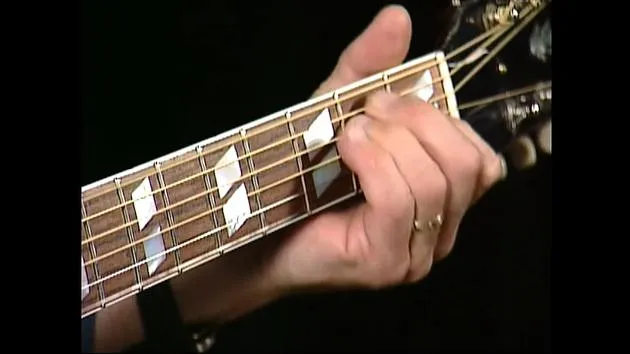
03. Nit Pickin' (interpretación)
3:22
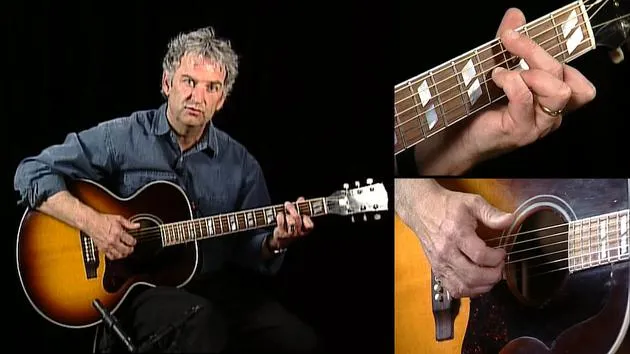
04. Nit Pickin' (lección)
Estás aquí11:02
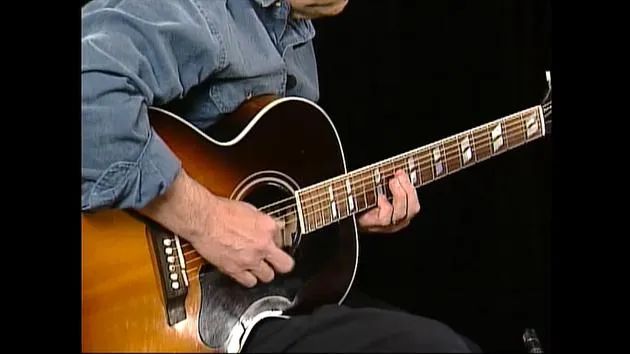
05. Minor Thing (interpretación)
4:21
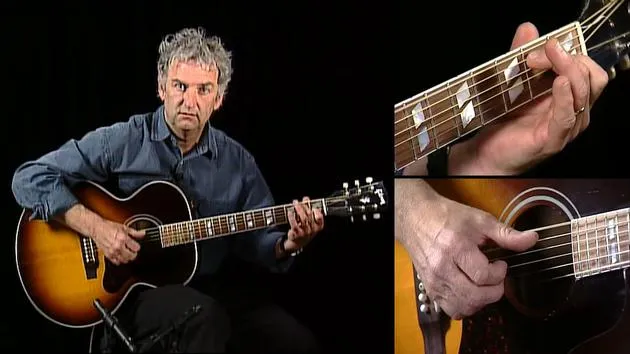
06. Minor Thing (lección)
10:48
07. Johnson City Rag (interpretación)
3:33
08. Johnson City Rag (lección)
9:39
09. Fishin' In The Wind (interpretación)
2:35
10. Fishin' In The Wind (lección)
10:15
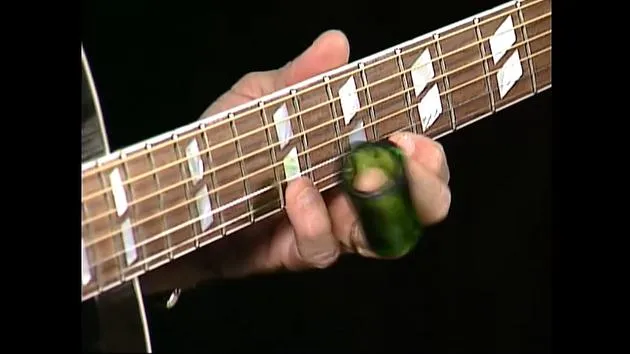
11. Bottleneck March (interpretación)
3:00
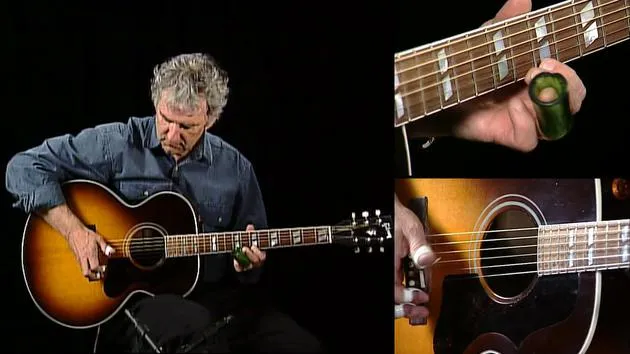
12. Bottleneck March (lección)
10:31
13. EXTRA: Bottom Lands (interpretación)
3:44
14. BONUS: String Crazy (interpretación)
3:34
Transcripción de la lección
Music Lesson: Tune Nitpicking Overview
Alright, now we're going to take a look at my tune "Nitpicking." To get a handle on this rhythm, there's a finger-picking technique that's critical. It's easy to relate to if you think of the tune in "In the Mood."
E Chord Practice
- Play an E chord: Just play a forward roll with your fingers.
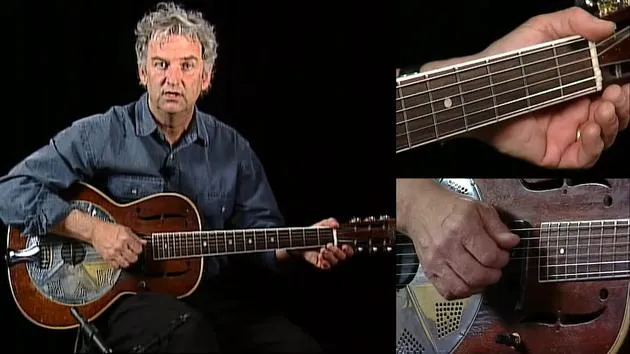
- Right-Hand Focus: You can use your angle button to access my right or left hand as we get further along here.
Right-Hand Riff
Here's my riff:
-
Eighth notes:
- 1 and 2 and 3 and 4
- 1 and 2 and 3 and 4
-
With an alternating thumb.
Next, I've got quarter notes against that:
- "I remember learning this tune, this syncopation, almost sitting in my room, pulling my hair out trying to get this down."
- While these are eighth notes, they're grouped in threes. Some call this a three against two syncopation, but it's really eighth notes against quarter notes.
Chord Variation
Now, let's take a look at "Nitpicking."
- I'm going to ask you to give these chords some big names, though it's not critical.
- I'm playing a G major 7 form; we can just call it an altered G.
Rhythm Cadence
With my right hand and the chord:
- It looks like this.
- Then I lift up my first finger, you can see it happening while I'm going.
Chord Changes
- IV Chord: I alter this chord for my C9 altered chord.
- Return to G: Then come back to G.
- Next Chord: Move to an E7 chord.
- Previewing Play: I come up here and will play the whole passage shortly.
Structure Recap
So here it goes from the top:
- Pattern: C9 back to G.
- You can break out of that pattern if you want; it won't harm anything.
Full Playing Context
Let me play it in context without interruption:
- Back to G, and E goes to A7.
- Just a bar chord, A9, and make it minor, same motif.
- C altered back to G major like before.
- Move to my A bar.
Key Modulation
Finishing up here on the second part in the key of C:
- G7 augmented.
- Now we've modulated to the key of C, moving out of the pattern we had before, into regular pattern picking to get the melody notes.
Palm Muting Technique
You can hear me muting with my palm down here:
- "I feel I'm really pushing it. If I don't have a thumb pick and I'm playing with my bare thumb, I'm muting it."
Playing Without Finger Picks
You might wonder, "Why don't you just use finger picks?"
- If I've got this three-finger pattern, I'm not adept at playing with a finger pick on my ring finger.
- I sometimes play this tune with my bare fingers and just a thumb pick if I want to get more definition.
Be aware: Playing with bare fingers can prevent low-end notes from getting washed out or too muffled.
Bridge Progression
Back to the Bridge
Let me go back to the bridge of this tune:
- Chords: C, E minor 7, a sixth.
- Setting up the last part of the tune.
- Back to our refrain: C.
Chords Recap:
- Just implying a C chord.
- Minor sixth, A7, D7, and to G.
Special Chord Mention
There's one chord I wanted to bring to your attention:
- Seven flat five.
- It gives me an E flat and rings against an open high E.
I appreciate finger picking tunes that create a bell-like quality with discordant notes ringing against one another.
- Positioning: I can stay in fourth position and make it a minor seven flat five as the passage continues.
Second Part of the Tune
Single Note Passages
Let's go to the second part of this tune where I'm playing some single note passages.
- The second part of the tune goes like this, and I'll get there in a minute.
Syncopation Practice
Here's my syncopation:
- "Hear that?" It's the same as the opening syncopation but I'm using it on an A 9th chord, A minor 7.
Turnaround Chords:
- Then I get into this.
- Tap your foot and use your thumb and the finger on the "ands" to stay on track rhythmically.
Technique Reference
The late great Oscar Alimon was superb at this technique:
- "It almost sounded like plectrum playing, but he was playing with picks."
Balance Suggestion
The key is achieving an even balance to those notes because sometimes the thumb has more weight and tends to overpower the finger notes.
Final Tips
For single line passages:
- Practice playing on one string.
- "See what I'm doing?" Thumb, finger, thumb, finger, thumb, finger.
If you're tapping the foot on quarter notes:
- Use the thumb on the downbeat, and as a general rule, use your finger on the "ands" or the offbeat.
Ending Passage
For the last passage in that tune:
-
If you take a D chord and move it over to the next set of strings, then up one more fret and just pluck those notes, it looks like a D chord.
-
This creates a great all-purpose turnaround with three voices moving down.
Conclusion
To capture the ending of this tune, we can put it up an octave and use harmonics at the 12th fret to take us out.
I hope that what we've talked about will get you started playing this tune, especially the critical syncopation. I encourage you to expand on it and use it in your own way as well.
Alright, let's go to the next tune!
14 lecciones
1h 30m de lecciones en vídeo estructuradas
Funciones de vídeo avanzadas
Ralentiza, repite un pasaje, sigue la partitura
Móvil, tablet y ordenador
Practica donde quieras
Garantía de satisfacción 100%
30 días de garantía de devolución
Conoce a tu gurú
Conoce a tu gurú
Cuando el gran Vassar Clements, ya fallecido, escuchó tocar la guitarra a Mike Dowling allá por 1975, hizo lo más sensato. Lo contrató. Mike fue el guitarrista de la primera banda de gira de Vassar y se le puede escuchar en su “Nashville Jam”, nominada a un Grammy. Clements lo describió sencillamente como “uno de los mejores guitarristas que existen, en cualquier lugar”. Ese mismo sentir lo comparte un coro cada vez mayor de críticos musicales, estudiantes de guitarra y aficionados a la música acústica de todo el mundo.
Mike ahonda en el rico bagaje de la guitarra de raíces estadounidenses, con predilección por el melódico estilo Piedmont de maestros del blues acústico como Mississippi John Hurt y el gran intérprete de slide Tampa Red. Pero a Mike no se le puede encasillar como bluesman, ni siquiera como fingerstylist. Es demasiado versátil para eso. Del blues de bottleneck al jazz de antaño y mucho más de por medio, la musicalidad, la profundidad y el dominio del instrumento de Mike se trasladan con fluidez tanto a las guitarras de tapa plana como a las de tapa arqueada y a las resonadoras.
Intérprete, compositor, profesor, artista de sesión, inventor: todo lo que hace el guitarrista Mike Dowling refleja su amor y su dominio del instrumento que ha sido el eje de su vida durante más de cuarenta años.
En sus lecciones, Mike abre para ti el bagaje del uptown blues: fingerpicking Piedmont relajado, un bajo constante de pulgar alterno, ágiles líneas de nota única y los recursos de slide y bottleneck que dan alma a la guitarra de raíces estadounidenses, enseñado con el mismo sentimiento que él inyecta en cada nota.
“Un excelente instrumentista que se maneja con soltura en una amplia gama de estilos musicales. Inyecta sentimiento en cada palabra y en cada nota.”
--Hit List, Acoustic Guitar
“Dowling es un guitarrista fluido y preciso, y sus curtidas voces tienen un aire juguetón y saltarín de lo más atractivo.”
--Dirty Linen







