



Bottleneck March (lección)
Lesson time: (10min 31sec)
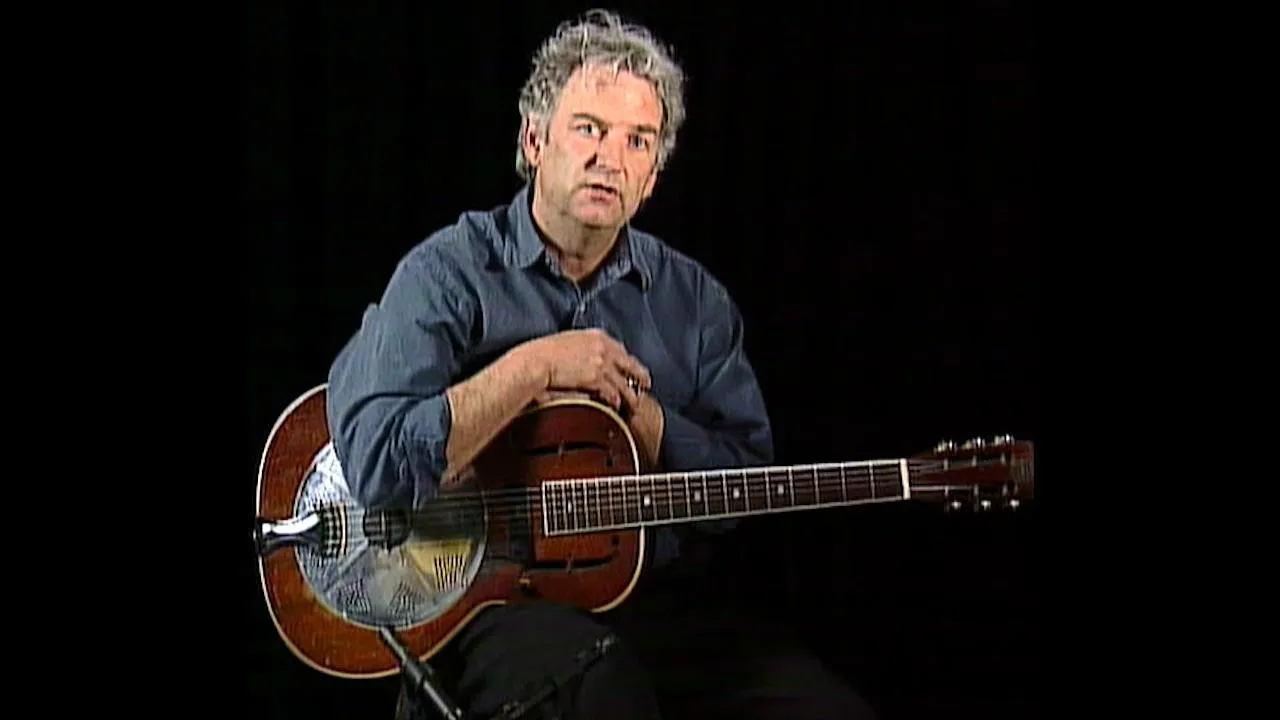
Mike Dowling enseña “Bottleneck March” en guitarra acústica en afinación de Re abierto, cubriendo el trabajo de slide, los pull-offs y las síncopas de fingerpicking que mueven el tema.
Course preview
This lesson is part of the course Uptown Blues (guitarra American Roots)
Watch a preview of the full course below.
Lesson transcript:
Bottleneck March Music Lesson
All right, here's my tune: Bottleneck March. It's not truly a march, but please don't hold that against me. This is the only tune I'm playing today with my finger picks on.
As in Johnson City Rag, there are a couple of little fingerpicking syncopations that are good to get under your control. This will help you achieve as smooth an execution of this tune as possible.
Techniques and Tips
- If I'm up here implying E at the seventh fret, you can see the pull-off there.
- If I get the bottleneck out of the way for a moment, you can see what I'm doing.
- There's my pull-off, strike two, and then I pull off as I'm bringing my thumb up.
Pinching Notes
- Pinch, single note, pull-off to get that second bass note along with it. This is a pinch generated by a pull-off.
- I would describe that if I slid with my little finger from the 8th to the 9th fret on the B string.
- When I got to the ninth fret, I added my bass note: one and one.
Let me put them together. That's the opening phrase. And there's my A7 (or my A chord) up there.
Detuning Explanation
I'm in Detuning here. If you're not familiar with that, you've got:
- Low D
- A
- D
- F#
- A
- D again.
You might notice in my performance of this piece and as I'm teaching it that, for some reason, to get my fretted notes in tune up high at the ninth fret, especially on the B string, I've just put a little piece of plastic under the string there, creating a partial fret.
This allows me to play this song in tune, especially for my high fretted passages. When I come open, it's still in tune for me. Why it works, I don't know, but it's something that I'll continue to do.
Tuning Observations
- G tuning is fine.
- In standard tuning, it seems to be fine as well.
- There's just something about that detuning that helps.
Starting the Tune
Let's get back to this tune. To start, I'm going to have a series of forward rolls.
The cadence would be:
1 and 2 and 3 and 4 and 1 and 2 and 3 and 4 and 1 and 2 and 3 and 4.
I'm sorry.
Let's try again: 1 and 2 and 3 and 4 and 1 and 2 and 3 and 4, 1 and 2 and 3 and 4.
Okay, that's the intro. A lot of people ask why I play with the bottleneck on my third finger. Most people put it on their pinky.
If I had it on my pinky, I wouldn't be able to play this song. I probably wouldn't have written it the way I did. Having the bottleneck on my third finger allows me to make these reaches that span an extra fret that I wouldn't have available if using my pinky.
Balance and Technique
As far as playing these fretted tones, I like the bottleneck there because it feels balanced in my hand.
In the 7th position, I'm making a D chord, but putting it way down here. I have my ring finger free for the bottleneck while I'm moving it down. That's my turnaround.
This is a useful turnaround for the key of G and also works in standard tuning as well.
Second Part of Bottleneck March
Here's the second part of Bottleneck March:
- Surrounding tones for my D chord.
- A B flat chord with my same high D in the melody.
- Now, here I'm thinking I can be a little bit raucous this way: back to D, back to B flat, back to D.
That was my A passage, sort of. Then I play the theme again and use the introduction as a little interlude.
Pull-off Forward Roll
The bottleneck's probably in the way there, so let me get rid of that.
This sets up the next part of the tune: pull-off forward roll.
- A diminished D diminished, this little five-note thing is kind of interesting and fun to play.
- It starts with a thumb: thumb, thumb, index, middle, thumb.
Final Part
Now, onto the final part:
- A low octaves.
- A da da da da da da da da da da da da da.
- It's a common ragtime syncopation.
Diminish back to D, E, and back to D.
Now all that's left to finish out this tune is to play part one again.
I won't play the whole thing again; I'll just play the last part for you. You can see what I'm doing with my right hand there, just single noting those going out seventh harmonics.
See if you can capture those harmonics. Hit them at the 12th fret while they're ringing. Try to pick it up!
There it is on the first string, but you want to get more.
Alright, there's the Bottleneck March. Good luck with it!
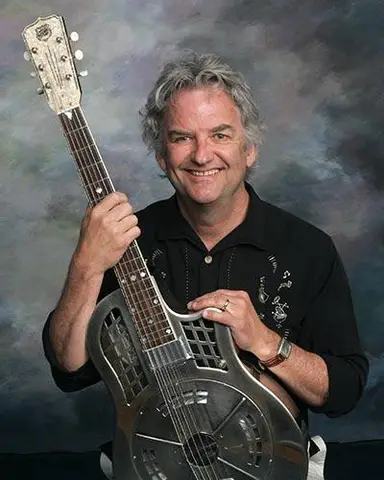
About the instructor
Cuando el gran Vassar Clements, ya fallecido, escuchó tocar la guitarra a Mike Dowling allá por 1975, hizo lo más sensato. Lo contrató. Mike fue el guitarrista de la primera banda de gira de Vassar y se le puede escuchar en su “Nashville Jam”, nominada a un Grammy. Clements lo describió sencillamente como “uno de los mejores guitarristas que existen, en cualquier lugar”. Ese mismo sentir lo comparte un coro cada vez mayor de críticos musicales, estudiantes de guitarra y aficionados a la música acústica de todo el mundo. Mike ahonda en el rico bagaje de la guitarra de raíces estadounidenses, con predilección por el melódico estilo Piedmont de maestros del blues acústico como Mississippi John Hurt y el gran intérprete de slide Tampa Red. Pero a Mike no se le puede encasillar como bluesman, ni siquiera como fingerstylist. Es demasiado versátil para eso. Del blues de bottleneck al jazz de antaño y mucho más de por medio, la musicalidad, la profundidad y el dominio del instrumento de Mike se trasladan con fluidez tanto a las guitarras de tapa plana como a las de tapa arqueada y a las resonadoras. Intérprete, compositor, profesor, artista de sesión, inventor: todo lo que hace el guitarrista Mike Dowling refleja su amor y su dominio del instrumento que ha sido el eje de su vida durante más de cuarenta años. En sus lecciones, Mike abre para ti el bagaje del uptown blues: fingerpicking Piedmont relajado, un bajo constante de pulgar alterno, ágiles líneas de nota única y los recursos de slide y bottleneck que dan alma a la guitarra de raíces estadounidenses, enseñado con el mismo sentimiento que él inyecta en cada nota. “Un excelente instrumentista que se maneja con soltura en una amplia gama de estilos musicales. Inyecta sentimiento en cada palabra y en cada nota.” --Hit List, Acoustic Guitar “Dowling es un guitarrista fluido y preciso, y sus curtidas voces tienen un aire juguetón y saltarín de lo más atractivo.” --Dirty Linen read more