



Ultrabeat como instrumento multisalida
Con
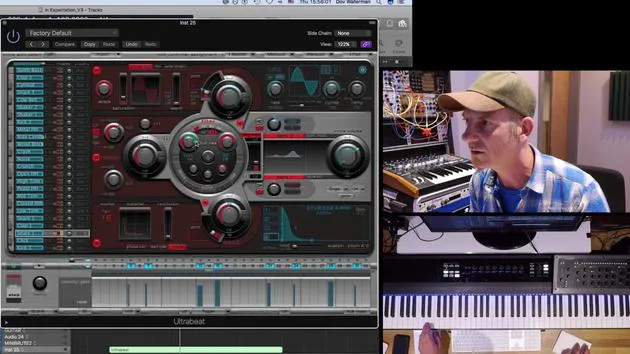
Dov WatermanConfigura el Ultrabeat de Logic como un instrumento multisalida para poder enrutar cada sonido de batería a su propio canal y procesarlos por separado.
Qué incluye el curso
14 lecciones (1h 19m) · 1 gratis
01. Introducción a la programación de ritmos y beats
1:18
02. Introducción a Ultrabeat
7:56
03. Ultrabeat como instrumento multisalida
Estás aquí5:53
04. Introducción a Virtual Drummer
9:27
05. Virtual Drummer - efectos avanzados y capas
11:18
06. Introducción a los Apple Loops
4:40
07. TAREA: Drum Machine Designer
1:07
Transcripción de la lección
Understanding Ultrabeat as a Multi-Output Instrument
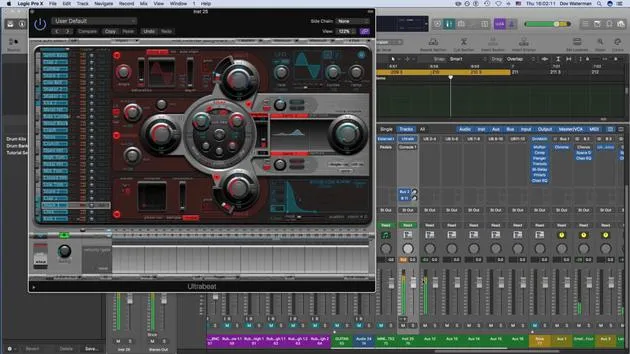
Another thing that Ultrabeat is capable of is turning itself into a multi-output instrument. Currently, I've got it set as a multi-output instrument.
Outputs Overview
If you look over here, you'll see the outputs. Each one of these can be opened up in stereo output.
- Reconfiguration: It will reconfigure itself even if it's still showing the different subgroups. However, it will only go to the main stereo output of that instrument.
- Finding Ultrabeat: So, let's find Ultrabeat. Where's Ultrabeat? Ah, Ultrabeat!
Configuring Multi Outputs
Now, if I change Ultrabeat to multi out, what I will get is little plus and minus signs here.
- Adding Auxiliary Outs: These allow me to add as many auxiliary outputs as I'd like, depending on what I want to send out.
- Auxiliary Channel Behavior: Logic is a bit funny; it opens auxiliary channels in odd places, so you can't actually drag them into something a little more coherent.
Current Setup
Currently, I have my little drum loop going. It's just using a kick and a snare.
- Sound Sources: For all intents and purposes, I'm going to change this to something that uses more sound sources.
- In Use: It currently has the kick, snare, ride, and various cymbals.
Sending Sounds to Outputs
Now, let's send the wood block out to one of the outputs given to it:
- Available Outputs: I have outputs from 3 to 12, but I will send it to outputs 3 and 4.
- Echo Effect: On 3 and 4, the cowbell will come in. I'll give that an echo by calling up a plugin.
Choosing Plugins
Let's stick to Logic plugins just for the sake of it.
- Applying Delay: I'll call a stereo delay plugin and give it some effect.
Fine-Tuning Sounds
Now, back to my kick, where is that kick? Oh, here it is!
- Pitch Adjustment: I'm going to pitch it slightly and center this to outputs 3 and 4, 5 and 6.
- Compression: Next, I'm going to compress that to give it a little kick.
Recap of Ultrabeat's Capabilities
You start seeing how we've managed to dissect Ultrabeat a little and open it out into its auxiliaries.
- Control & Modulation: This allows us to control things and make them unique by giving each sound source its own discrete channel, affecting or modulating it as we like.
Step Sequencer Features
Without going into too much detail, here's a recap:
- Custom Sequences: The step sequencer is excellent for pulling up generic presets that come with Logic.
- Movement in Tracks: You can set up your own sequences and save them. The step sequencer allows you to modulate sound sources, creating movement and body in the track.
- Multi Outputs: Having Ultrabeat as a multi-output instrument enables you to affect and control the different sources at will.
14 lecciones
1h 19m de lecciones en vídeo estructuradas
Funciones de vídeo avanzadas
Ralentiza, repite un pasaje, sigue la partitura
Móvil, tablet y ordenador
Practica donde quieras
Garantía de satisfacción 100%
30 días de garantía de devolución
Conoce a tu gurú
Conoce a tu gurú
Dov Waterman es compositor, pianista y productor. Ha escrito y diseñado el sonido de películas como After Earth, Terminator Genisys, Transformers: The Last Knight y The Snowman, y trabaja como editor de audio de bibliotecas de samples y diseñador de sonido con empresas como Native Instruments y SonoKinetic.
Su serie Composition in Logic recorre la construcción de un tema de principio a fin en Logic Pro —desde las plantillas y el flujo de trabajo hasta la síntesis y la programación de ritmos, los efectos MIDI, la edición y la mezcla final— para productores que quieran convertir sus ideas en discos terminados.







