



9. Escalas disminuidas, de tonos enteros y cromáticas

Lesson time: (8min 14sec)
Peter Gane y Chris Houlding abordan las escalas menos comunes -disminuidas, de tonos enteros y cromáticas- y cómo tocarlas con fluidez en el trombón.
Course preview
This lesson is part of the course Entrenamiento por circuitos para trombón
Watch a preview of the full course below.
Lesson transcript:
Circuit Training: Unit 9 - Diminished Whole Tone Chromatic
Hello and welcome to circuit training, unit 9.
Introduction to the Diminished Scale
The diminished scale is very widely used in the world of jazz, but it's quite a rarity for us classical players.
Basic Formation
- The basic formation is either:
- Tone - Semitone
- Semitone - Tone
With every third note creating the interval of a minor third. If we join these minor thirds together, we create a diminished chord.
Diminished Scale Structure
A diminished scale can be thought of as two interlocking diminished seventh chords.
- Chris, if you play figure one, page 51, you can hear this.
Relation to Major Intervals
Four majors is based on intervals found on the diminished scale. Define the phrasing clearly and use D in fourth in bars 8, 13, and 19.
Importance of Pivot Points
Pivot points on the slide are very important, especially in chromatic scales.
- Try to:
- Change the direction of the slide on main beats to avoid irregular accents in the low register.
- Carefully learn the sequence of smaller shifts in the higher register as repeated patterns or clich?s.
The Sanctus movement from Verdi's Requiem is a good example of this.
Trombone Section Playing
It's also a good idea when playing in a trombone section to use all the same slide positions. The effect of ascending across the harmonics while moving the slide out is particularly pleasing.
Exercises Based on the Diminished Scale
-
Crabwise Cocktail, page 54, is also based on the intervals found in the diminished scale.
- In Bar 7, you can use second or fourth position for all the notes, but be careful to tune them correctly.
-
The One and a Half Study is what it says, a study based on the tone and semitone relationship of the diminished scale.
- Make sure you sustain the length of the two slurred quavers in the phrasing to avoid any rushing.
-
Sa Swing Along is a short study in the jazz style, still based on the diminished scale.
- You can play across the harmonics for the jazz turn in bars 4, 21, 23, etc.
- Make sure to exaggerate the jazz phrasing.
- Long - Short: that means the short, really short.
Relaxed Swing Feel
Tara, try to produce a relaxed, cool swing without any reference to a classical dotted rhythm.
Conclusion
We have covered a lot in this unit and heard some fantastic playing. Don't forget that all we have talked about and heard played can be found in Circuit Training, Volume 2.
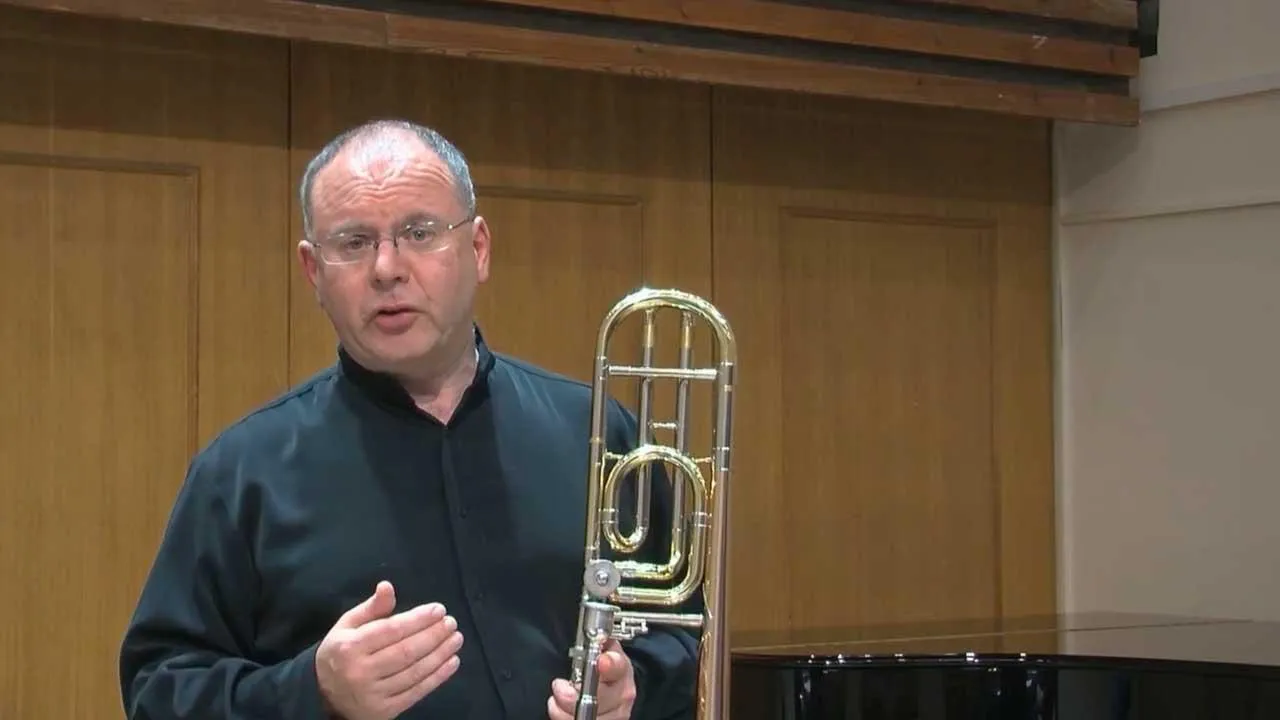
About the instructor
Peter Gane es uno de los principales especialistas en metales y trombonistas de Gran Bretaña. A los 19 años se convirtió en miembro de la London Symphony Orchestra. Fue nombrado profesor de la Guildhall School en 1971 y lo sigue siendo hoy. En 1981 fue elegido Fellow de la Guildhall School y fue Jefe del Departamento de Viento, Metal y Percusión de 1988 a 2008. Es asesor artístico del Combret Music Festival, en Aveyron, Francia. Fundador y expresidente de la British Trombone Association, Peter es un reconocido pedagogo. Mantiene una prolongada relación con la National Youth Orchestra of Great Britain y la European Union Youth Orchestra, donde es profesor de trombón desde 1977 y 1984 respectivamente. Como profesor, especialista en metales y director, ha impartido clases magistrales y talleres en numerosos conservatorios europeos y con grupos profesionales en Alemania, Francia, Dinamarca, Suecia, Noruega, España, Holanda, Austria, Italia y Estados Unidos. En 1996, su reputación internacional quedó confirmada con la concesión del Neill Humfeld Award a la excelencia en la enseñanza del trombón por parte de la International Trombone Association. Entre las publicaciones de Peter figuran: The Good Brass Guide, Trombone Books 1 & 2, publicado por Trinity Guildhall; Circuit Training for Trombone, volumes 1 and 2, Slide Systems, Five Games, Guildhall 125, World in Motion, Mansion House Fanfare, todos publicados por Warwick Music; How Trombonists Do It, publicado por Brass Wind; y Brass Medals, publicado por la Associated Board. Ese mismo enfoque de Circuit Training es lo que Peter comparte aquí contigo: ejercicios específicos y repetibles que desarrollan la precisión de la vara, el control de la respiración, la flexibilidad y el tono que necesitas para dominar de verdad el trombón, sea cual sea tu nivel. read more