



2. Calentamiento
Con
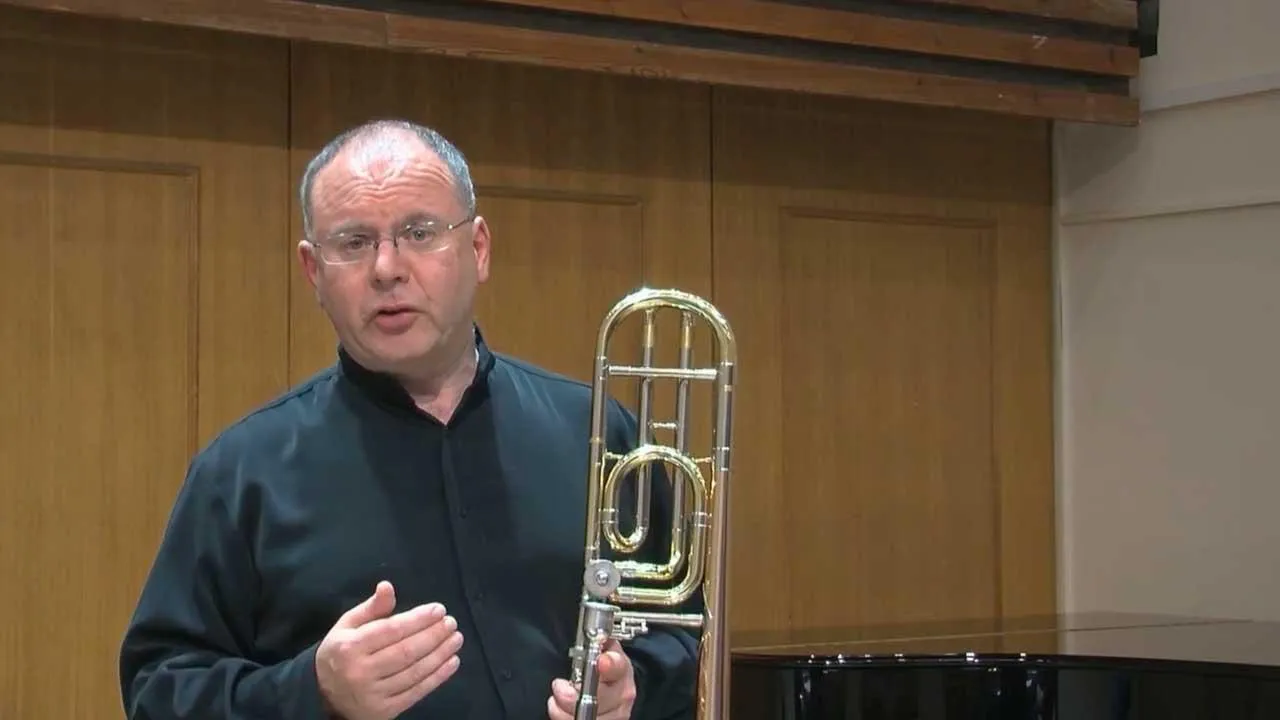
Peter GanePeter y Chris hablan de combinar correctamente los músculos abdominales y la técnica de la lengua para conseguir notas con una calidad de tono uniforme.
Qué incluye el curso
10 lecciones (1h 33m) · 1 gratis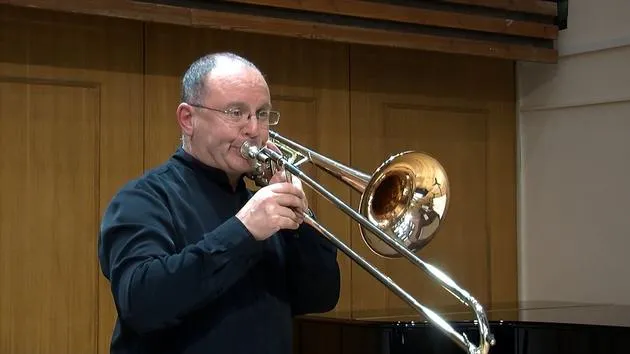
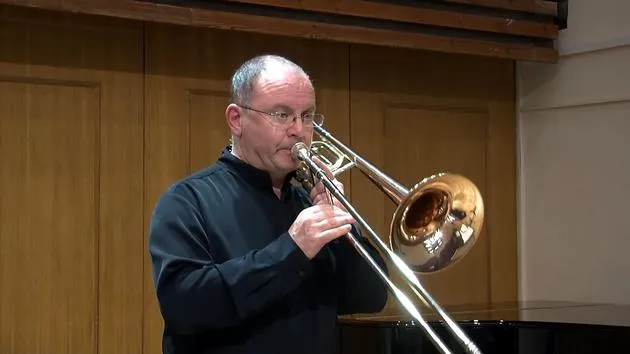
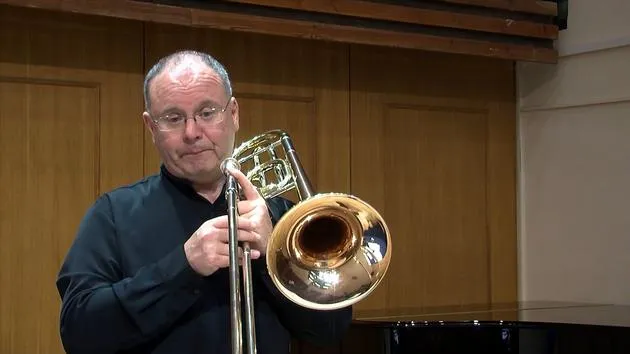
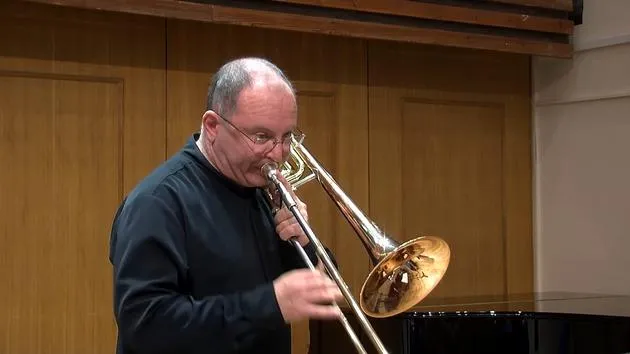
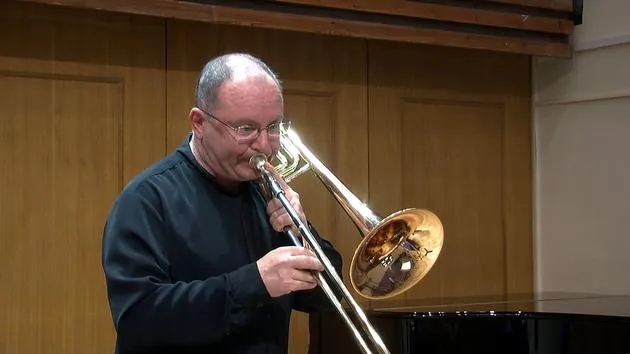
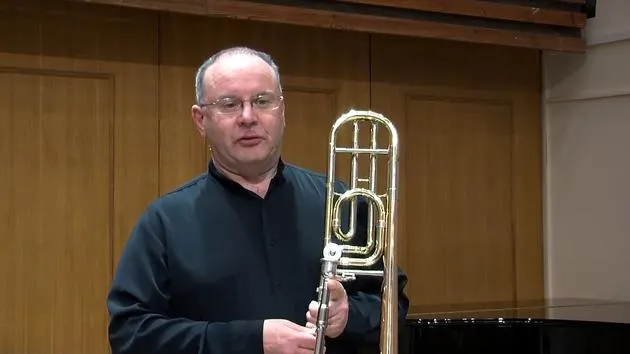
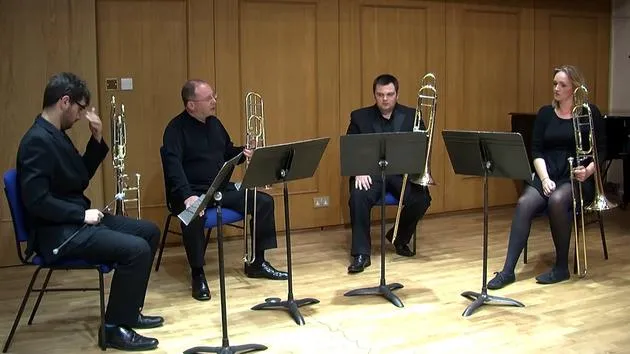
Transcripción de la lección
Circuit Training Unit 2: Warming Up the Motor
Introduction
Hello and welcome to Circuit Training Unit 2. Today, we will focus on warming up the motor.
Key Principles
When playing separate notes, we really concentrate on getting the abdominal muscles working well so each note has weight and identity.
Demonstration
Chris, could you demonstrate the following?
- Figure One: Just with tummy pushes, no tongue.
- Figure Two: Half without tongue and the rest with tongue.
The tummy pushes create the body of the note.
- Notice how I'm pushing out, rather like sighing, and not sucking in.
- I'm also being careful not to use my embouchure and tongue to create a purring effect.
- Additionally, I'm trying to keep the corners of my embouchure set with no air pockets.
Useful Exercises
Another useful exercise is to practice panting like a dog:
- For low register notes: A slow pant like a big dog.
- For middle register notes: A slightly faster pant like a medium-sized dog.
- For high register notes: A faster pant like a little dog.
Now, I will play figure two:
- First half without tongue, second half with tongue.
Having a free and well-supported low register is a fundamental building block.
Support Techniques
Chris, could you demonstrate how you support loads in the low register?
To acquire the tone in the low register, I'm using body resonance, that is, opening the throat like an actor or a singer, and not over-opening the aperture.
- If I over-open my aperture, the note dips down below the pitch, making it very hard to focus.
To find out for yourself just where the embouchure should be, try a basic glissando from Bb to F:
- Here, I coordinated the lowering of the jaw, the opening of the aperture, relaxing the lips a little bit forward, and allowing my body resonance to produce the note without over-opening to maintain focus.
Cheek puffing can also add limited benefit to your low register.
However, be cautious:
- There is a serious side effect: your embouchure virtually completely collapses, so try to avoid this one.
Chris, moving forward, your Bb to F glissando.
A good way to encourage the low notes and develop the low register is to practice playing the false harmonics.
- Chris, could you show us how you approach figure 2, the moving on section?
Yep. As I referred before, I'm:
- Coordinating the lowering of the jaw, moving the lips slightly forward, and pushing the instrument very slightly away from me.
That's excellent.
Having a full and well-supported lower distance also acts as a springboard for the high register.
- Chris, could you expand on this by playing maybe, say, exercise seven?
Tone Quality
Before I do, I want to emphasize the importance of getting a good tone throughout the register.
- Try to avoid pinching with the embouchure and throat.
To help this, you can do a little buzzing exercise to highlight the importance of the abdominal support:
- Try resting the mouthpiece on the top lip and half buzz, half play up two octaves.
This simulates the abdominal support I'm going to use in this next exercise in Unit 2.
Summary
In Warming Up the Motor, we have covered:
- Tummy pushes, both with and without tongue.
- Morning yawns exercises, including supporting low register notes.
- False harmonics and expanding your range to consolidate.
Play the complete unit once again.
And don't forget, all we have talked about can be found in Circuit Training, Volume 2.
10 lecciones
1h 33m de lecciones en vídeo estructuradas
Funciones de vídeo avanzadas
Ralentiza, repite un pasaje, sigue la partitura
Móvil, tablet y ordenador
Practica donde quieras
Garantía de satisfacción 100%
30 días de garantía de devolución
Conoce a tu gurú
Conoce a tu gurú
Peter Gane es uno de los principales especialistas en metales y trombonistas de Gran Bretaña. A los 19 años se convirtió en miembro de la London Symphony Orchestra. Fue nombrado profesor de la Guildhall School en 1971 y lo sigue siendo hoy. En 1981 fue elegido Fellow de la Guildhall School y fue Jefe del Departamento de Viento, Metal y Percusión de 1988 a 2008. Es asesor artístico del Combret Music Festival, en Aveyron, Francia.
Fundador y expresidente de la British Trombone Association, Peter es un reconocido pedagogo. Mantiene una prolongada relación con la National Youth Orchestra of Great Britain y la European Union Youth Orchestra, donde es profesor de trombón desde 1977 y 1984 respectivamente.
Como profesor, especialista en metales y director, ha impartido clases magistrales y talleres en numerosos conservatorios europeos y con grupos profesionales en Alemania, Francia, Dinamarca, Suecia, Noruega, España, Holanda, Austria, Italia y Estados Unidos. En 1996, su reputación internacional quedó confirmada con la concesión del Neill Humfeld Award a la excelencia en la enseñanza del trombón por parte de la International Trombone Association.
Entre las publicaciones de Peter figuran: The Good Brass Guide, Trombone Books 1 & 2, publicado por Trinity Guildhall; Circuit Training for Trombone, volumes 1 and 2, Slide Systems, Five Games, Guildhall 125, World in Motion, Mansion House Fanfare, todos publicados por Warwick Music; How Trombonists Do It, publicado por Brass Wind; y Brass Medals, publicado por la Associated Board.
Ese mismo enfoque de Circuit Training es lo que Peter comparte aquí contigo: ejercicios específicos y repetibles que desarrollan la precisión de la vara, el control de la respiración, la flexibilidad y el tono que necesitas para dominar de verdad el trombón, sea cual sea tu nivel.







