



7. Menor natural o modo eolio

Con
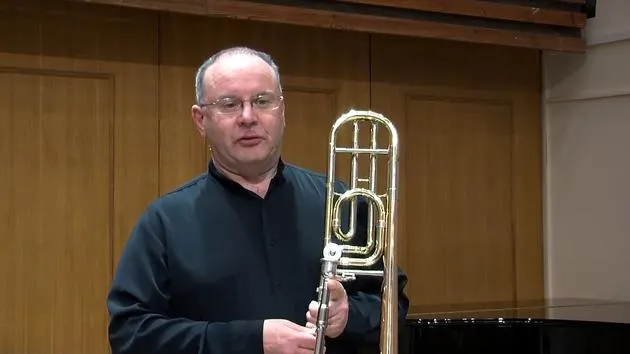
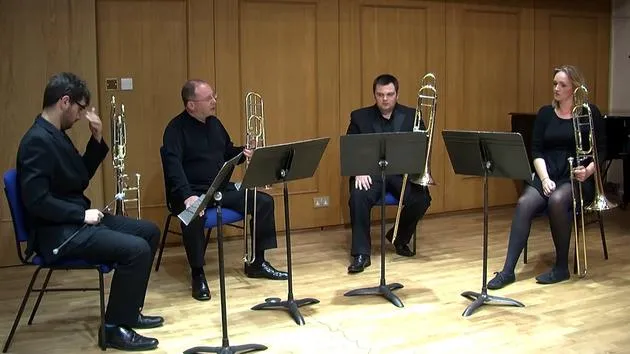
Peter GanePeter Gane y Chris Houlding abordan el modo menor natural (eolio) con ejercicios de escala y arpegio en zigzag para tocarlo con fluidez al trombón.
Qué incluye el curso
10 lecciones (1h 33m) · 1 gratis
Transcripción de la lección
Circuit Training: Unit 7 - Natural Minor or Aeolian Mode
Hello and welcome to circuit training!
Understanding the Natural Minor or Aeolian Mode
The easiest way to find the natural minor or Aeolian mode is by playing all the white notes on the piano from A to A.
Demonstration
Chris, could you demonstrate the A mode by playing "God Rest Ye Merry Gentlemen"?
Note: Remember, the difference between the various modes is the order in which the tones and semitones are placed, not on which notes they start or finish.
Patterns in Time
Again, patterns like these can be put into five time, which add musical flavor and interest.
Chris, can you now play the natural swing study?
This study cleverly combines:
- Harmonic and melodic minors
- Chromatic syncopated rhythms
- Different articulations in an irregular 5/4 meter
Challenges in Coordination
Playing the harmonic and melodic scales crabwise is not only challenging but also great for:
- Coordination
- Intonation
Using the same format as the major crabwise scales in Unit 6, try working on the harmonic and melodic minor crabwise in your own time. Have fun!
Combining Interaction with Unfamiliar Keys
Now, let us combine interaction between more unfamiliar keys with a variety of changing compound rhythms in Minor Spider Crab on the Move.
Review of Material Covered
In Unit 7, covering the natural minor or Aeolian mode, we have looked at:
- Harmonic and melodic minor crabwise scales
- Arpeggios to consolidate these concepts
Final Reminder
Play the complete unit once again. And don't forget that all we have talked about can be found in Circuit Training, Volume 2.
10 lecciones
1h 33m de lecciones en vídeo estructuradas
Funciones de vídeo avanzadas
Ralentiza, repite un pasaje, sigue la partitura
Móvil, tablet y ordenador
Practica donde quieras
Garantía de satisfacción 100%
30 días de garantía de devolución
Conoce a tu gurú
Conoce a tu gurú
Peter Gane es uno de los principales especialistas en metales y trombonistas de Gran Bretaña. A los 19 años se convirtió en miembro de la London Symphony Orchestra. Fue nombrado profesor de la Guildhall School en 1971 y lo sigue siendo hoy. En 1981 fue elegido Fellow de la Guildhall School y fue Jefe del Departamento de Viento, Metal y Percusión de 1988 a 2008. Es asesor artístico del Combret Music Festival, en Aveyron, Francia.
Fundador y expresidente de la British Trombone Association, Peter es un reconocido pedagogo. Mantiene una prolongada relación con la National Youth Orchestra of Great Britain y la European Union Youth Orchestra, donde es profesor de trombón desde 1977 y 1984 respectivamente.
Como profesor, especialista en metales y director, ha impartido clases magistrales y talleres en numerosos conservatorios europeos y con grupos profesionales en Alemania, Francia, Dinamarca, Suecia, Noruega, España, Holanda, Austria, Italia y Estados Unidos. En 1996, su reputación internacional quedó confirmada con la concesión del Neill Humfeld Award a la excelencia en la enseñanza del trombón por parte de la International Trombone Association.
Entre las publicaciones de Peter figuran: The Good Brass Guide, Trombone Books 1 & 2, publicado por Trinity Guildhall; Circuit Training for Trombone, volumes 1 and 2, Slide Systems, Five Games, Guildhall 125, World in Motion, Mansion House Fanfare, todos publicados por Warwick Music; How Trombonists Do It, publicado por Brass Wind; y Brass Medals, publicado por la Associated Board.
Ese mismo enfoque de Circuit Training es lo que Peter comparte aquí contigo: ejercicios específicos y repetibles que desarrollan la precisión de la vara, el control de la respiración, la flexibilidad y el tono que necesitas para dominar de verdad el trombón, sea cual sea tu nivel.







