



Greensleeves - Tonalidades menores
Lesson time: (9min 5sec)
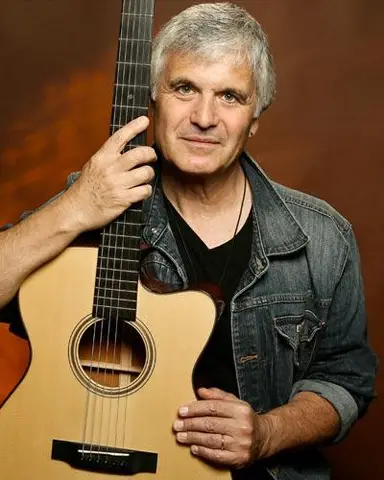
Laurence Juber usa la tradicional 'Greensleeves' para explicar cómo funcionan las tonalidades menores, incluidas la menor natural y la menor armónica.
Course preview
This lesson is part of the course Fundamentos de la guitarra acústica: Vol.1
Watch a preview of the full course below.
Lesson transcript:
Understanding Minor Keys in Music
Little taste of Henry VIII there with the traditional English Green Sleeves. In this segment, we're going to talk about minor keys.
Overview of Minor Keys
We've looked at harmonizing major scales, but we haven't really discussed what happens with the minor. Minors get a little tricky, especially unless we're in A minor.
Playing A Minor
Let me just play the A minor. If we stick to the C key signature (which is no sharps, no flats), everything is natural.
- You actually don't have a scale here; you have a kind of a natural A minor mode, but it's not a scale.
- In an A scale, the seventh will always lead you up to the tonic. It's the leading note.
A Harmonic Minor
However, if we apply this to A minor, we arrive at what is known as the A harmonic minor.
- In the harmonic minor, the sixth degree of the scale (an F) is natural, but the seventh is sharp, giving it an Eastern sound.
- This appears outside the norms of Western classical music, and thus, the committee that formulated these rules decided that as we ascend the scale:
- You make the sixth degree major (F sharp)
- You make the seventh natural when descending (leading towards the tonic).
Melodic Minor
This gives us the melodic minor, which introduces interesting choices when harmonizing the scale.
- For example, my G (the seventh of the A scale) can be either sharp or natural, meaning it can be G sharp or G natural.
- My sixth can be either F sharp or F natural.
Chord Variations
This variability means any chords containing those notes could have either variation:
- D minor chord or D major chord (depending on F).
- E minor chord or E major chord (depending on G).
Example Progressions
So, I could have:
- A minor → D → G → E minor
In a sense, the chords I'm playing with here almost feel like I'm in the key of G since I have G, D, and E minor, but the tone center still revolves around the A.
More Chord Options
I can also incorporate an F natural chord:
- A minor → F → E major
In this case, the E major is the dominant chord in A minor.
- Progressions:
- A minor → E minor → E major
- This gives me the I, V, I sound.
Exploring C Chord
When I go to the C chord, it feels like I've moved to the key of G because I'm introducing another C into the harmony.
- Notice how I create a D sus chord:
- When you have a D chord with an F sharp, playing the fourth instead of the third gives what we call a sus four (suspended fourth).
Melodic Movement
This type of suspension delays resolution to the third. For example, a familiar sound in pop music goes from the fourth to the third, second, and back to the third.
- This showcases how scale tones can work into a chord without changing the fundamental underlying tonality.
Final Thoughts on Greensleeves
Returning to Green Sleeves, I feel like I'm going through:
- 4, 5, 1, 6 in the key of G.
Even though all the notes in those chords are common to our A minor tonality, I can extend the ending for a more medieval sound by shifting from G to F to E, creating a softer relationship.
- This results in:
- A minor → G (common in pop music), but lacking the dominant-tonic relationship of E to A.
Conclusion
So, there's an introduction to how minor keys work. It becomes more complex with jazz harmony, where sometimes the sixth and seventh can coexist as either major or minor within the same chord.
- Later, we'll explore the character of those kinds of chords further.
About the instructor
Laurence Juber se dio a conocer primero como guitarrista principal de Wings, la banda de Paul McCartney. Desde entonces ha construido una carrera como guitarrista fingerstyle, compositor y arreglista, trabajando en gran medida con la afinación DADGAD, que le valió el apodo de 'the Duke of DADGAD'.Los lectores de Fingerstyle Guitar Magazine lo han votado Guitarrista del año, y la revista Acoustic Guitar lo ha incluido entre los mejores guitarristas, junto a una larga lista de álbumes en solitario y giras por todo el mundo.En sus cursos enseña su técnica fingerstyle y la afinación DADGAD por la que es conocido, cómo combinar melodía, armonía y bajo en un arreglo para guitarra sola, y las piezas -como su emblemática 'Wooden Horses'- que lo reúnen todo. read more