



Eine andere Pentatonik-Form!

Mit
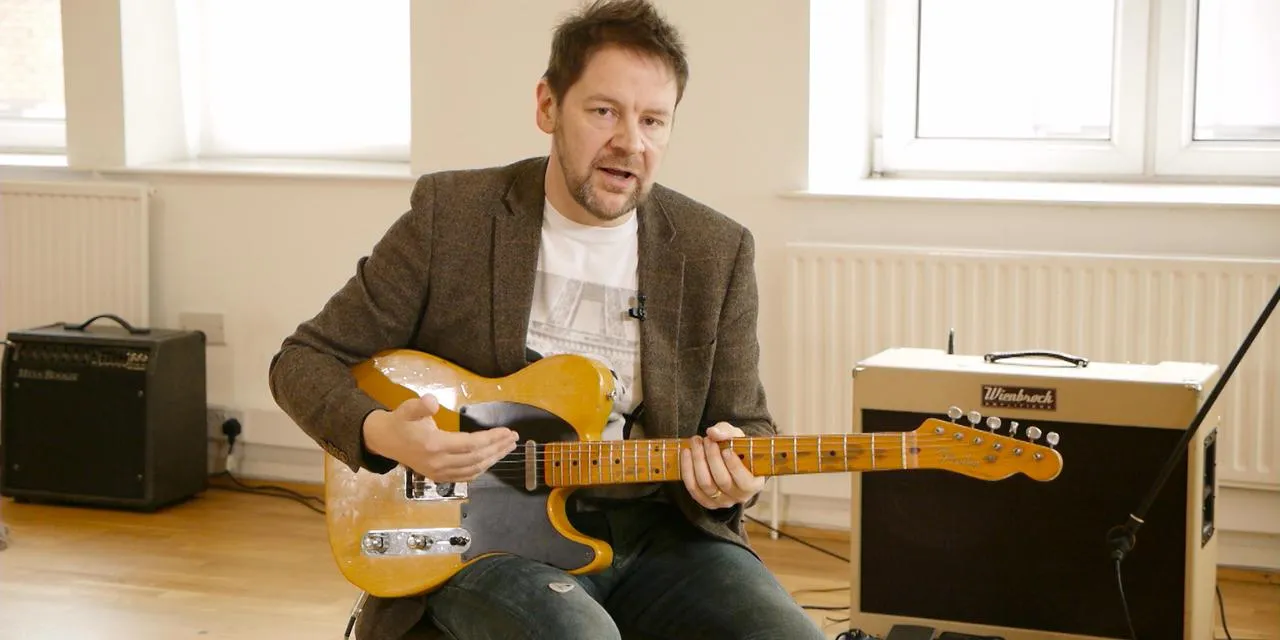
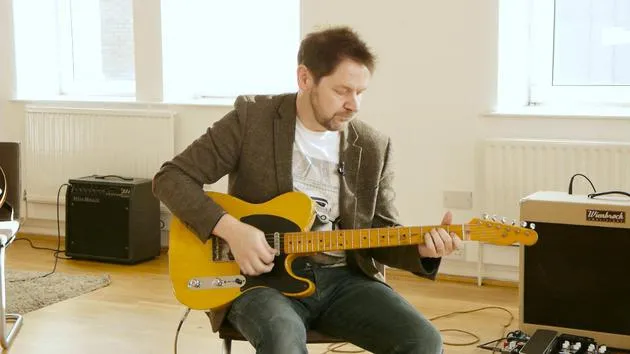
Ron SayerRon Sayer lehrt seine bevorzugte Pentatonik-Form, die „2-und-3-Skala“ — zwei Bünde auf einer Saite, dann drei auf der nächsten —, um mehr vom Griffbrett zu erschließen.
Das steckt im Kurs
12 Lektionen (1h 8m) · 1 gratis
01. Pentatonik- und Blues-Skalen-Formen: eine Wiederholung
Gratis-Lektion6:59
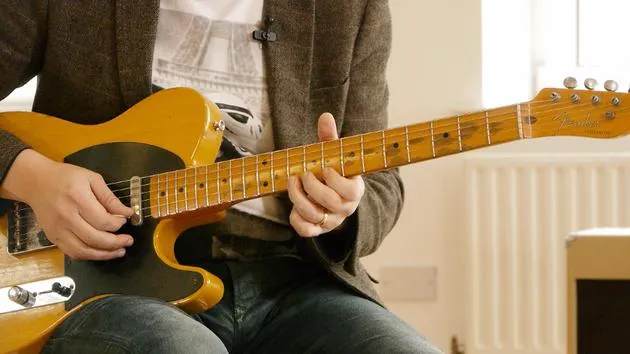
02. Eine andere Pentatonik-Form!
Du bist hier5:10
03. Verminderte Quinte und große Sexte zur Pentatonik hinzufügen
3:45
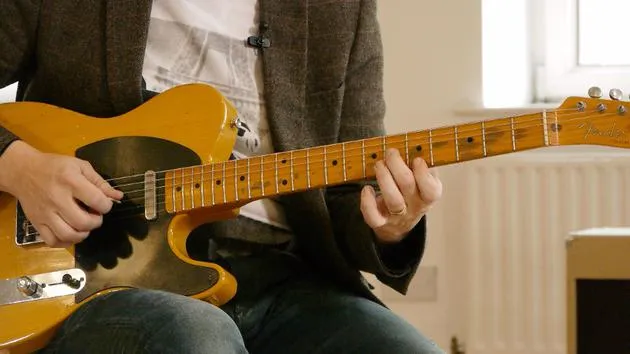
04. Dur- und Moll-Pentatonik mischen.
4:41
05. Die hybride Blues-Tonleiter
4:26
06. Double Stops verwenden
6:35
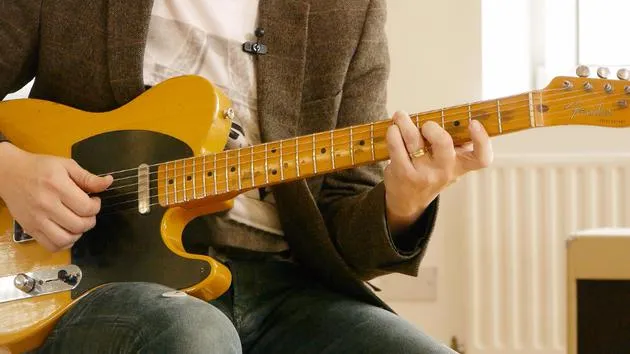
07. Double Stops mit Durchgangsnoten
4:18
08. Spielweisen: Septakkorde
6:26
09. Spielweisen: None-Akkorde
4:49
10. Coole Akkorde
10:42
11. Turnaround-Variationen
5:25
12. BONUS-RIFF: Lerne, Pride & Joy von Stevie Ray Vaughan zu spielen
5:30
Transkript der Lektion
Music Lesson: Exploring a New Pentatonic Position
Hello again!
Hopefully, you enjoyed the last lesson and you've worked on playing over the A, D, and E using the A minor pentatonic, D minor pentatonic, and E minor pentatonic scales. You should have a feel for that and have learned your pentatonic scales in five different positions to open up the neck.
Introducing the New Pentatonic Shape
What I want to look at now is a different pentatonic position that I really prefer. This shape opens up much more of the neck for me.
The 2 and 3 Scale
I call it the "2 and 3 scale" for reasons that will become clear:
- It uses two frets on one string.
- Then it moves to the next string and uses three frets.
Let's dive in and you'll see how it works.
Position One: The A Pentatonic
-
Start on the third fret of the E string:
- Start on G, then move to A.
-
Move to the A string:
- Play the third fret, fifth fret, seventh fret.
-
Next, the D string:
- Play the fifth fret and the seventh fret.
-
Now, the G string:
- Play the fifth, seventh, and ninth frets.
-
Next is the B string:
- Play the eighth and tenth frets.
-
Finally, the high E string:
- Play the eighth, tenth, and twelfth frets.
This is a normal pentatonic scale, but it encompasses from the third fret right up to the twelfth fret in one position.
Repetition in the Scale
You'll notice that you are repeating yourself three times:
- Play: 3, 5
- 3, 5
- 7
- 3, 5
- 5, 7
- 5, 7
- 9
- 8, 10
- 8, 10
- 12
So, the same thing is played three times, giving you some scope to play in a different way.
Adding Technique
What I want you to do is incorporate hammer-ons and slides into your scale practice to make it more valuable.
- Hammer on and slide:
- Go from 3 to 5.
- Hammer on, hammer on slide.
- Hammer on, hammer on slide.
- Hammer on, hammer on slide.
Once more, you'll find that sounds lovely.
Putting It All Together
Now, let's throw in a 12-bar progression, and I'll show you how you can use that to great advantage before we start adding some more notes to it.
Count In:
- One, two, three, four...
Lovely, thank you!
Conclusion
You can see that even by sticking to a pentatonic scale, the sound can be quite nice. This approach gives you more of the neck to explore, helping you to move beyond that initial box pattern while also providing techniques to use.
12 Lektionen
1 Std. 8 Min. strukturierte Videolektionen
Erweiterte Videofunktionen
Verlangsamen, Passagen loopen, mitlesen
Handy, Tablet & Desktop
Üben, wo du willst
100 % Zufriedenheitsgarantie
30 Tage Geld-zurück-Garantie
Lern deinen Guru kennen
Lern deinen Guru kennen
Ron Sayer ist ein Gitarrist für Gitarristen auf der britischen Blues-Szene und Mentor von Spielern wie Oli Brown und Sol Philcox. Er wurde viermal für die British Blues Awards nominiert - für das Album 'Better Side', die Single 'Don't Make Me Stay' und seine Mitwirkung als Co-Autor bei Oli Browns 'Here I Am' - und hat den Preis als Guitarist of the Year gewonnen. In seinen Kursen schlüsselt er das Phrasing, den Ton und das Feeling hinter dem elektrischen Blues-Leadspiel auf.







