



Analyse von Sarabande und Gigue mit Rachel Podger
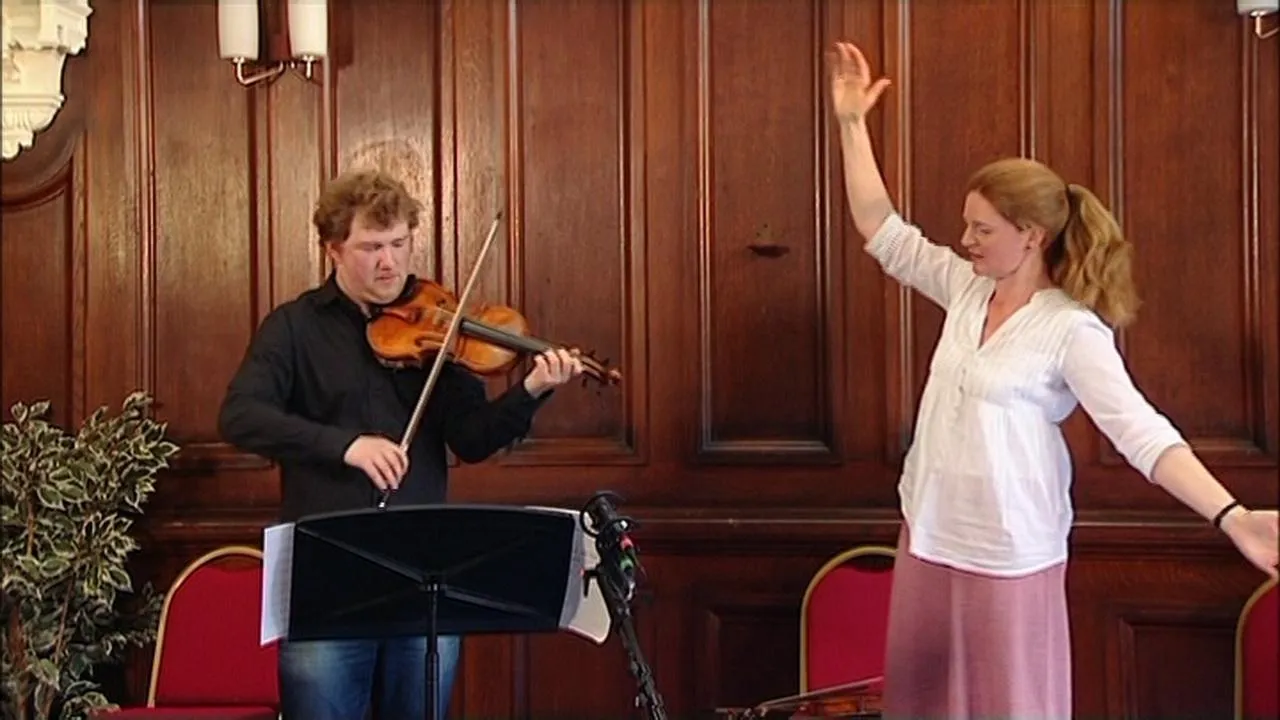
Lesson time: (17min 26sec)
Course preview
This lesson is part of the course Bach - Werke für Solovioline und Solocello
Watch a preview of the full course below.
Lesson transcript:
Music Lesson Reflection
Wonderful!
Really, really lovely. And I know it's hot. We're all hot in here.
Intimacy in Performance
Well, I love that in the Sarabanda. I loved the sense of intimacy that you had,
- sound-wise,
- pulse-wise,
- and space.
I thought you captured that really beautifully. And I'm sure you agree.
Contrast in the Jig
In contrast, the Jig, which of course is very brilliant and quite hard, is really great. It's funny, isn't it, when you think about the jig? You kind of think of skipping and bouncing around, and that's, of course, the origin of the jig. Being Scottish, you know all about those!
Mattheson said at some point that an Italian jig, which this one definitely is, is "not for dancing; it's for fiddling." For fiddling.
I'm glad to hear that! They're always very brilliant, and I think that brilliance is really apparent.
Suggestions for Brightness
I was actually wondering whether you could have a bit more of that feeling of brightness when it is bright:
- Just play a little bit more with the figurations.
- Use more contrast.
- Sometimes have a bit more space.
Especially enjoy the cycle of fifths. Enjoy what's happening in the instrument as well, particularly the resonance and especially when it's on the lower strings in the second part. Those were things that occurred to me.
Musically, it made so much sense. It was very convincing.
Tempo Considerations
Do you think it was a bit fast or not?
- No, it didn't strike me because you played it very well.
- It could actually go a bit slower because then you'd have a bit more chance, and more poise.
Most of all, I didn't mind that you were playing a modern violin. Is that usually a big sticking point?
- No, not really. It's all to do with music and expression.
- The tools help us.
The only drawback, of course, is the E string.
- It's very bright.
- It's kind of one color.
With gut strings, as you know, you can play around with the speed of the bow, and especially in the Sarabanda, you can coax the sound out in different ways. You can get different characters, which is just a shame you can't do with this string.
But, you know, that's just how the tools work. Still, I thought you did a lot with it already.
Focus on the Bass
Why don't we do a bit of Sarabanda again? Could you home in on the bass? Much more so, if you just listen to the bass? Because, of course, as violinists, we're not so used to playing bass lines. We normally play the top part or maybe the second part.
Colin knows that, he plays in a quartet, string quartet, the second one. We might play the bottom part in a duet or something. But we're not so used to playing the bass line, of course, like a cellist might be.
Encouraging Awareness
That's the thing we really need to encourage ourselves to do:
- Listen to the sound.
- Understand the line of the bass, the punctuation of the bass.
- Basically, grasp the grammar of the harmony that the bass provides.
Okay, okay, okay!
Very beautiful.
Could we have a little more hierarchy in the bar?
- Yes, it's beautifully smooth.
- But I think we need to take some of the smoothness out.
- Not that it needs to be broken up because the line is so much within your space that you're not going to lose it.
Could you play the bass for us so we can hear it?
Lovely!
Expression of the Bass
What kind of expression would you say is there when the bass starts moving?
- It's very soul-searching, isn't it?
- Absolutely.
That's exactly what it is, really, looking inside, especially that seven it creates on the E flat. Just play that seven for us.
Yes!
And then we get another seven.
Yes, so it only resolves right at the end.
There's lots of searching sevens; they create dissonances, don't they? And there's always a lot of tension on those dissonances. Typically, he doesn't resolve it where you think he might.
- He adds another one and then resolves only just at the end.
Coming Together
There's a tiny happy ending and then it goes back into the...
Exactly!
Should we do it all together?
Beautiful!
I would normally do that on a down bow, but you did it so convincingly.
Technical Considerations
I'm still trying to find a way to have the bow stick to the original score whilst,
- Yes, okay, I could do that. Yes, yes.
Oh, I see. Just hook on. You're bowing that.
Yeah, you think that's the case?
- Yeah, I took that because I thought it wasn't there anyway.
I think that could work, but the down bow on the upper is a bit bumpy, isn't it? It's odd, especially with this bow because down bows, especially at the tip, and especially this thorn, actually....
- Oh, is it okay?
Contrast and Shape
No, it's fine. I was wondering whether we could have more contrast.
- You know when we go back into that minor after those two sevens?
- Just like... yes, that's it!
Then we go to G minor and have this slightly experimental kind of scale in the same key. But then it's like...
- Can we feel the distances?
Aha!
Okay, now, Colin, if you were playing with gut strings, even though the G is not a gut string, you'd probably time it a little so you have articulation on the bass note.
Okay, good. Added to that, I know there is a sense of direction, but if you're going to be really pedantic, the end of the slur does need to be accounted for also.
- He goes up, doesn't he?
Breathing and Shape
He doesn't go... he goes up.
So let's feel that. Beautiful!
And breathe... beautiful.
Sorry for getting really pedantic; I hope you don't mind. Could the crotchet beat, when there's no division of the beat, have a bit more shape?
- Okay, yeah!
Lovely!
Yes, good! And release time.
Focusing on the Bass
More bass. More bass. How about striking the bass first alone?
Good. And a C major, but...
- Oh, yeah, yeah.
That's so bizarre! We get to C major, and we think, "Ah, finally everything's all right," but not for long.
- It kind of reaches out again, tightening the chest and the soul.
Oh, where is my soul?
You know, it's really, really looking for it. And release... Snow!
Good, and release little bass. No bass. Now bass. Articulate this.
Ornamentation
This is very ornamental. Beginning of a sequence. Articulate the beginning of the sequence.
He changes direction, "Say it forever."
Take as much time as you like; they're all hanging with you.
Reflection on the Melody
What do you think?
To me, it seems like it warms up a little bit. Okay.
- To the B flat there under the coda.
- A bit more gesture on the slow.
You don't expect it to go like that.
- Oh, bosh! Yes, great!
It's just remembering that I've got more than bow.
Yes, of course! That's what I'm saying.
Be Mindful of Articulation
I need to remember not to play it as if I have more than bow.
Yes! You know what I mean? I do need to articulate. Yes, exactly. Because it's not going to do it naturally... as you're used to with a brock.
Isn't it astounding, that last coda?
- Don't you think?
Yeah, it's really weird. It's like a kind of afterthought, maybe a nostalgic kind of feeling?
- Oh, that's how it was.
As if he kind of finished it there, then came back to it a few days later. Or maybe one of his 25 children interrupted him!
Maybe!
Not that I have 25, but that's interrupted cadence, isn't it? And then we have the leaf kind of thing, doesn't he? Then finally cadence.
Conclusion
But he goes up. He doesn't go down; he goes up to the top.
So there is actually salvation; he goes up, which is fantastic.
Yes, please! Let's see what happens!
Okay!
Yeah!
I actually like the way you start, but could we just try something else for experience?
Could you breathe more? And could you have the feeling as though you're about to skip, kind of like...
- That kind of... yeah.
Great! Wonderful!
Oh, can we hear the next half as well, please?
And the breathing, just actually one thing, baby. Think about...
I know this, the slur da... and it's probably because of the E string and the bow, but don't forget it's one unit as well.
- Okay?
Yes, yeah, yeah, yeah. Nice.
How about returning to D minor just for a little longer and then carrying on with the story?
You're home. But...
About the instructor
Rachel Podger ist eines der kreativsten Talente, die auf dem Gebiet der historischen Aufführungspraxis hervorgetreten sind. In den vergangenen zwei Jahrzehnten hat sie sich als führende Interpretin der Musik des Barock und der Klassik etabliert, mit zahlreichen Aufnahmen, die von der Musik des frühen 17. Jahrhunderts bis zu Mozart reichen. Sie wurde in Deutschland und in England an der Guildhall School of Music and Drama ausgebildet, wo sie bei David Takeno und Micaela Comberti studierte. Nach Anfängen mit The Palladian Ensemble und Florilegium war sie von 1997 bis 2002 Konzertmeisterin von The English Concert. 2004 begann Rachel eine Gastleitung beim Orchestra of the Age of Enlightenment und tourte durch Europa und die USA. Ein Höhepunkt dieser Zusammenarbeit war ein im Fernsehen übertragenes Konzert bei den BBC Proms 2007. 2009 entstand eine Aufnahme von Mozarts Sinfonia Concertante mit dem Bratschisten Pavlo Beznosiuk, zusammen mit zwei Violinkonzerten von Haydn. Über die Jahre hat Rachel zahlreiche Kooperationen mit Orchestern in aller Welt genossen; ihr besonders am Herzen liegende Projekte umfassten jene mit Arte dei Suonatori (Polen), Musica Angelica und Santa Fe Pro Musica (USA), der Academy of Ancient Music, der European Union Baroque Orchestra und der Holland Baroque Society. In ihrem MusicGurus-Kurs über Bachs Werke für Violine und Violoncello solo erschließt Rachel dieses grundlegende Repertoire und teilt, wie sie es angeht, und hilft dir, stilistisches Verständnis, Phrasierung und barocke Sensibilität in dein eigenes Bach-Spiel einzubringen. Fotocredit: Jonas Sacks read more