



Moll, Prélude-Analyse mit Rachel Podger
Das steckt im Kurs
11 Lektionen (2h 38m) · 1 gratis
Transkript der Lektion
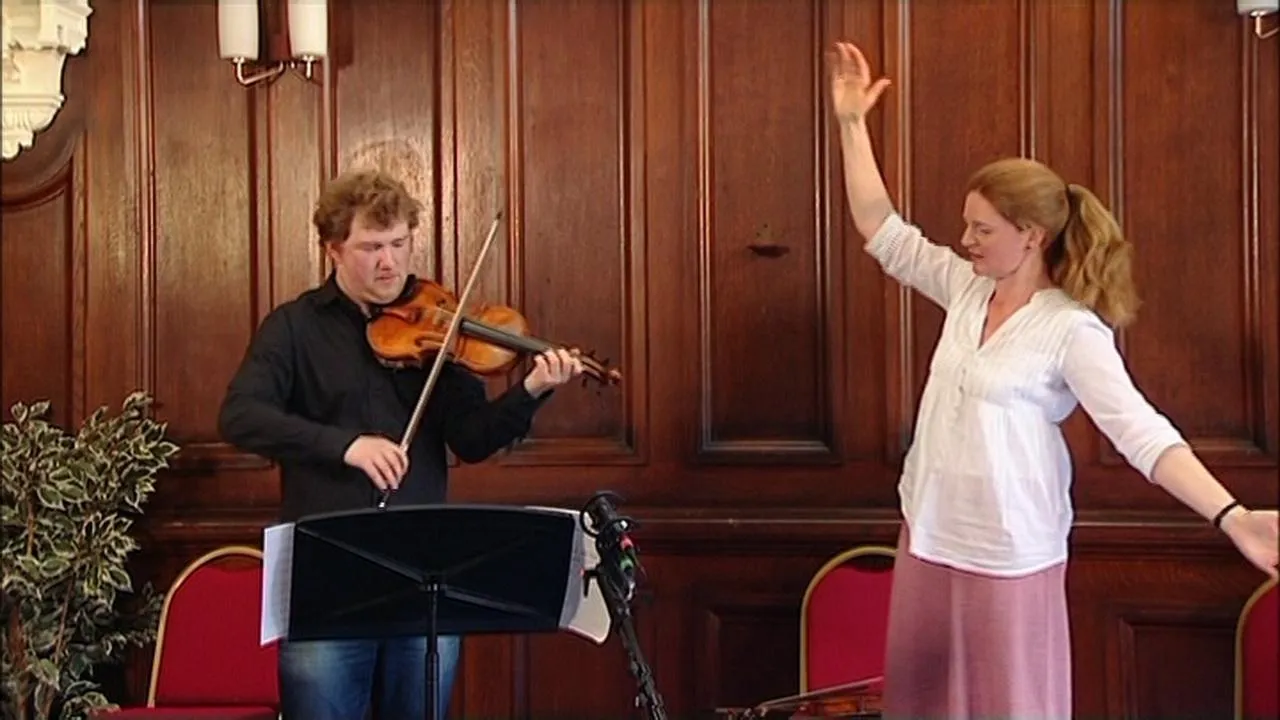
Music Lesson
Introduction
"That was beautiful playing. And I loved just everything you did. Just about, yeah, everything you did. So we have..."
Understanding the Music
"It's Vladimir. Yes. He's brought the Bible along. Here we are. This is actually not JS's handwriting, because we don't have that, unfortunately. That was lost. But this is Anna Magdalena, I think.
This particular prelude is really unusual, isn't it? Because he adds a fugue to it, and the other preludes don't actually have that. So this doesn't really feel so much like a prelude. The beginning does, but then it feels much more... We have a lot of meat because, of course, the violins get lots of fugues, but the cellists don't. That's our only one. Yes. So you're lucky to have this. Just this one country."
Exploring the Prelude
"Yes, with the kind of free style in mind, I was wondering about the first part of this prelude and whether it could have maybe even more of a kind of exploring nature. I thought you did some very nice things, but I was wishing for sometimes a little bit more time, or actually just a kind of feeling of enjoying the resonance even more, especially on the bottom string.
I don't quite know how much you need to go into the string with this particular instrument. Do you want to just try and see how much you could draw out the sound? Yeah, that's lovely. That's really great."
Focus on Chords
"Can you play one of those chords at the end, you know, when you go back to the kind of prelude, feeling those dissonance? Yeah, sorry for putting you on the spot. Yes, yes. Especially the dissonant chords. Could there be a bit more meat in those? Maybe draw the bow a bit slower?
Let's just hear that one. Could you play them with separate notes just to really, really find the sound on each note? Can you play legato? Kind of down and up. Down, up. He's got a fifth there. He's doing so well. It's hard to do, especially with gut strings."
Bow Techniques
"Yes. Okay. Can you just, as an experiment, nothing to do with baroque style or anything, could you play on an up bow? And can you feel like you're scooping? So you're not actually following the bridge like that?
It's like you're going the other way. You're going to pick another chord. Okay, yes, sorry. Yes, of course. How about just the last one?
Now, just as an exercise, could you bring out the middle voice with a slightly slower bow, so you're really scooping into the middle? Yes. And then follow through to the end."
Layering the Voices
"So let's try that on the down bow, see if we can get the richness in the middle.
Now, can you spend a little bit more time on the second note? So you have your bass note and your tenor... a bit more on the tenor. And now can you spend a bit more time on the alto? Bit more pressure on the alto. Bit more. Yes. And now on the soprano. Good.
And now on all of them. Aha. Yes. Okay, good. Can we play that really tricky one like that with a down bow? Yeah, great. I think maybe just a little bit more pressure would do."
Creating Resonance
"Yes, yes. So actually, you need to create a lot of resin. Especially, you know, we're sitting on carpet. I mean, it's not really the ideal place for a cello, right?
You really need a wooden podium to resonate with. And we've got lovely panels, but of course, there's lots of carpet and then lots of, you know, which is lovely, but of course, it affects the way the resonance works.
So that was one thing I had in mind, was that these chords just to have more resonance. And I think what helps is to get more of the middle, like we were doing that. This exercise of bringing out different voices really helps to do that. And do do it on an up bow as well, because it kind of makes you work harder."
Returning to the Beginning
"Can we go from the beginning and have more kind of freestyle harking back to the 17th century? Very nice.
Could we just, as an experiment, this might not go along with your concept, but just to kind of shake things up slightly, could you articulate the beginning of each slur?
Yeah, of course. You need to kind of place it so it follows after the chord. And could you have a little bit more of a pulse when the note values are shorter, so we actually feel the beat a little bit more? So we have the juxtaposition of this freedom chord.
Yeah, yeah, I understand now. Right, and then you can be a little bit freer. So a bit more of a contrast between the freedom and the pulse. Good."
Transitions and Dynamics
"In a way, the way you played it just now feels like a kind of introduction, doesn't it? And then the next one feels like the beginning.
And just talking of that, when you start with the C, could you play, or in your mind, could you separate the bass? Yes.
And actually, so it's doing this as though you're a keyboard player, and you actually see visually you're doing it with two hands at the moment. It sounds very mellifluous and really rich, but I don't hear the difference.
So really feel the fact it's in unison, and then it gets bigger and bigger. And take time. Good. Yeah. Personally, I'd like there to be more air. Yes.
Because I think that this dotted figure has something very, I mean, it's not just dancy, but it can be so many things. It can be elegant, it can be grand.
And with this whole kind of pedal of C all the time, it feels like it needs to be quite grand to me. You're very welcome to not agree.
I don't think I disagree. Yeah, I love that. But then can we also differentiate? Arrive. So a bit of timing, bit more gesture at the ornamented cadence.
And now relax. Where are we gonna go now? Time your bass also. Sorry to interrupt, but it gives you time to find the resonance, doesn't it?"
The Importance of Musical Structure
"Normally, something that works musically, if you've kind of made a technical change, it normally kind of marries up rather well. It can happen both ways. Sometimes you make the decision to change something musically, and technically, it's fantastic.
Or something's not working, and you change it technically, and you think, 'Oh, that works musically. Bingo. Brilliant.' You know, and it can happen both ways, can't it?
Tips for Playing
"Yes. Little tip: Slow bow and also a little front to the beginning of the slow. It just kind of helps you place it.
No, no, no. I think you realize anyway, you just need to be a bit lighter. Do you want a crescendo? Maybe a bit more? Or how is the hierarchy there? Or what were you thinking?
Okay, yeah. Let's hear that. Just the last note. Just lighten up. Yeah. It's like exactly your body. You just did it. You went like that. See? Exactly it."
Understanding Different Voices
"Okay, good. Yes. So different levels. Timing of the bass is one thing that does not need to react to how you've played the top.
So if you can see them as different entities, as though there are different players there with their own mindset, and they just happen to meet up, like counterpoint."
Feeling the Music
"Okay. Yeah, that's a big chord, isn't it? If you... I think it needs to be bigger and hold a little bit bigger at the end so that you then... because the phrase is longer.
I think you need more Spanish, what would happen, Vladimir, if you went...? Yeah, good, great. Let's really feel the huge difference. Yum. Maybe take a bit more time bowing.
I mean, you can, I'm sure you can do that on either way around. But it needs front, doesn't it? The bottom note. Oops. That was beautiful. Really, really, really great."
Reflection on the Prelude
"Yeah, that doesn't feel like a prelude much, does it? Feels like an overture with a... Yes. Da dum, da da ba ba.
Very grand. Very French. French overture, isn't it? And then we have the obligatory fugue after."
Transition to Fugue
"Do you want to go straight in? Okay, thank you. Do you want to start it a little bit slower and then get into it? Is that conscious? Yes and no.
It's conscious, yes. I have this idea. I want to already make clear that there's a bom bom and then a completely separate bom. Boom, boom, boom, boom, boom. Okay."
Finding Clarity in the Music
"I found that if I start straight away in a kind of faster tempo, it just all gets slightly muddled.
I also felt that. Muddled in your head? No, muddled in... No, no, muddled in sound. It didn't just sound like a pile of notes.
Yeah. That didn't make that much sense. And also coming from the prelude, it felt very odd to me to snap out of it and snap into something different.
I did actually do that for a while, and it never made sense to me. Okay. And I decided to find something different.
Yes. No, that's great. It's definitely a way of doing it. I understand that. Could we try something different? Maybe. If you feel. I mean, it's quite direct music.
There's kind of... There are no doubts anywhere. If you look at the theme, Dum ding dum bum, like you sang just now, it's actually what it is. There's no kind of sense of having to get into it from what I can see."
Direct Approaches to Performance
"So how about you have the direct approach in your head and you think voices? Just that. And think space and voices. So it's actually very, very straightforward.
Well, just motivic then. Okay, good. Yeah. Yeah. I love that. I don't know what you think.
I think your way was also very nice, but it just seemed less convincing. I think partly because it was very soft and just wasn't one... wasn't quite sure what's happening, where it's going."
Nuances in Performance
"So do feel free to try the kind of warming up approach, but maybe with a bit more space and a bit more of the feeling of telling the story, and really showing the listener what's happening.
Just putting all your cards on the table. Aha. Here we have this down that. And then this carries on, and that's connected to this.
And now we cadence, you know. So you actually explained... I think that's what I was trying to do. Just came into it the wrong way.
No, no. Could you bring out the syncopation a bit more? There's quite a lot of fun in this as well. It's not just serious, is it?
Yeah. So a lot of that. Yeah. Good. Yeah. Just be... There's a slight danger to rush once you've done the little voices. I think it's lovely to have the direction, but we just need to have the nuance of arrival beforehand.
Do you know what I mean? Do you want to do that last thematic bit? I think it was the higher one. And sing this ornamentation.
Yeah. Yes. Let's hear that a little bit more. You're doing beautiful things. I think the nuance just needs to be spoken a little bit more."
Final Thoughts on Performance
"One, it's cause it's over the string, is it Tia? Yeah, that one. Yeah. No more gesture. Yes, more time. There's no rush, you know.
I mean, it's a big instrument. It takes a long time to get from there to there. And he knew that, didn't he? And he's doing that for reasons.
Big voices. So sopranos are doing that. Reasons. We have big voices, and he's doing that for... He knew that, didn't he?
There you go. And it's a big instrument. It takes a long... You know, I mean, there's... There's no rush.
So sopranos are doing that. Reasons... We have big voices, and he's doing that for... He knew that, didn't he?
There's a long time to get from there. More time. There's no rush. He knew that, didn't he? It's a big instrument.
It takes a lot, you know. I mean, it's... There. And he... Long time to get from there. More time.
There's this no rush, and he's doing that for a reason. So we have big voices. He knew that, didn't he?
It's a big instrument. It takes a lot... and he's doing that for... you know. I mean, and he... sopranos are doing that. Reasons.
So you have big voices. More time... long time to get from there. He knew that, didn't he?
There's this no rush, you know... I mean, more time. And he's doing that for sopranos are doing it for a reason...
So we have big voices. He knew that, didn't he? It's a big instrument. It takes a lot... He knew that, didn't he? There. And he...
There's this no rush. Long time to get from there. More time. There's no rush."
11 Lektionen
2 Std. 38 Min. strukturierte Videolektionen
Erweiterte Videofunktionen
Verlangsamen, Passagen loopen, mitlesen
Handy, Tablet & Desktop
Üben, wo du willst
100 % Zufriedenheitsgarantie
30 Tage Geld-zurück-Garantie
Lern deinen Guru kennen
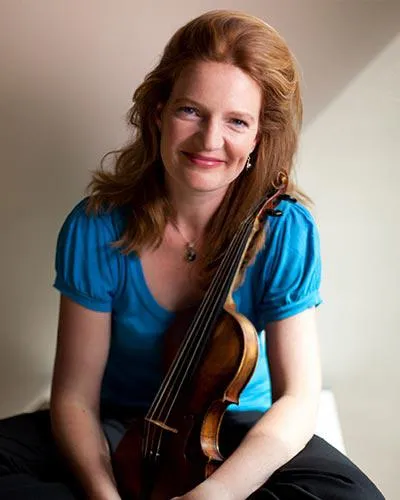
Lern deinen Guru kennen
Rachel Podger ist eines der kreativsten Talente, die auf dem Gebiet der historischen Aufführungspraxis hervorgetreten sind. In den vergangenen zwei Jahrzehnten hat sie sich als führende Interpretin der Musik des Barock und der Klassik etabliert, mit zahlreichen Aufnahmen, die von der Musik des frühen 17. Jahrhunderts bis zu Mozart reichen. Sie wurde in Deutschland und in England an der Guildhall School of Music and Drama ausgebildet, wo sie bei David Takeno und Micaela Comberti studierte.
Nach Anfängen mit The Palladian Ensemble und Florilegium war sie von 1997 bis 2002 Konzertmeisterin von The English Concert. 2004 begann Rachel eine Gastleitung beim Orchestra of the Age of Enlightenment und tourte durch Europa und die USA. Ein Höhepunkt dieser Zusammenarbeit war ein im Fernsehen übertragenes Konzert bei den BBC Proms 2007. 2009 entstand eine Aufnahme von Mozarts Sinfonia Concertante mit dem Bratschisten Pavlo Beznosiuk, zusammen mit zwei Violinkonzerten von Haydn.
Über die Jahre hat Rachel zahlreiche Kooperationen mit Orchestern in aller Welt genossen; ihr besonders am Herzen liegende Projekte umfassten jene mit Arte dei Suonatori (Polen), Musica Angelica und Santa Fe Pro Musica (USA), der Academy of Ancient Music, der European Union Baroque Orchestra und der Holland Baroque Society.
In ihrem MusicGurus-Kurs über Bachs Werke für Violine und Violoncello solo erschließt Rachel dieses grundlegende Repertoire und teilt, wie sie es angeht, und hilft dir, stilistisches Verständnis, Phrasierung und barocke Sensibilität in dein eigenes Bach-Spiel einzubringen.
Fotocredit: Jonas Sacks







