



Sharp Suit (Durchgang)

Mit
Talia Girton
Das steckt im Kurs
21 Lektionen (0h 42m) · 1 gratis










Transkript der Lektion
Music Lesson: Sharp Suit
Let's have a look at Sharp Suit. In my opinion, this is the trickiest piece in the entire course. So, take your time, go slowly, and be patient with yourself.
Rhythmic Patterns
We're going to explore some of the rhythmic patterns that show up several times in the piece.
Bass Clef
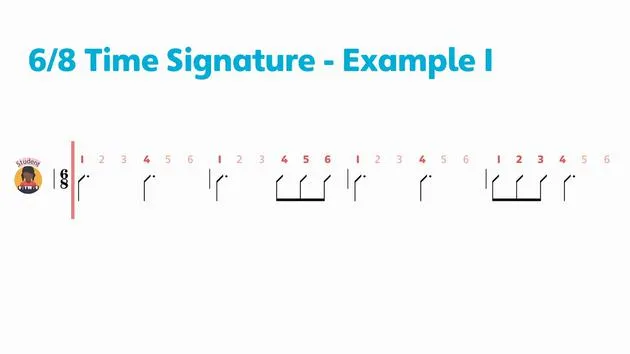
Let's first look at the bass clef of bar one. You can see that there is:
- A dotted quarter note
- Followed by an eighth note
- Another dotted quarter note
- And another eighth note.
If I snap that rhythm, it sounds like:
1 and 2 and 3 and 4.
The same rhythmic pattern repeats for all of the bass clef notes, with some minor variations for the rest of the piece.
Right Hand Rhythms
There's also some tricky right hand rhythms, so I want to do a couple of those with you.
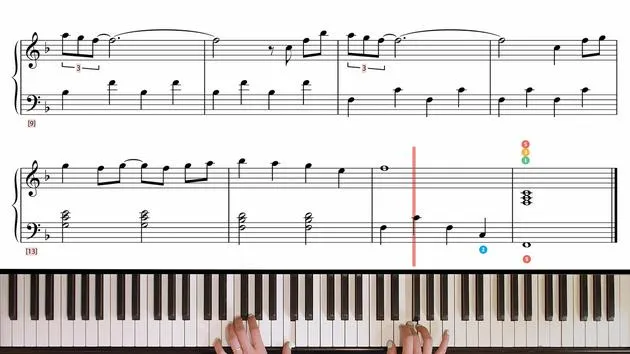
Bars Two to Three
First, have a look at bars two to three in the treble clef.
I'll count you in:
1 and 2.
Then I'll try playing the right hand part here:
1 and 2 and 3 and 4 and 1 and 2 and 3 and 4.
Bars Six to Seven
There's another tricky rhythmic part in bars six to seven. Watch out for those tied notes here as well. It sounds like this:
I'll count to four first:
1 and 2 and 3 and 4 and 1 and 2 and 3 and 4 and 1 and 2 and 3 and.
So, you're really going to have to be careful with that syncopation.
Practice Tips
Once again, take this piece slowly.
- Do it separate hands first
- In very small chunks.
Then you can try it with the backing track.
Remember: You've got the interactive sheet music, so you can speed up and slow down the track as needed, allowing you to go at a pace that's comfortable for you.
Demonstration
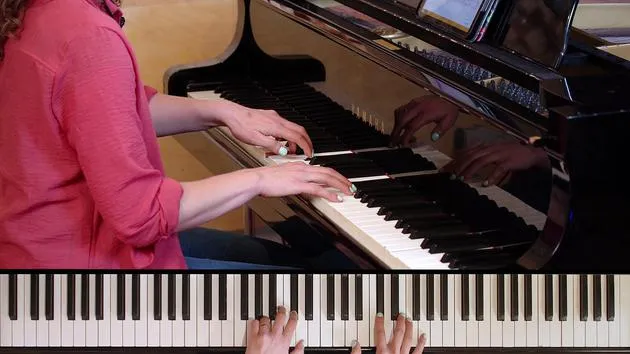
Let's have a listen to what this song would sound like:
1 and 2 and 3 and 4 and 1 and 2 and 3 and 4 and 1 and 2 and 3 and 4 and 1 and 2.
3 and 4 and 1 and 2, 3 and 4 and 1 and 2 & 3 and 4.
And 1 and 2 and 3 and 4 & 1 and 2 and 3 and 4.
And 1 and 2 and 3 and 4.
And 1, 2 and 3 and 4.
And 1 and 2 and 3 and 4, and 1 and 2 and 3 and 4 and 1 and 2 and 3 and 4.
Finger Numbers and Position Changes
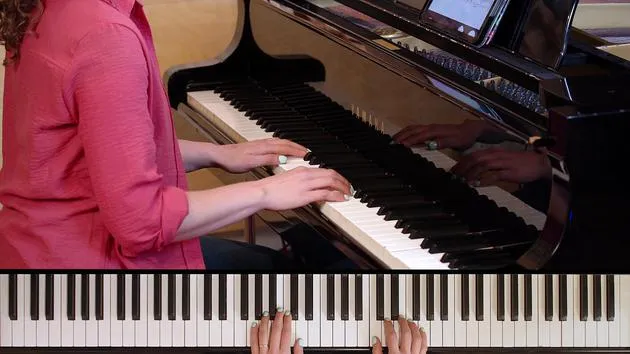
Be sure to watch out for the finger numbers because they're going to be really helpful where you need to make those changes. You might also need to pay attention to where you need to change your finger position, but it's actually not written in the music for you.
Conclusion
So, take some time to think about this again. This is a really, really tricky piece, so take your time, be patient with yourself, and break it down into small chunks. If you ever get frustrated, take a break and come back to it.
Let's now have a look at what this would sound like with the backing track.
21 Lektionen
0 Std. 42 Min. strukturierte Videolektionen
Erweiterte Videofunktionen
Verlangsamen, Passagen loopen, mitlesen
Handy, Tablet & Desktop
Üben, wo du willst
100 % Zufriedenheitsgarantie
30 Tage Geld-zurück-Garantie
Lern deinen Guru kennen
Lern deinen Guru kennen
Talia Girton ist Musikerin und beim HCPC registrierte Musiktherapeutin sowie Gründerin von The Cycling Music Teachers. Ihre Arbeit verbindet Musiktherapie, Beratung und Pädagogik, und sie unterrichtet international im Musiktherapie-Ausbildungsgang der UDELAS in Panama und wirkt zudem an der beruflichen Weiterbildung mit der European Piano Teachers Association (EPTA) mit. Auf MusicGurus unterrichtet sie die Kurse Piano Method und Piano Foundations und führt absolute Anfänger von den ersten Schritten über Rhythmus, beide Hände, Theorie bis zur Aufführung.







