



Viertelnoten und Achtelnoten
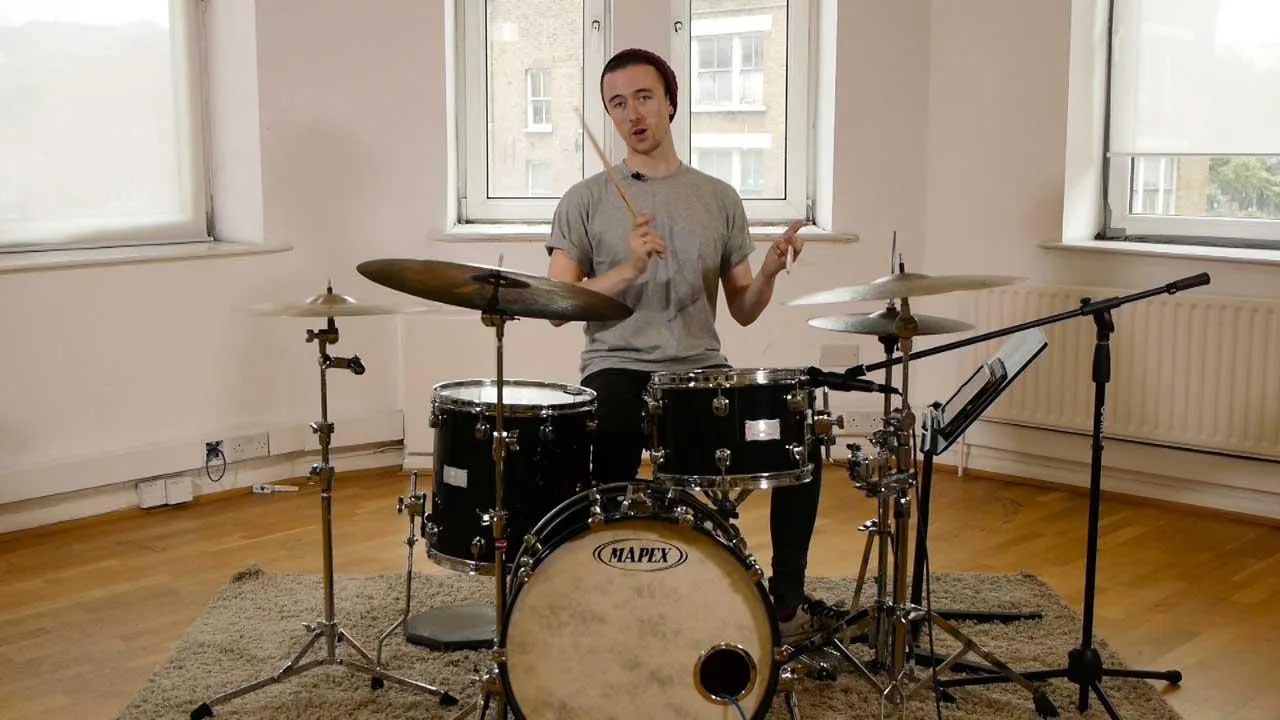
Lesson time: (6min 5sec)
Harry Pope stellt zwei neue Notenwerte vor - die Viertel- und die Achtelnote - und zeigt dir, wie du sie zwischen Bassdrum und Hi-Hat zählst und spielst.
Course preview
This lesson is part of the course Meine erste Schlagzeugstunde
Watch a preview of the full course below.
Lesson transcript:
Lesson Four: Introduction to Quavers
Hello. Welcome back. This is lesson four.
Recap of Lesson Three
In lesson three, we learned to play a really basic rock beat like this.
- The actual notes we're playing are crotchets, and they last for one whole beat.
- So we're counting like this: 1, 2, 3, 4.
That's our pulse just there.
Introducing Quavers
Now what we're going to do is add a new value of note, a new type of note, and they're called quavers.
- A crotchet lasts one whole beat: 1, 2, 3, 4.
- A quaver lasts for half as much, meaning we can fit two quavers in one crotchet: 1 and 2 and 3 and 4 and.
So again, to summarize:
- Crotchets: One whole beat.
- Quavers: Half a beat.
Demonstration
To demonstrate that, I'm going to play crotchets on the bass drum: 1, 2, 3, 4.
Alongside that, I'm going to play quavers on the hi-hat so you can hear them both together:
1 and 2 and 3 and 4.
Does that make sense? I hope so.
New Beat with Added Quavers
In this next beat we're going to learn, it's essentially an evolution of the beat we learned before with just some added quavers.
-
The part for the bass drum and the snare drum remains the same: 1, 2, 3, 4.
-
The hi-hat will be playing quavers on all the beats:
1 and 2 and 3 and 4.
In time, it sounds like this:
1 and 2 and 3 and 4.
Practicing the Beat
Taking it very slowly:
1 and 2 and 3 and 4.
A good way to start is to get the hi-hat going first:
1 and 2 and 3 and 4 and.
Then, start adding the bass drum:
1 and 2 and 3 and 4 and.
Important Coordination Tips
So far, we have the bass drum and the hi-hat.
It's important to remember that, although the bass drum is playing on beat three because it's a crotchet, it's not playing on both of the quavers.
This is not what you're looking for:
1 and 2 and 3 and 4 and.
What we want is:
One crotchet on beat one and one crotchet on beat three.
So that would sound like:
1 and 2 and 3 and 4.
Sound Quality
It's also good to think about the sound we're getting from each instrument.
Now that we have the basic coordination together, aim for a nice, strong sound from the bass drum.
- I'm using heel up at this point.
- You can use heel down if you want, but heel up provides a nice focused sound: 1 and 2 and 3 and 4.
Adding the Snare Drum
Once we've got that together, let's start adding the snare drum:
1 and 2 and 3 and 4.
Repeat:
1 and 2 and 3 and 4.
This is the same beat we had before:
- 1 on the bass drum,
- 2 on the snare drum,
- 3 on the bass drum,
- 4 on the snare drum.
This may be simple, but that doesn't mean it can't sound really, really good.
Listening Example
Check out "Billie Jean" by Michael Jackson for an absolute lesson on how good this can sound. It's one of the most listened to and sampled beats in the world, and it is just brilliant.
Final Summary
To sum up:
- 1 on the bass drum
- 2 on the snare drum
- 3 on the bass drum
- 4 on the snare drum
- All in crotchets with quavers on the hi-hat: 1 and 2 and 3 and 4 and.
Overall, it sounds like this.
Key Takeaway
Remember:
- Crotchets last one whole beat.
- Quavers last half a beat.
It's crucial to get these subdivisions right because that's how the grooves are going to sound great.
Now that we've added the quavers, I'm going to leave you there.
Thank you very much for watching, and I will see you in lesson five!
About the instructor
Harry Pope ist ein Londoner Schlagzeuger und Absolvent des Jazzprogramms am Trinity College of Music. Er hat mit der Brit-Award-Gewinnerin Eddi Reader, dem Gitarristen Jim Mullen, Graeme Duffin von Wet Wet Wet und der Royal Scottish National Orchestra Big Band gespielt. Sein Kurs für Anfänger beginnt beim Schlagzeug selbst – Haltung, Griff, Timing und deine ersten Grooves – in einem Tempo, das jedem passt, der zum ersten Mal die Sticks in die Hand nimmt. read more