



Ride-Becken und offene Hi-Hat hinzufügen
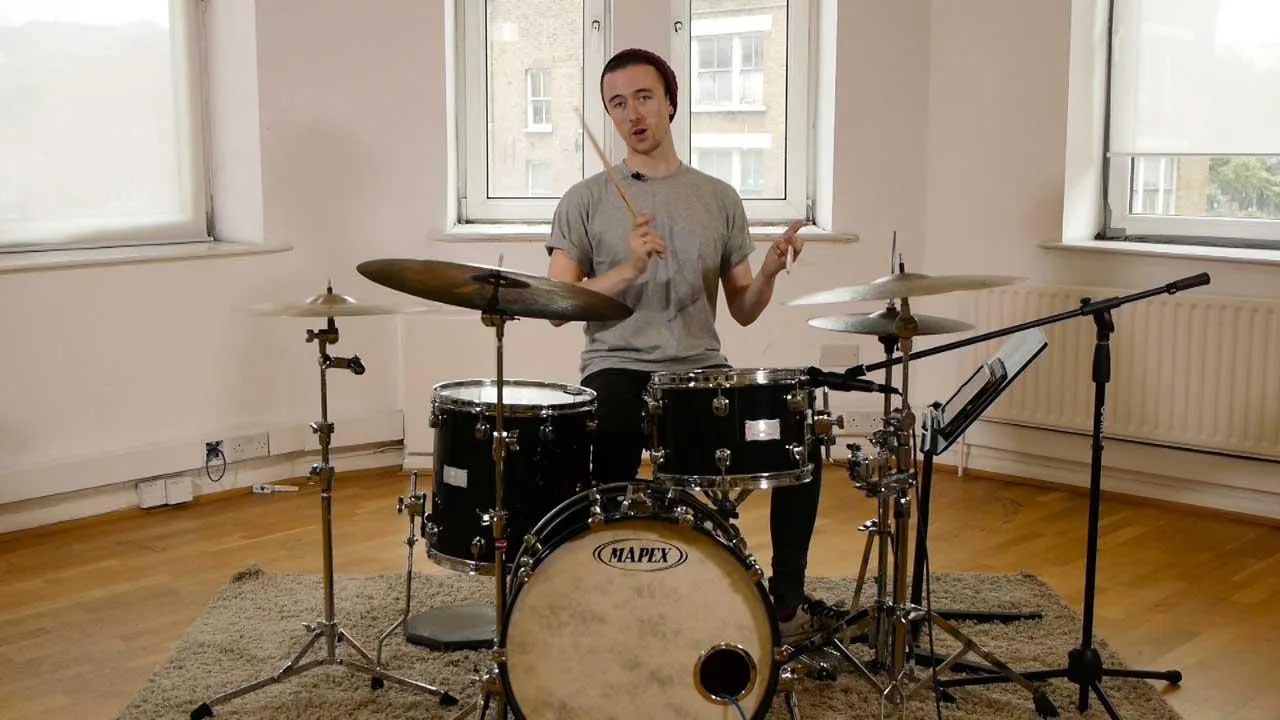
Lesson time: (7min 8sec)
Harry führt deine taktgebende Hand zum Ride-Becken und bringt die offene Hi-Hat ins Spiel, mit Tipps, wann und wo du jeweils zuschlägst.
Course preview
This lesson is part of the course Meine erste Schlagzeugstunde
Watch a preview of the full course below.
Lesson transcript:
Lesson: Exploring the Ride Cymbal and Hi-Hat Techniques
Hey, welcome back again!
Introduction
In this lesson, we're going to start moving our timekeeping hand when we're playing grooves. We'll begin by shifting from the hi-hat to the ride cymbal.
Ride Cymbal vs. Hi-Hat
The ride cymbal produces a much washier sound compared to the hi-hat. It's less of a "chick" and more of a nice underbody of sound.
Exercise: Playing the Ride Cymbal
Let's try the beat we practiced last lesson, featuring the two semiquavers and the "and" of two, but this time, we'll place our right hand on the ride cymbal.
Tips for Playing the Ride Cymbal
- Aim for the following areas:
- Edge: If you hit it too close to the edge, it will crash immediately and lose definition.
- Bell: Playing on the bell creates a cool sound, but ensure it's the sound you're looking for.
- Body: Hitting around the body provides a nice wash. The bell is a lot straighter.
Both are valid choices; just be aware of the differences.
Demonstration
Here's how it sounds on the ride cymbal: (Same beat as before, but with the right hand on the ride cymbal.)
Practically every beat you play on the hi-hat can be transferred to the ride and vice versa. This gives you another sonic choice, which is especially useful when playing with a band.
Example: Billie Jean
For instance, when playing a song like Billie Jean, you can transition between the verse and chorus. This simple shift offers two vastly different possibilities with the same groove.
Experimenting with Open Hi-Hat
The second part of this lesson will focus on experimenting with an open hi-hat.
Open Hi-Hat Technique
We already have the foot "chick" sound, but what happens when you play it while the hi-hat is open? A completely different sound!
- How to Open the Hi-Hat:
- Loosen your foot just enough so that both cymbals hit off each other, creating that nice sizzle.
Play the Beat
Let's take the same beat and incorporate the open hi-hat.
- Pattern: Open the hi-hat on beat four and then close it again on beat one.
- Result: It will sound like this:
- "One and two and three and four. Open, open, shut, open, shut."
Focus on Timing
The tricky part is getting the hi-hat back down on beat one. Remember:
- On beat one, both feet come down.
- Open feet should come straight down immediately.
Sound Quality
Aim for a nice, washy sound. Avoid the crash cymbal sound. The beat can sound great at any tempo, slow or fast, but maintains the same groove.
- Variations:
- The first groove sounds really rocky, like Black Sabbath, pure heavy stuff!
- The second almost resembles an Uptown Funk vibe. For that sound, ensure the hi-hats are tightly closed for a defined "chick."
Practice Assignment
What I'd like you to do is:
- Practice the groove at your own comfortable speed.
- Experiment by filling in semiquavers, changing your hand position with each beat.
This could result in something completely different!
Remember:
- If you want consistency, keep your hands the same.
- Start thinking of your own variations to make it your beat, not mine.
Conclusion
As always, practice it slowly. Remember: rebound sticks are key, rebound, rebound, rebound, and more rebound.
Thanks very much for watching!
About the instructor
Harry Pope ist ein Londoner Schlagzeuger und Absolvent des Jazzprogramms am Trinity College of Music. Er hat mit der Brit-Award-Gewinnerin Eddi Reader, dem Gitarristen Jim Mullen, Graeme Duffin von Wet Wet Wet und der Royal Scottish National Orchestra Big Band gespielt. Sein Kurs für Anfänger beginnt beim Schlagzeug selbst – Haltung, Griff, Timing und deine ersten Grooves – in einem Tempo, das jedem passt, der zum ersten Mal die Sticks in die Hand nimmt. read more