



Den Rhythmus im 5/4-Takt fühlen - mit Take Five, 5/4-Etüden
Darius und Mike nutzen Dave Brubecks berühmtes Stück Take Five, um zu erklären, wie man einen 5/4-Takt fühlt, einschließlich der verschiedenen Arten von Metren und Unterteilungen, die innerhalb dieses Taktes verwendet werden können.

Das steckt im Kurs
12 Lektionen (2h 10m) · 1 gratis
01. Den Rhythmus im 5/4-Takt fühlen - mit Take Five, 5/4-Etüden
Du bist hier13:06

02. Die Melodie im 5/4-Takt platzieren - mit Take Five, 5/4-Etüden
11:57

03. Ideen zum Improvisieren im 5/4-Takt - feat. Take Five
12:28
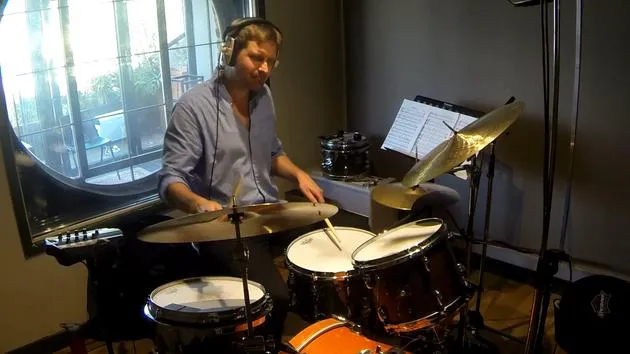
04. Fortgeschrittene Ideen zur Improvisation im 5/4-Takt - feat. Take Five, District Five
16:36

01. Full-Band-Performance von 5/4-Stücken - Take Five von Paul Desmond
6:34

02. Performance mit voller Band von Stücken in 5/4 - District Five von Darius Brubeck
4:08
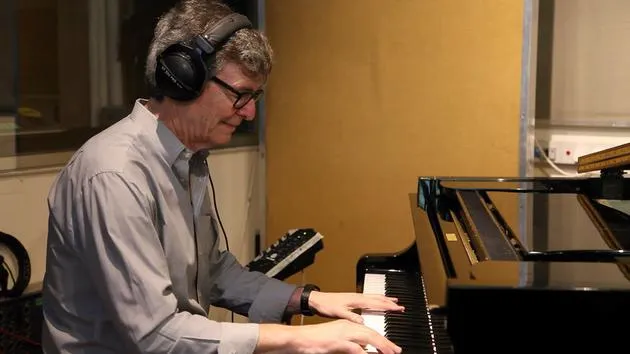
03. Full-Band-Performance von 7/4-Stücken - Unsquare Dance von Dave Brubeck
3:53
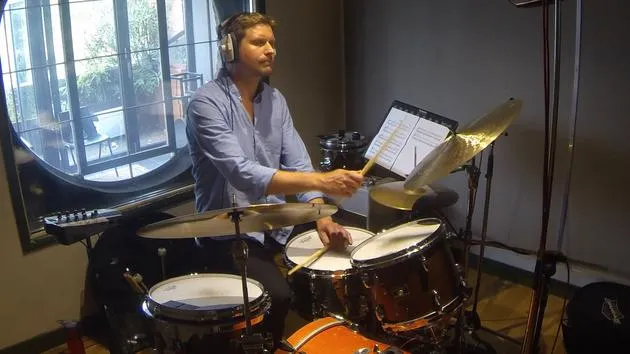
04. Performance mit voller Band von Stücken in 7/4 - Earth Rise von Darius Brubeck
6:13
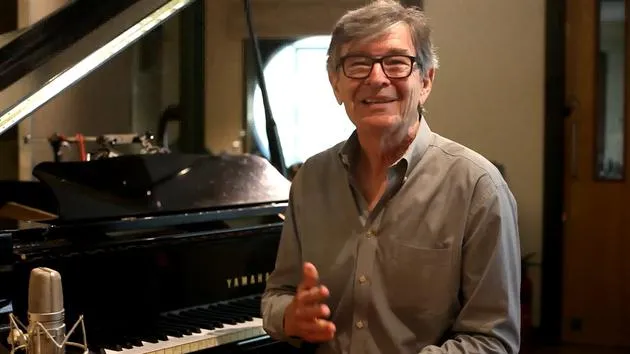



Transkript der Lektion
Welcome to Music Gurus
In this episode, we're going to talk about 5/4. You've just listened to the introduction to Take Five. We haven't heard the tune yet, but you probably recognize Take Five already because that's one of the most familiar vamp-ins in contemporary music.
If you're walking across a shopping mall or you hear someone busking in the subway, they might well be playing this. Even people who aren't jazz fans consider this pretty familiar. And so it is, because it's been around for a long time.
Playing in Odd Meters
Some people might consider playing in odd meters difficult. Sometimes it is. It is for me too. But when something is as familiar as this, you can afford to stop thinking of the meter and to stop counting. Just think of it as a beat you're used to playing in 4/4.
But there are a lot of different ways of playing 4/4. It could be:
- A bossa nova
- Afro Cuban
- Regular jazz swing
Because it's familiar, we don't realize how complicated it is, but it's really a polyrhythm superimposing three against two. And so it is with the Take Five vamp that is so familiar.
Understanding the Five
What makes it five is that it is simply three plus two. Because Take Five was a hit so long ago and remains heard, when we think of 5/4 in jazz, that's the kind of feel we expect.
When you listen to the drums at the beginning, they're superimposing a regular jazz feel. But let's just drop meter for a moment and talk about the beat. The beat is really a three against two. The three is divided evenly, one and a half.
That's dotted quarter notes in American parlance, or, I should say, dotted quarter notes plus two quarter notes. And when we were vamping in, you got to hear the drums for four bars.
The Feel of Jazz
Notice how easy that really is. It has an even number feel because 20 is an even number, it's 20 beats. When we're playing jazz, we're not trying to make it complicated necessarily. When we add different meters to our vocabulary, it's just a way of giving more variety.
The bass is articulating the parts of that beat:
- 1, 2 and 3, 4, 5.
- 1, 2 and 3, 4, 5.
- 1, 2, 3, 4, 5.
That's basically the Take Five 4 formula. When we get to the melody, we'll see other ways that this three plus two is being articulated and divided.
Introducing Different Divisions
Now, to be complete, we should say there's an unfamiliar way of dividing five. Of course, you can do two plus three, and that is often something we might do even when we're improvising.
In Take Five, the familiar 3/2 just makes it more interesting to cut up our lines into different units. Mike Rossi, who wrote many etudes, lines, and exercises for the Odd Times book, has put it all down into units that you can practice.
I'm going to have him illustrate on the saxophone, going three plus two in a familiar way, and then the opposite way, two plus three.
Practicing the Beat
Let's just start with the beat:
- 1, 2, 3, 4, 5.
- 1, 2, 3, 4, 5.
- 1, 2, 3, 4.
Now practice accenting three:
- 1, 2, 3, four, five.
- 1, 2, 3, Four, Five.
- 1, 2, 3, four, five.
Now practice accenting four:
- 1, 2, 3, FOUR, FIVE.
- 1, 2, 3, 4, 5.
- 1, 2, 3, four, five.
To kind of internalize the two and the three and the three and the two, you can take just the first five notes of your minor scale, starting on E-flat concert, and play the first five notes and group them that way.
So I'll first start with:
- The more common one would be three, two.
Now we'll do two plus three:
- Da da da da da da da da da da.
So it gives you kind of a feeling, and you're feeling the subdivisions within the beat to use when you're starting to improvise or starting a phrase, or ending a phrase, or playing with the drummer, or playing with the bass player or the piano player and how they accommodate you.
Additional Resources
Also in the book, and as a play-along part of this series, there's a tune called Take Another Five, which demonstrates three, two, and then switches in the next section at the B section to two plus three and alternates back and forth. So you'll find that quite useful to play along with.
In addition to having a listen to Take Another Five, if you check out also in the book and a PDF of a 5/4 minor etude, done in a play-along fashion, included with this series is three plus two.
So Darius and I, why don't we give it a go and play the first part of that? This illustrates three plus two over C minor and B-flat minor going back to C minor.
Performing Together
Okay. Actually, it's quite long if you play the whole thing because it's going through 12 keys. So let's do the first four lines, and then like you said, we'll just go back to the top. Cool.
Here we go:
- 1, 2, 3, 4, 5.
All right, so that was the basic three plus two, Take Five kind of rhythm.
Moving On to Etudes
Now we're going to move on to an etude, which will require a lot more concentration because I'll have to be alert to the fact that the melody goes from three plus two to two plus three.
If you look on page 18, you can see in the first line, it's a dotted half note, half note. That rhythm articulates perfectly:
- 1, 2, 3, 4, 5.
- 1, 2, 3, four, five.
The next line where the chord changes goes da, da, da, da. So you have the syncopated three, the sort of jazzy three, and the three divided into two equal parts, preceded by two accented beats.
So that's where we have to be alert. And Dr. Rossi wrote this, and he's responsible for that difficulty.
Here we go: So starting off three plus two, switching to two plus three every eight bars:
- One, two, three, four.
Okay, so there we have an example. You can start using these, turning these around if you want to bar by bar or every four bars and playing with them.
Final Thoughts
The thing is to do it slowly and to mark those changes when they occur. It's like Darius says, so you're aware of it, and the others in your group or your band are also aware of it.
We've tried to use the Take Five rhythm. Turning it around makes it a little more complicated, but overall, the feel is pretty much the same.
It's a swing feel superimposed on 3/2 or 2/3. In every case, the 3 is cut into two equal parts, and that's what makes it sound jazzy. That's what relates it to swing.
12 Lektionen
2 Std. 10 Min. strukturierte Videolektionen
Erweiterte Videofunktionen
Verlangsamen, Passagen loopen, mitlesen
Handy, Tablet & Desktop
Üben, wo du willst
100 % Zufriedenheitsgarantie
30 Tage Geld-zurück-Garantie
Lern deinen Guru kennen

Lern deinen Guru kennen
Darius Brubeck ist ein renommierter Jazzpianist und Musikpädagoge. Er hat zahlreiche Alben als Bandleader veröffentlicht, ist international mit seinen eigenen Gruppen getourt und hat mit seinen Brüdern an Brubecks Play Brubeck zusammengearbeitet.
Darius war als Fulbright-Gastprofessor in Rumänien und der Türkei tätig. Er rief den ersten Jazz-Studiengang an einer afrikanischen Universität ins Leben, an der University of KwaZulu-Natal in Südafrika, wo er bis 2005 unterrichtete.
Darius arbeitet häufig mit Mike Rossi zusammen, Saxofonist und Musikprofessor an der University of Cape Town. Zu Mikes Verdiensten zählen zahlreiche Aufnahmen und internationale Bühnenauftritte als Leader, Solist und Sideman unter anderem mit Tony Bennett, Dave Liebman, Winston Mankunku Ngozi, George Russell, Clark Terry und Alessio Menconi.
Mit Darius als Mentor kommst du direkt zum Wesentlichen. In Harmony 101 entmystifiziert er die Jazzharmonik, damit du sie schnell anwenden kannst, und in Mastering Odd Times zeigt er dir, wie du in ungewöhnlichen Taktarten souverän spielst und improvisierst.







