



Die 'Horn Lines' hinzufügen

Mit
Tom Seals
Das steckt im Kurs
23 Lektionen (1h 39m) · 1 gratis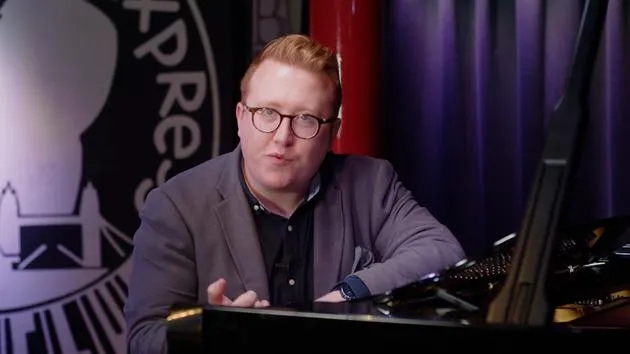
01. Einführung in Jumpin' At The Woodside
1:19
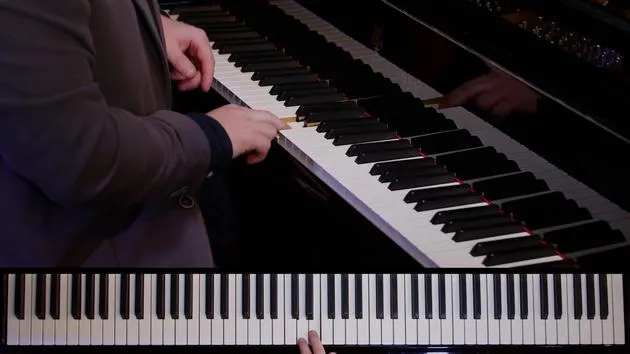
02. Die Melodie der rechten Hand des 'A'-Teils
Gratis-Lektion1:19
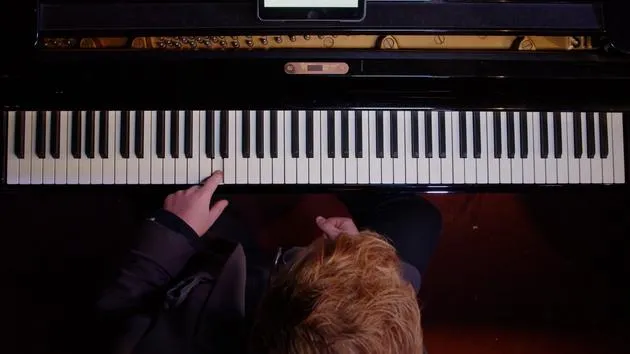
03. Die linke Hand des 'A'-Teils
8:09
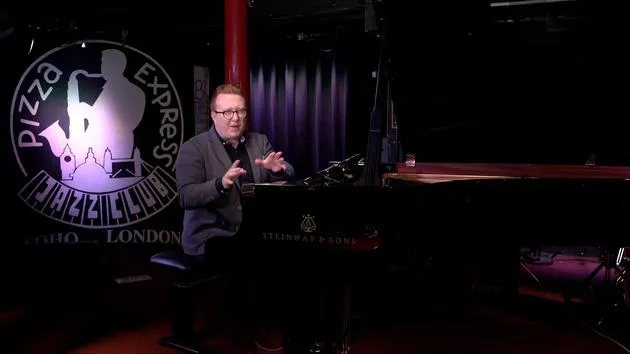
04. Übe den 'A'-Teil mit Tom
3:31
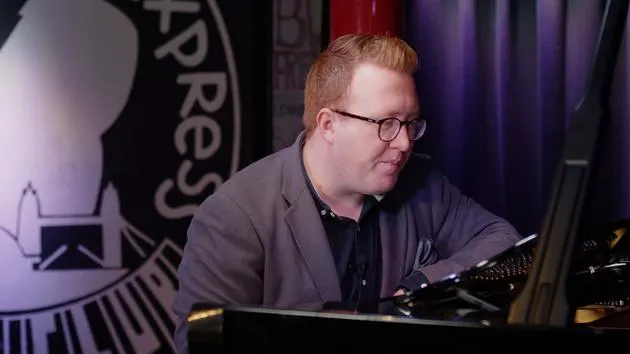
05. Der 'B'-Teil in der rechten Hand
6:48
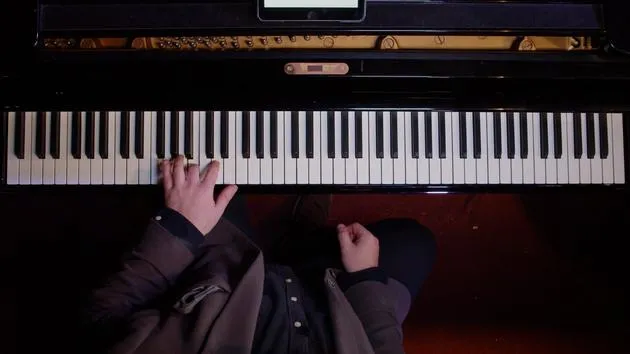
06. Der 'B'-Teil von Jumpin' At The Woodside in der linken Hand
1:23
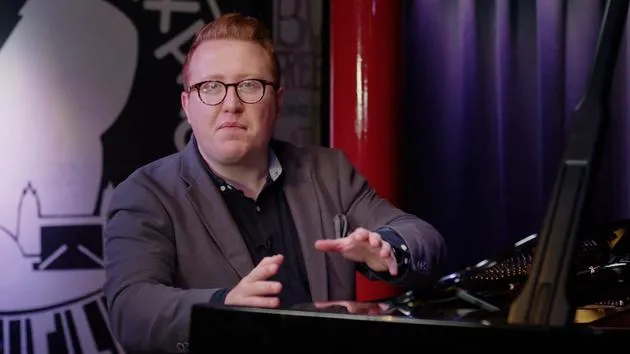
07. Übe den 'B'-Teil mit Tom!
3:17
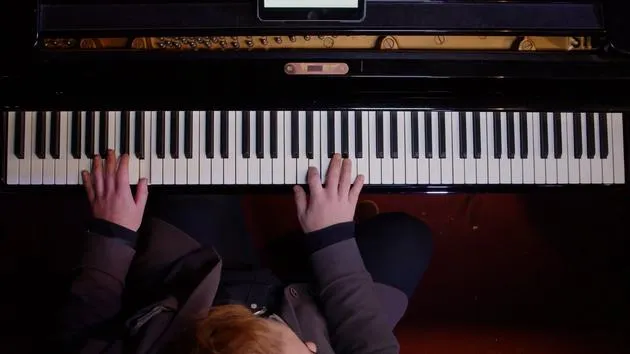
08. Übe Jumpin' At The Woodside mit Tom
4:16
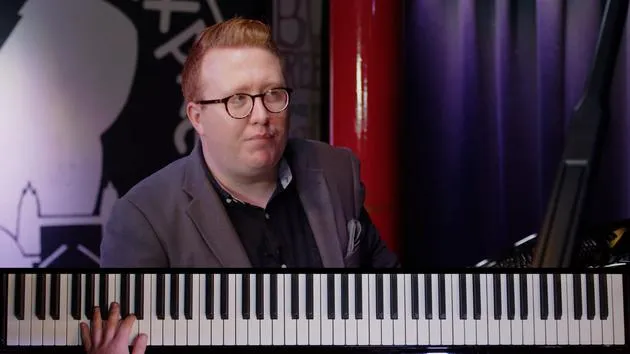
09. Comping mit der rechten Hand
6:17

10. Ideen zur Verzierung
7:05
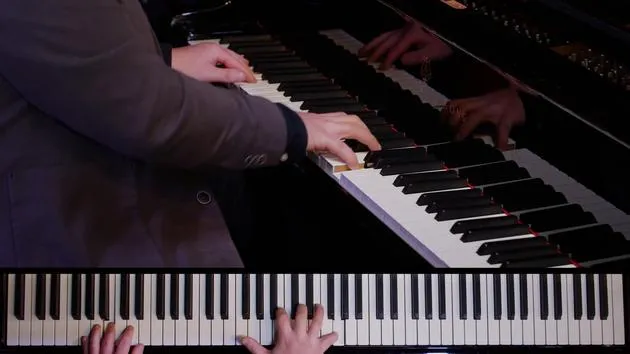
11. Jumpin' At The Woodside – Performance
2:08
01. Die Melodie der rechten Hand im 'A'-Teil
5:13
02. Die linke Hand des 'A'-Teils
5:31
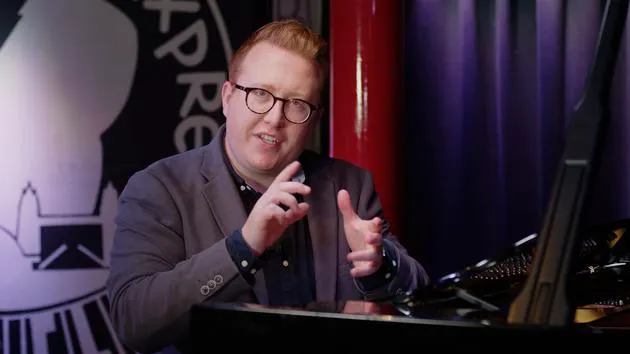
03. Die 'Horn Lines' hinzufügen
Du bist hier9:22

04. Der 'B'-Teil in der rechten Hand
4:56
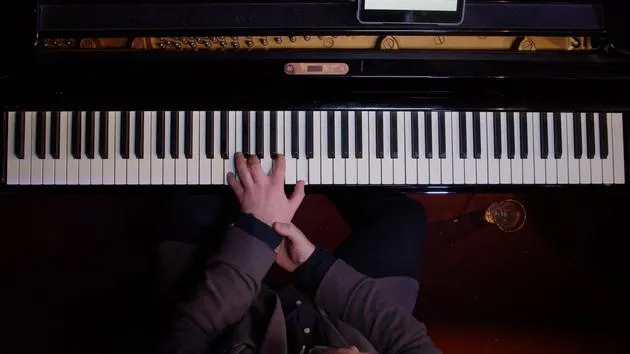
05. Der 'B'-Teil in der linken Hand
9:17

06. Übe Don't Get Around Much Anymore mit Tom
6:18
07. Tipps zum Improvisieren
1:38
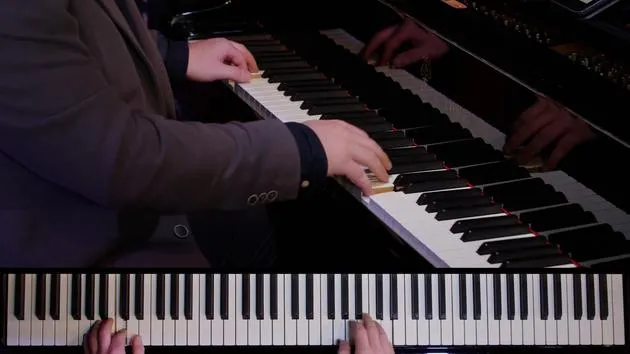
08. Solo-Ideen
5:47

09. Don’t Get Around Much Anymore – Performance
3:11



Transkript der Lektion
Music Lesson: A Section - Right and Left Hand Integration
So now you've got the right hand and the left hand of the A section. What I want to do now is add the horn lines in.
Vocal Melody:
The vocal melody which you're playing, the lead melody, is:
Ba ba da da da da.
Left Hand Rhythm:
Now your left hand is going:
Bada bada.
I want to add the right hand doing that as well. So what's going to happen is your right hand's going to play both hands at the same time.
Chromatic Exercise
To do this, we're just going to do a nice chromatic thing in the right hand.
-
Start with:
- Play A, B, and E with your right hand.
- I would use your second finger on B and your little finger on E.
-
Move Upward Chromatically:
- Move it up a semitone: B and E → C and F.
- Up another semitone: C sharp and F sharp.
- Up another semitone: D and G.
Now just try that to the same rhythm as before with the left hand. And again, keep going! Get that down.
In context, it may sound a little odd on its own, but when we add it with the bass and the left hand, it will come together beautifully.
Left Hand Notes
-
Your left hand starts on:
- C, C, D, E flat to E.
-
Your right hand starts on:
- B and E, which gives us actually a nice C major 7 chord.
- Rhythmic Practice:
1A, 2A. 1, 2, 3, 4.
Ba Ba Doo da da da.
Second Chromatic Descending Line
For the second chromatic descending line, we'll start in a slightly different position.
-
New Starting Notes:
- Instead of playing B and E, we're going to play B flat and E.
-
Move Down Chromatically:
- Your B flat becomes an A and your E becomes an E flat.
- Then A becomes A flat, and your E flat becomes a D.
- The A becomes a G and your D becomes a C sharp.
This sounds quite complicated, but all we're doing is starting here and just moving every note down:
- Effectively, you're moving your hand like this.
Putting it Together
For the second pattern:
- Don't forget, the left hand goes:
- C, B, B flat to A.
Put both of them together, and this happens:
- Play Slowly:
Sounds like this.
Don't forget about the rhythm. Let's just try and get those in your fingers, and this time with a B flat instead of a B natural.
Advanced Tip: Expanding Chords
Once you've got that and want to try something else:
-
Right Hand Position:
- You could actually add our thumb at G and our third finger at C.
- Move everything up from your base position.
-
Expanded Chord Example:
Instead of:- B and E (second finger and fifth finger), you can add:
- Thumb on G, second finger on B, third finger on C, little finger on E.
- B and E (second finger and fifth finger), you can add:
-
Moving Up:
- For the second chord:
- Thumb on A, second finger on C, third finger on D, little finger on F.
- Moving everything up a semitone.
- For the second chord:
Repeat this process for the following chord changes.
Summary of Finger Positions
-
Initial Position:
- Thumb on G, second finger on B, third finger on C, little finger on E.
-
Next Position:
- Thumb on A, second finger on C, third finger on D, little finger on F.
Continue the process with the following notes:
- E flat in the bass, and so on, down to A in the bass.
Wrapping Up
Now, it's quite tricky to get your fingers around all of that, but just remember:
It's all semitones, so we're just moving everything down.
- Get that in your fingers.
- For now, let's go back to the first exercise.
- Add that in and you get something like this:
1, 2, 1, 2, 3, 4. 1.
- Add that in and you get something like this:
This is the A section with the right hand and the left hand together.
Practice Steps
- If you want to practice, maybe you can play the right hand while I play the left hand.
- Don't forget to play the melody and the chromatic lines together.
Ready?
1, 2.
1, 2, 3, 4.
One.
And again. Great!
Now I'll play the right hand, and you play the left hand.
Ready?
1, 2, A.
1, 2, 3, 4.
One.
And again. Great.
23 Lektionen
1 Std. 39 Min. strukturierte Videolektionen
Erweiterte Videofunktionen
Verlangsamen, Passagen loopen, mitlesen
Handy, Tablet & Desktop
Üben, wo du willst
100 % Zufriedenheitsgarantie
30 Tage Geld-zurück-Garantie
Lern deinen Guru kennen
Lern deinen Guru kennen
Den Titel des UK Piano Man haben lange Elton John, Jools Holland und Jamie Cullum getragen. In den vergangenen fünf Jahrzehnten kam ihm sonst niemand auch nur ansatzweise nahe – bis jetzt!
Frisch von seiner ausverkauften Tour "Let The Good Times Roll" hat Tom Seals – "möglicherweise schlicht die Zukunft von Jazz und Blues" – die Welt in den Fingerspitzen. Sein virtuoses Solospiel, seine hervorragenden Improvisationsfähigkeiten und seine unverwechselbare Stimme haben führende Branchengrößen dazu bewogen, ihn als besten Boogie-Woogie- und Blues-Pianisten und -Sänger Großbritanniens zu feiern.
Noch Mitte zwanzig, hat Seals bereits ausverkaufte Shows rund um den Globus gespielt, darunter Londons legendäres Ronnie Scott's, ein umwerfender Auftritt im Birdland Jazz Club am Broadway in New York und Arbeiten an der Seite von Jools Holland.
Bemerkenswerte Auftritte:
- 'Gregory Porter & Friends' beim Cheltenham Jazz Festival
- Jools Hollands 'Boogie Woogie & Blues Spectacular'
- Birdland Jazz Club, New York City
- British Summer Time - Hyde Park
- Ronnie Scott's Jazz Club
- Gisburne Park Pop-Up
- Montreux Jazz Festival
- Cropredy Festival
- The Steinway Two Pianos Festival
- Glastonbury
- Newark Showground "Drive-In"
- Blenheim Palace
In seinem Kurs lüftet Tom die Geheimnisse hinter seinem Spiel – er zeigt dir, wie du Standards am Klavier zum Swingen bringst, authentische Boogie-Woogie- und Blueslinien aufbaust und die Freiheit zum Improvisieren findest –, damit du selbst zum ultimativen Piano Man wirst.
Die vollständige Biografie von Tom findest du unter www.tomseals.co.uk.







