



Anfang und Ende gestalten

Lesson time: (7min 29sec)
Tom betrachtet verschiedene Möglichkeiten, den Song zu beginnen und zu beenden, ob mit oder ohne Sänger.
Course preview
This lesson is part of the course Werde der ultimative „Piano Man"
Watch a preview of the full course below.
Lesson transcript:
Music Lesson: Topping and Tailing a Tune
So we've looked at the main bulk of the tune. Let's look at topping and tailing, how to start and how to finish this tune.
Starting the Tune
Now, there are two different ways to start the tune:
Without Vocals
If you don't have a vocalist and we're just playing solo piano, to me, this tune is very, at tempo, it has a lot of stabs and a lot of stops. Let's start with something contrasting, like a really nice, laid-back rubato intro.
- Take the melody and really slow it down.
- Use lots of arpeggios.
- Spread the chords around the piano while incorporating the melody.
For example:
"Let me tell you about a girl I know," but change it ever so slightly.
We're not at tempo here, this is completely free and really relaxed. Just enjoy the moment. This is your spotlight; drag it out.
I'm just playing around with the chords here. One technique you could employ is pedaling. This technique, almost derived from stride piano, involves:
- Using the left hand for the root note,
- Using the right hand for the chord.
This constant motion allows the left hand to reinforce the root note and the chord while letting the right hand do the nice, melodic, flowy stuff.
Here's a simple starting example:
- Let me play a B, a D7.
Now, let's make what we're playing a bit different and jazzy.
Jazz Chords
One of my favorite chords is a D7 with a sharp 5 and a sharp 9. It looks like this:
- Play with the left hand:
- Keep the first three chords quite simple.
- G, G with a B (B down there), still a G.
- C, C there, and then a D down here.
Watch this finger placement:
- Little finger on the F sharp,
- Third finger on the B flat,
- Second finger on the C,
- Thumb on the F.
Recognize that chord? It's the sharp 5, sharp 9!
Listen to how jazzy and bluesy that sounds. Here's a nice little run:
- G, D, C sharp, C natural, B flat, G.
Imagine that little run, speeding it up:
- G, D, C sharp, C, B flat, G over that incredible D7 chord. How nice does that sound?
Starting with a Vocalist
If you have a singer (it could be you), or if you don't have one, go find someone to sing this Ray Charles tune with you.
- Give the singer some space.
- Create a dramatic intro with:
"Let me tell you about a girl that I know."
Now's your time to shine!
Back to simple:
"She's my baby, she lives next door."
Classic Ray Charles Trick
This is a nice little trick, especially when we're in G. The B in the thumb and G with your little finger move everything up a semitone:
- Semitone on the thumb,
- Whole tone in the right hand,
- Up a semitone again.
You get this nice moment when hitting the D and the B. That's nice to hit the G all at the same time!
You'll have a great dramatic intro.
Ending the Tune
Now let's look at the ending. This is a classic Ray Charles ending that I've heard on a lot of his live recordings of this exact tune. It's at tempo and consists of single notes.
Creating the Ending
- Take the G chord, then the C chord.
This is the ending:
- G, B, D just once each,
- Two times on the C,
- Once on the E and G.
So, the only note you play twice is the C:
G, B, D, two times on the C, E, G, D octave, D, and G.
Putting that together:
- This could be straight or swung:
- Straight: Every note is the same amount of length.
- Swung: The first note is slightly longer than the second.
Finish with a nice G7 chord:
- Same notes all the way across the piano, running up to give it a nice ending.
Example Finale
For an example, you could come out of the tune like this:
"That's why I know? Oh, yes, I know? Hallelujah, I love her so."
Enjoy making that your own and playing with the ideas! I look forward to hearing you play it!
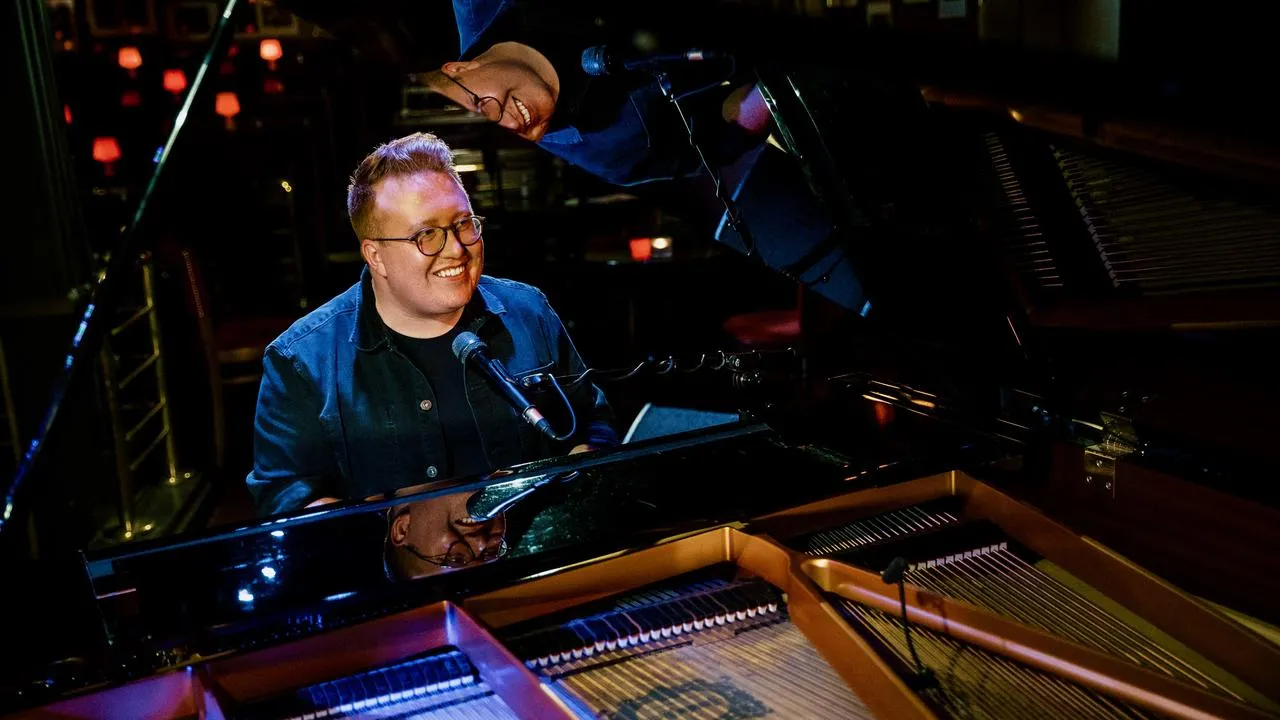
About the instructor
Den Titel des UK Piano Man haben lange Elton John, Jools Holland und Jamie Cullum getragen. In den vergangenen fünf Jahrzehnten kam ihm sonst niemand auch nur ansatzweise nahe – bis jetzt! Frisch von seiner ausverkauften Tour "Let The Good Times Roll" hat Tom Seals – "möglicherweise schlicht die Zukunft von Jazz und Blues" – die Welt in den Fingerspitzen. Sein virtuoses Solospiel, seine hervorragenden Improvisationsfähigkeiten und seine unverwechselbare Stimme haben führende Branchengrößen dazu bewogen, ihn als besten Boogie-Woogie- und Blues-Pianisten und -Sänger Großbritanniens zu feiern. Noch Mitte zwanzig, hat Seals bereits ausverkaufte Shows rund um den Globus gespielt, darunter Londons legendäres Ronnie Scott's, ein umwerfender Auftritt im Birdland Jazz Club am Broadway in New York und Arbeiten an der Seite von Jools Holland. Bemerkenswerte Auftritte: 'Gregory Porter & Friends' beim Cheltenham Jazz Festival Jools Hollands 'Boogie Woogie & Blues Spectacular' Birdland Jazz Club, New York City British Summer Time - Hyde Park Ronnie Scott's Jazz Club Gisburne Park Pop-Up Montreux Jazz Festival Cropredy Festival The Steinway Two Pianos Festival Glastonbury Newark Showground "Drive-In" Blenheim Palace In seinem Kurs lüftet Tom die Geheimnisse hinter seinem Spiel – er zeigt dir, wie du Standards am Klavier zum Swingen bringst, authentische Boogie-Woogie- und Blueslinien aufbaust und die Freiheit zum Improvisieren findest –, damit du selbst zum ultimativen Piano Man wirst. Die vollständige Biografie von Tom findest du unter www.tomseals.co.uk. read more