



The 5.55 (Lektion)
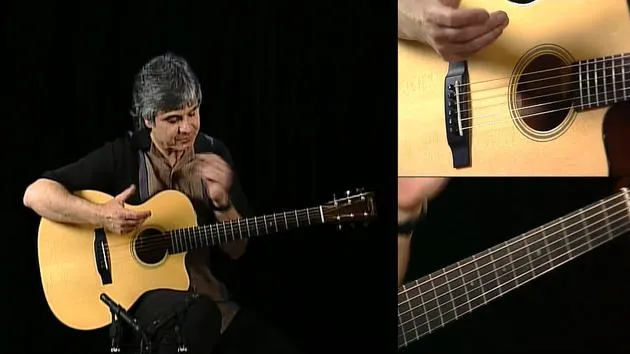
In dieser Lektion bringt dir Laurence Juber bei, sein Stück "The 555" auf der Akustikgitarre zu spielen.
Das steckt im Kurs
12 Lektionen (1h 22m) · 1 gratis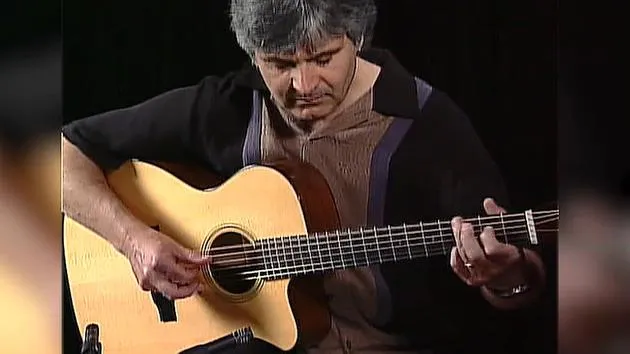
01. Cobalt Blue (Performance)
3:20
02. Cobalt Blue (Lektion)
Gratis-Lektion10:18
03. The White Pass Trail (Interpretation)
4:58
04. The White Pass Trail (Lektion)
10:17
05. Breaking Point (Performance)
3:28
06. Breaking Point (Lektion)
8:35
07. Buffalo Nickel (Interpretation)
3:41
08. Buffalo Nickel (Lektion)
10:29
09. Catch (Vortrag)
3:31
10. Catch (Lektion)
10:38
11. The 555 (Performance)
2:49
12. The 5.55 (Lektion)
Du bist hier10:44
Transkript der Lektion
Music Lesson: The 555 in E Minor
So, working on the 555, we're in standard tuning and it's in the key of E minor.
Introduction to Chords
We're starting off with:
- E minor chord
- Alternating with C7 chord
- Then moving to a cowboy B7 shape
There's a little bit of a lick in between. I do this two different ways:
- Coming off the C7 chord
- Repeating in the second verse
Right Hand Technique
You might just want to look at the right hand here:
- I'm just rolling through the chord like that: B7.
Now, walking up to a G chord (although actually, there's no B in there), transitioning to a:
- G5 to D
- A minor
- E minor
Complex Chords
It gets a little interesting here:
- I've got an A minor A7 chord, but I'm also throwing in the D melody note.
Melody Structure
The melody goes:
- C, D, E, and then moving to a B minor 7 (although that really is actually A; it's more like a G over B).
Next, we have:
- C# minor 7 flat 5.
Voicing Technique
The cool thing about that chord is that you can actually voice it with just one fretted note:
- C# here
- G (the flat 5)
- B (the minor 7)
- E (the minor 3rd)
Because those strings are open, my melody goes: G, F#, E. Everything keeps ringing.
Cascading Patterns
These cascading patterns aren't exclusive to DADGAD tuning at all. You can do this kind of thing in standard tuning as well.
For example:
- There's a little cascade there (kind of a faux cascade) trying to make it smooth.
- Coming down on that B note and then sliding backwards to G major.
Chord Progressions
Then moving on to:
- C major 7.
It's kind of tricky because there's no third in that chord until I articulate it as a melody note.
- B7#9 to flat 9 to B natural.
So there's my melody:
- Now transitioning to E minor to A7.
Melody Integration
In contrast to the section where I'm playing basic cowboy shapes, I incorporate melody notes into a more complex texture:
- Walking up from A minor to D and then to B7 (just a B over D#).
Advanced Chords
Now to a G chord without mentioning any copyright control tunes, but the ones that move around in tenths:
- E flat 9 to D9 to G.
There's also an F#.
Alternative Voicings
Here, C# minor 7 flat 5 can be a straightforward one-note chord. But if I raise the melody notes an octave, I get this voicing:
- F# minor 7 flat 5 to B.
I'm playing around with G major and E minor harmonically.
Returning to E Minor
You might think I'm going to E minor from the B chord, but I actually go to G and then a different voicing of C# minor 7 flat 5, which contains:
- C#
- G
- E
- G on top.
Licks and Solos
I have this little lick that goes in there and then back to the head.
The second turn ends with a little extension. It's actually a C7 chord, voiced a bit differently:
- Normally you'd play it like this.
- Here I'm using a couple of open strings and then a B7 throwing in an open E melody note and transitioning to B flat 7.
Bass Lick and Improvisation
After that:
- Moving down to AB7, then back up again to B and then a bass lick.
Now, I've got an improvised solo where I'm kind of playing off this bass line and some licks in E and E minor.
Favorite Licks
That's one of my favorite swing licks in E minor because it's a cascade:
- E, F#, G, B, D#, E.
So everything kind of rings, alternating between an E minor chord and a C7 chord.
Solo Section
The solo section might go something like this:
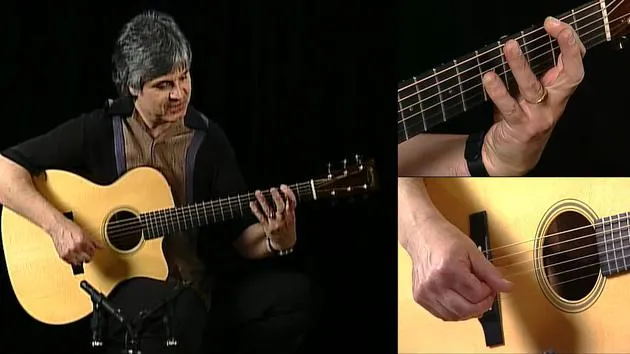
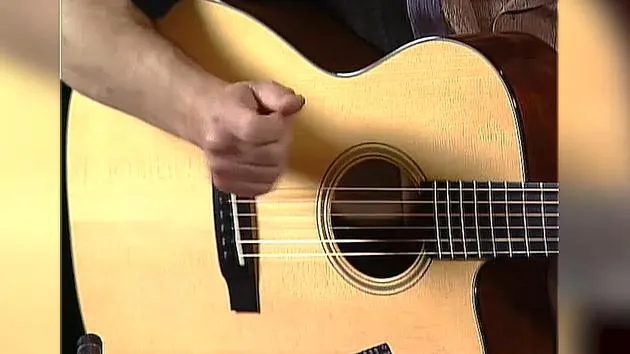
- Notice I'm muting using the palm of my hand to mute with the right hand to give that kind of upright bass feel.
It's a bit challenging to mute and keep the melody going simultaneously, but once I get the melody worked in, I kind of come off of that.
Returning to the B Section
Now I'm going to go back to the B section with the simple cowboy chords and the cascades, then back to the top.
After playing the verse through a couple of times, it will return to this pattern:
- Using the pickless pick technique with a little strum here.
Final Chord Progression
It's a little tricky here:
- A7, but with a little F# note thrown in, creating another cascade.
- Then transitioning to a jazzy seventh chord progression up to the top.
Finally, I'll play that last lick for you:
- Also a cascade, ending with a harmonic and a little virtual whammy bar.
So, there's the 555!
12 Lektionen
1 Std. 22 Min. strukturierte Videolektionen
Erweiterte Videofunktionen
Verlangsamen, Passagen loopen, mitlesen
Handy, Tablet & Desktop
Üben, wo du willst
100 % Zufriedenheitsgarantie
30 Tage Geld-zurück-Garantie
Lern deinen Guru kennen
Lern deinen Guru kennen
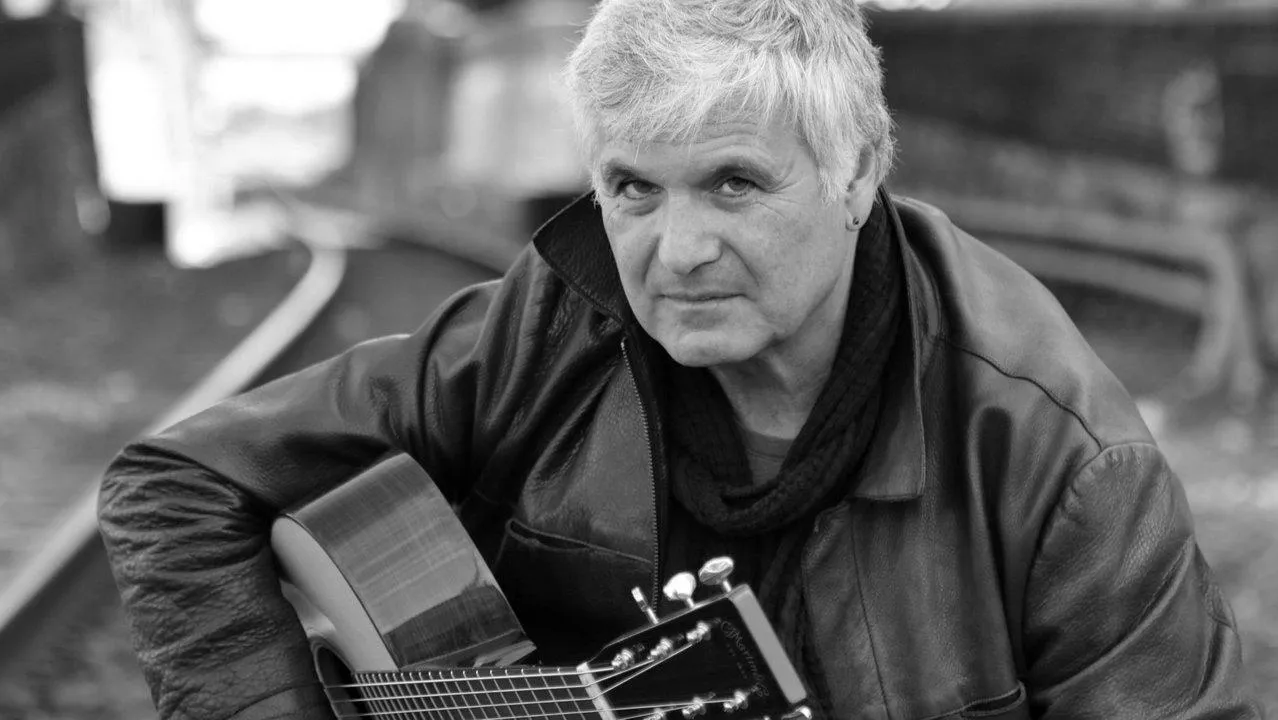
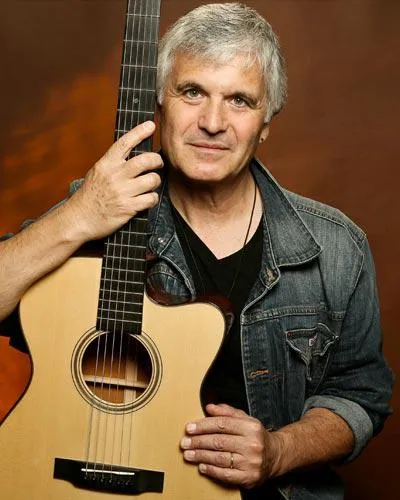
Laurence Juber wurde zunächst als Leadgitarrist in Paul McCartneys Band Wings bekannt. Seither hat er sich eine Karriere als Fingerstyle-Gitarrist, Komponist und Arrangeur aufgebaut und arbeitet vorwiegend in der DADGAD-Stimmung, die ihm den Beinamen 'the Duke of DADGAD' einbrachte.
Von den Lesern des Fingerstyle Guitar Magazine wurde er zum Gitarristen des Jahres gewählt und vom Magazin Acoustic Guitar zu den besten Gitarristen gezählt – dazu kommen eine lange Liste von Soloalben und Welttourneen.
In seinen Kursen vermittelt er seine Fingerstyle-Technik und die DADGAD-Stimmung, für die er bekannt ist, wie man Melodie, Harmonie und Bass für die Solo-Gitarre zusammenführt, und die Stücke – wie sein charakteristisches 'Wooden Horses' –, die all das vereinen.







