



Breaking Point (Lektion)
In dieser Lektion bringt dir Laurence Juber bei, sein Stück "Breaking Point" auf der Akustikgitarre zu spielen.
Das steckt im Kurs
12 Lektionen (1h 22m) · 1 gratis
01. Cobalt Blue (Performance)
3:20
02. Cobalt Blue (Lektion)
Gratis-Lektion10:18
03. The White Pass Trail (Interpretation)
4:58
04. The White Pass Trail (Lektion)
10:17
05. Breaking Point (Performance)
3:28
06. Breaking Point (Lektion)
Du bist hier8:35
07. Buffalo Nickel (Interpretation)
3:41
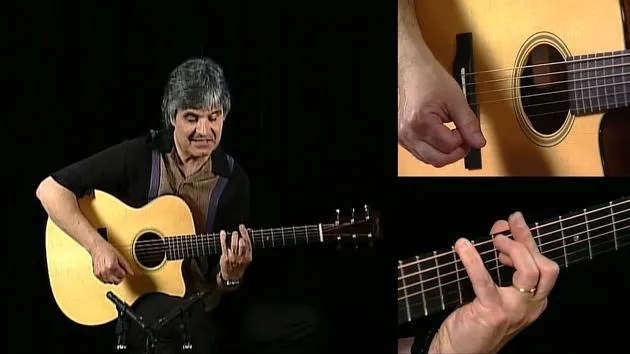
08. Buffalo Nickel (Lektion)
10:29
09. Catch (Vortrag)
3:31
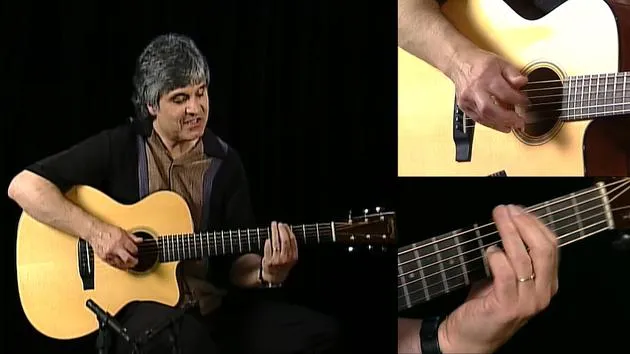
10. Catch (Lektion)
10:38
11. The 555 (Performance)
2:49
12. The 5.55 (Lektion)
10:44
Transkript der Lektion
Breaking Point Music Lesson
Alright then, so this is Breaking Point. As we speak, this composition is about a week old, so we can learn it together.
Introduction
I'm starting off with a repeated A where I'm alternating between the open A string and the bottom string with a little slur into it. That's where the groove comes from.
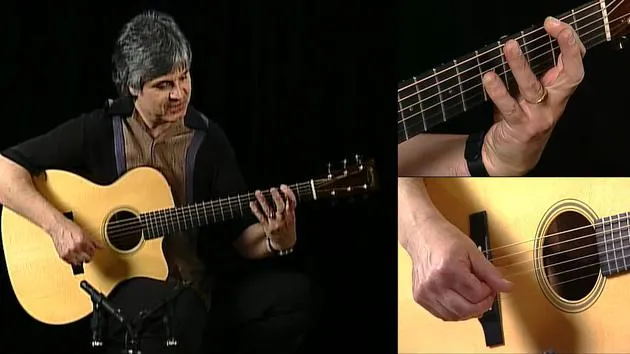
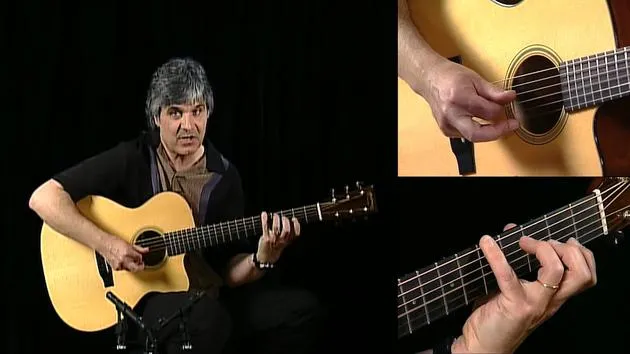
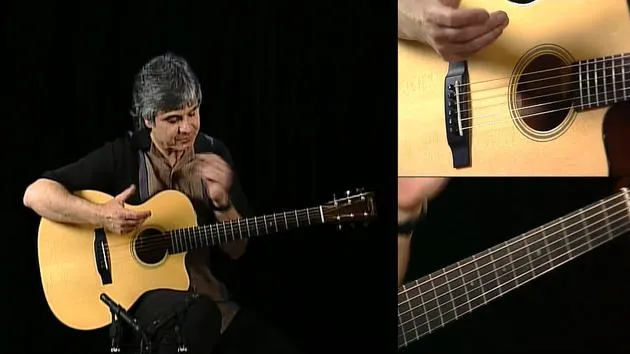
Now, I changed the fingering slightly here when I add the melody. What you might want to do is take advantage of the multiple camera angles to zero in on what the left hand and the right hand are doing. The tricky thing with this piece is to bring out the melody against this bass line.
Opening Section
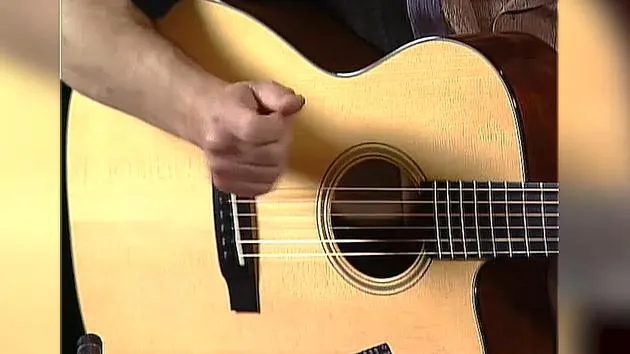
I'll play that opening section again, and I've got a little staccato thing there. You'll notice that I'm doing some rest strokes with my right hand so that the melody has the strength to sing over this bass line.
Moving to the Second Section
Moving into the second section, it then goes:
- Now I'm in DADGAD,
- I'm in A minor.
The four chord, which is where it's moving to, is a D chord (D major). I'm hitting the melody note. I'll do that one more time.
Now, I'm moving to an F major 7 chord. I've got an F, a G, an A, and an E. So it's actually an F major 9. Pretty simple fingering in DADGAD for what is actually a fairly advanced chord spelling. Then, kind of an E minor 7 sus to a D minor 7.
You'll notice the bass line's moving down, and I'm keeping a rhythm going with the thumb. I've run out of bass notes, so I'm jumping up to a higher C:
- I've got a G, an A, and a D on top here.
- Moving again down to a B: I've got a B, a G, an A, and an E here.
- Moving to an A bass note to a G to an F.
- Now, a full bar esus chord with a lick.
So, I'll play that a little faster for that whole section. You see you've got the melody moving but with the bass line constantly stepping down.
Chorus Section
Now moving into the chorus section, starting off with a bend. That's a little tricky that one.
Keeping the bass line moving while playing the melody on top, you really have to think kind of vertically, especially getting that hammer on and then repeating the first phrase with a little variation.
Here, this is basically your G chord in DADGAD. What I'm doing is a little turn, it's a little tricky. You've really got to master your hammers and pulls. Just take a look at the left hand by itself for this one.
Then, back to the opening riff, this pulsing A, and the melody comes back in over there. That whole sequence repeats with the opening, and then going back into the chorus.
B Section - The Bridge
Then the B section, well, actually, no, we call it the bridge, leads into:
Let me come out of the... There's a lick.
What's happening here? This is another one of those kind of hammer and pull licks. Again, it's that D minor 7. This is where it gets tricky. I need my thumb because I'm playing here and I'm really sliding up on that string.
I better play that slowly because it foxes me sometimes, too. So, holding, as much as possible, I try and let the notes ring. This is really kind of a G shape here.
Then I'm back to the D chord (D major chord). You'll notice what happens: I put a little vibrato when I do that and then we're back to this walking down bass line, into the chorus.
That'll repeat, and the second time it comes into a little coda.
Coda
Here, I'm jumping up into an octave pattern and I end up with a thumb slap at the 14th fret to bring out the harmonic of the A chord that I'm holding down here.
You kind of miss out on the top string, so you don't get a D on top because you want it to sound resolved.
So, that's Breaking Point!
12 Lektionen
1 Std. 22 Min. strukturierte Videolektionen
Erweiterte Videofunktionen
Verlangsamen, Passagen loopen, mitlesen
Handy, Tablet & Desktop
Üben, wo du willst
100 % Zufriedenheitsgarantie
30 Tage Geld-zurück-Garantie
Lern deinen Guru kennen
Lern deinen Guru kennen
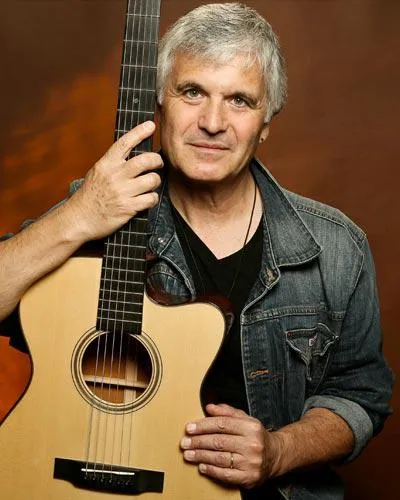
Laurence Juber wurde zunächst als Leadgitarrist in Paul McCartneys Band Wings bekannt. Seither hat er sich eine Karriere als Fingerstyle-Gitarrist, Komponist und Arrangeur aufgebaut und arbeitet vorwiegend in der DADGAD-Stimmung, die ihm den Beinamen 'the Duke of DADGAD' einbrachte.
Von den Lesern des Fingerstyle Guitar Magazine wurde er zum Gitarristen des Jahres gewählt und vom Magazin Acoustic Guitar zu den besten Gitarristen gezählt – dazu kommen eine lange Liste von Soloalben und Welttourneen.
In seinen Kursen vermittelt er seine Fingerstyle-Technik und die DADGAD-Stimmung, für die er bekannt ist, wie man Melodie, Harmonie und Bass für die Solo-Gitarre zusammenführt, und die Stücke – wie sein charakteristisches 'Wooden Horses' –, die all das vereinen.







